America -- The Land of the Great Divide
Thoughts on the Market
November 11, 2025
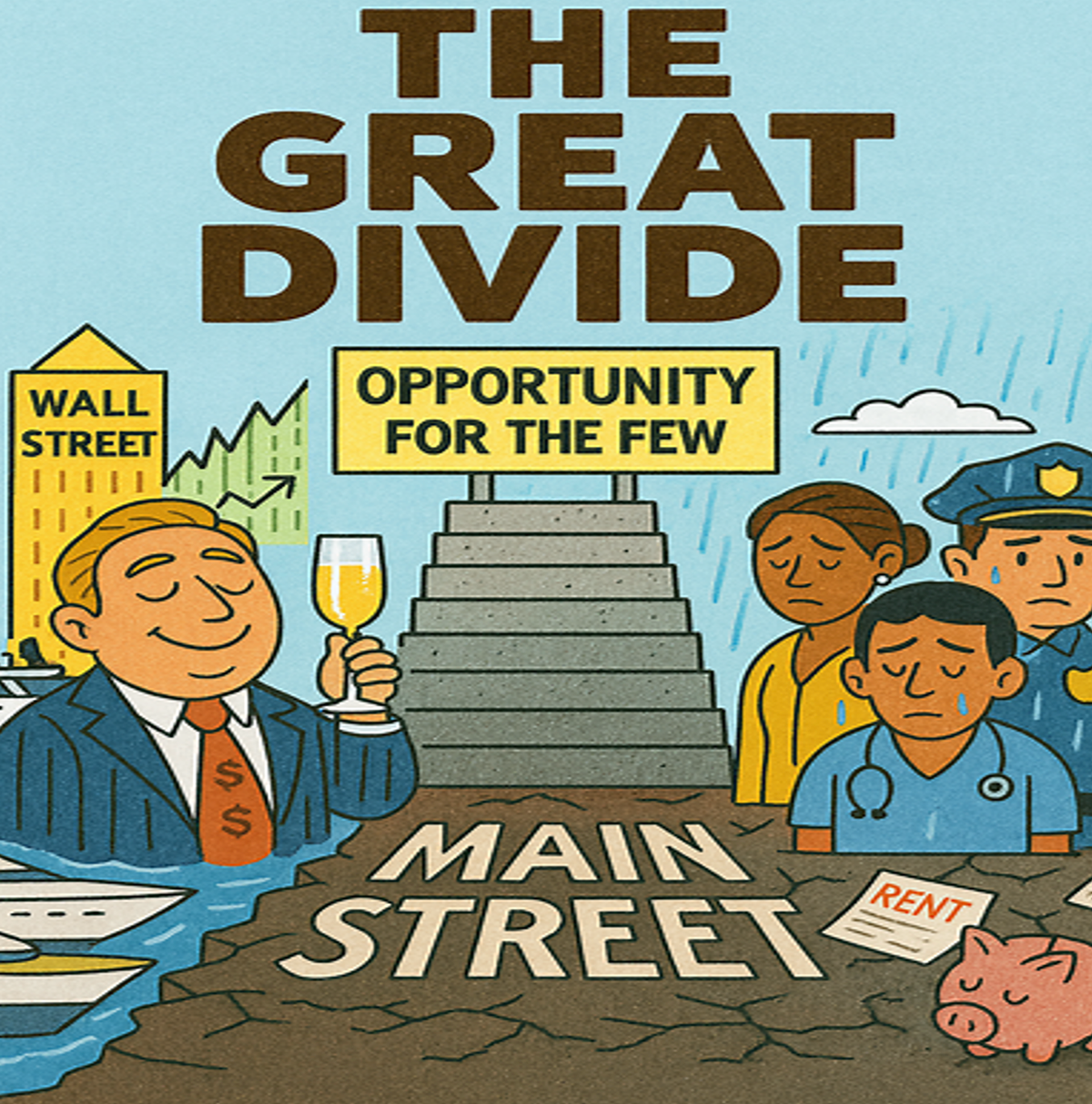
This week I want to address what I see as a terrifying trend in the United States, one that could one day rip this great country apart. I am labeling this trend “The Great Divide.” Over the past forty years the U.S. economy has increasingly split into a two-tiered system: one tier for the wealthy, and another for everyone else. This divide is now so stark that economists describe ours as a “K-shaped economy,” where the rich continue to rise while, in an almost mirror image, the rest fall behind.
The term “K-shaped economy” generally refers to how different groups have fared since the 2008 financial crisis – and especially after the COVID-19 pandemic – but this trend has roots that run much deeper than just the past seventeen years. Although it certainly has accelerated during this period, upper-income Americans have seen strong income growth, booming stock portfolios, and rising home values for many decades. Meanwhile, low- and middle-income Americans – people like teachers, tradespeople, law enforcement, skilled medical technicians, hospitality workers – have faced stagnant wages, rising debt, and progressively unaffordable housing and healthcare. The typical American family now has two wage earners but is still struggling financially.
Wealth Concentration at the Top
- As of 2025, the top 10% of earners own nearly two-thirds of all U.S. wealth, while the bottom 50% hold just 2.5%.
- Since 1989, the top 1% gained 987 times more wealth per household than the bottom 20%.
- The top 0.1% alone gained an average of $39.5 million per household, while the bottom 20% gained less than $8,500 in the same period.