America's Fiscal Time Bomb: A Looming Crisis?
This coming crisis of confidence can still be avoided, but the current trajectory certainly guarantees a fiscal crisis in the relatively near future

In recent write-ups, I have discussed in broad terms some of the highly questionable policies of the Federal Reserve Board and the US Treasury, and how those policies impact us in very real and tangible ways. This week I will dig deeper into the likely ramifications of these policies if our government continues on the same path.
While I love to write about shorter-term trading ideas and strategies to capture profits from developing trends in the markets, it is important that we have a clear perspective on the underlying macroeconomic conditions as they ultimately drive the bigger trends. In future write-ups, I will focus more heavily on trading ideas.
For obvious, self-serving reasons, the political leaders of our country tout the so-called great economic performance of the United States. This is a well-worn practice followed by both of the major political parties in the US, so neither party wins any special awards for deceit and cynicism. Both parties have proved to be quite masterful in this regard.
The reality is that there is something very insidious going on behind the scenes in Washington, and it has been going on a long time. Consider the following basic statistics.
Since 2001, the Federal Reserve’s balance sheet has grown by 1039%. That’s right. It has increased roughly 10.4 times!! During this same period, the Federal deficit has grown by more than 580%. At the same time, the US GDP has grown by roughly 270%. Compared to the flagrant borrowing, spending, and monetization, our growth rate has actually been very disappointing. How would our economy look if the government hadn’t been on a wild borrowing and spending spree? The answer is clear – pretty lousy.
During this entire period, our political leaders and central bankers have been playing an astonishing game of financial kick-the-can down the road by trying to effectively forestall one financial downturn after another by implementing a series of extraordinary fiscal and monetary policies to cover up financial crises. They are very skillful at this game, and they have managed to kick major problems far enough down the road that things look almost alright.
Unfortunately, as we saw last week, it has really been mostly alright for an increasingly smaller percentage of the total population. In the meanwhile, the political and leaders simply leave a progressively bigger and bigger mess for the next group of leaders to try to manage. The basic fact, however, is that the explosion of our debt-to-GDP ratio from 33% to 122% places a massive burden on our children and grandchildren, and this financial burden is getting progressively worse and worse. All the while, our government’s fiscal and monetary policies give the illusion of our nation having a great economy. If the economy were so great, we would not currently have the least affordable housing conditions in our nation’s history. In fact, our growth has been even further distorted by the inflation that is baked into our growth numbers by the Fed’s monetary policies.
The US has been able to sustain this vast acceleration in Federal debt and corresponding enormous monetization of assets primarily because the US is the true global hegemon. The US has been able to handle the near quadrupling of debt and the simultaneous explosion in our central bank’s balance sheet primarily because the US dollar is the world’s true reserve currency. Most international commodity transactions are conducted in US dollars, and the dollar is used as the transactional currency in a shockingly large percentage of all global trade. This creates a constant demand for dollars and helps us shore up our banking system and fund our deficits.
The problem is that we are approaching a tipping point, a point beyond which investors will abruptly say, “No más! Enough! We are no longer willing to purchase your crappy bonds unless you pay us a huge premium in the form of much higher interest rates.” There is already a growing backlash from global investors about the lack of fiscal and monetary discipline in our country, but it hasn’t translated into a full-blown crisis yet. A widespread shift in sentiment, however, typically occurs “out of the blue” without warning. It would start to spread slowly at first, with some steady selling of our government bonds by investors, but suddenly it would turn into a cascade of selling. Yields would spike higher, and our paper would no longer be deemed the ultimate safe-haven investment.
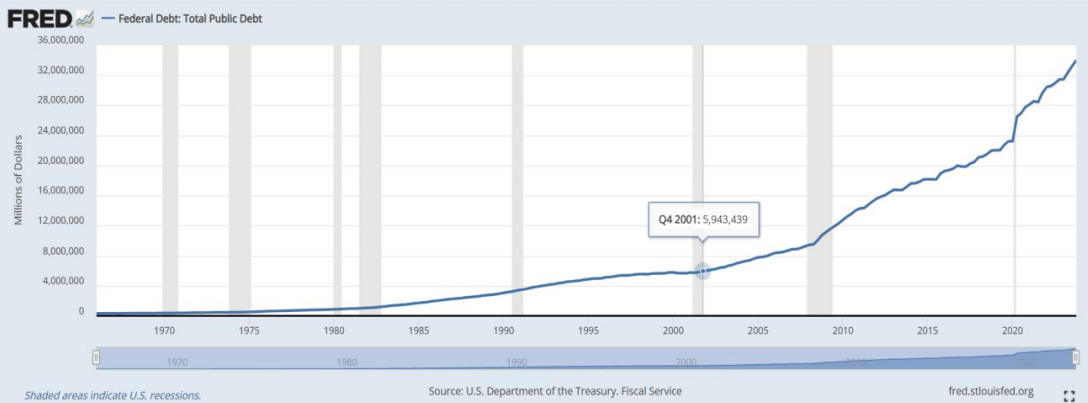
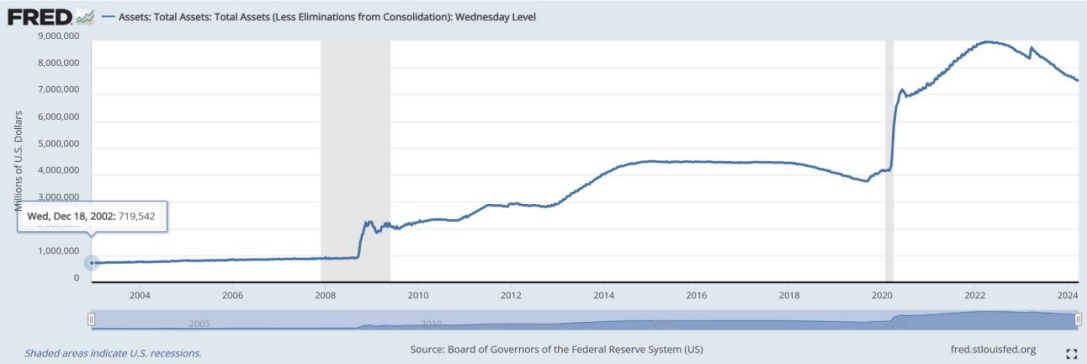
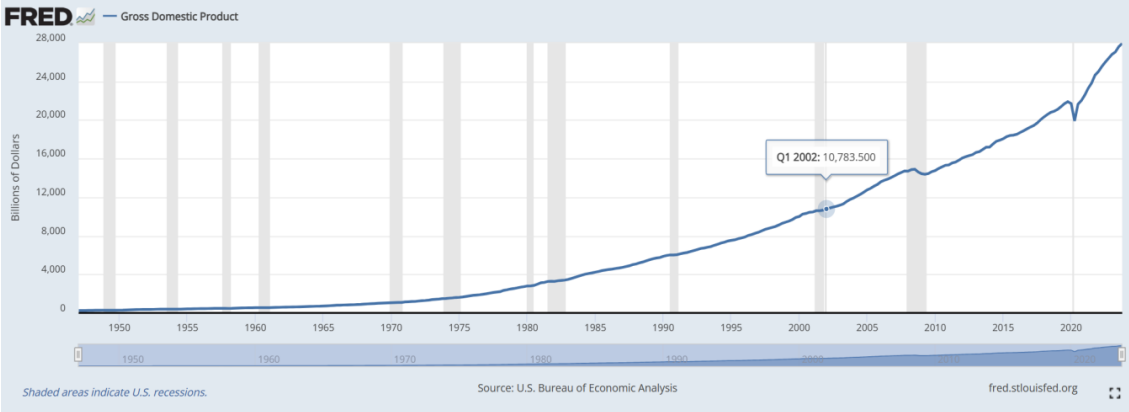
This coming crisis of confidence can still be avoided, but the current trajectory of our debt levels almost certainly guarantees a fiscal crisis in the relatively near future. The net effect will effectively be a general loss of confidence in both the government’s finances and the government officials managing them. The ramification will be frightening, and the projected path to this disaster is almost inevitable unless we have a notable change in the rate at which things are developing. The power of the United States is vast, but it is only a matter of time before legitimate alternatives to the US dollar emerge. BRICS is already trying to shift the balance by conducting major commodity transactions in other currencies, but the severe problems in China are delaying the real rise of BRICS as a bonafide alternative. In fact, China could well be on the way towards its own lost decade.
The ramifications of a widespread crisis of confidence in the US fiscal situation are far-reaching. They will affect every aspect of American life and have enormous ramifications for many markets. In a worst-case scenario, a dramatic crisis could lead to a military conflict.
So what am I foreseeing? If the US continues on its current path, then the end result will be panic in the markets, and likely social unrest with lots of domestic protests. The dollar will crash after initially spiking higher due to the sharply rising interest rates. Speculators will almost certainly fall for the head fake of the rising interest rates and buy dollars to earn the rising interest rate differentials. The reality of a fiscal crisis, however, will quickly sink in, and then the dollar will get crushed. Dollar yen, for example, would sink to new all-time lows, probably settling around 60 yen to the dollar. Massive government intervention along the way would cause periodic spikes and bounces, but the dollar selling pressure would be overwhelming. Bond prices would also get slammed. Interest rates would shoot higher as a true loss of confidence is very, very hard to repair. This would be perhaps the greatest trading market in history for skilled speculators who are savvy enough to load up on long option plays before the dollar and the bonds crash.
Would the US default on its debt? Unlikely. The US can just keep issuing more and more junky currency, so a default is not something I would anticipate. Still, it would be a hypervolatile and unsettling environment. Gold would surge. Active trading in Bitcoin would likely be banned as tens of millions of Americans would try to move their money out of dollars. Inflation overall will surge, and the dollar’s purchasing power will weaken sharply. In this environment, investors would be best served by accumulating real assets. Agricultural lands, forest lands, precious gems, and other real assets will outperform nearly all financial assets due to the dollar’s diminished purchasing power.
Federal spending programs would be sharply curtailed, but this will only occur only under maximum levels of duress by investors. No government wants to be the one that cuts back on social programs as it is an extremely unpopular policy move. Still, it would eventually have to take place. The only question is which unlucky party will be in power when the ugly scenario turns into a full-blown crisis that can no longer be kicked down the road. Eventually, the deficit spending will need to be brought under control, but that will only happen as the result of a painful economic disaster. If sensible fiscal discipline were to be implemented sooner, then the fiscal time bomb could be avoided altogether.
Over the weekend, I decided to explore the history of social security since that is yet another time bomb waiting to explode. According to the Social Security Administration’s 2023 Trustee Report, the “Old-Age and Survivors Insurance Trust Fund (OASI – my lord, what a name!!), which pays out Social Security benefits, is projected to be able to pay 100% of benefits until 2033. After that, it will only be able to pay 77% of its required benefits. This doesn’t take into account the further loss of buying power due to inflation, so the impact on retirees could be crushing.
According to the Pew Research Center, a highly reputable entity, we have a nation in which forty percent of American households admit to owning at least one gun, while thirty three percent of all adults admit to owning a gun. I say “admit” because I suspect the numbers are actually much higher. This is a potentially explosive situation, and I have no doubt that the authorities have considered the ramifications of possible civil unrest from widespread reductions in social services. I am not sure if I am more horrified or amused by the idea of fifty million old people, armed to the teeth, heading down to their local government offices and threatening retribution for cutting off their social programs.
Approximately fifty million Americans receive social security checks, and that number is growing each year. The extended life expectancy of US citizens is creating a demographic time bomb for our government. The history of retirement plans and social security is fascinating, and it is worth examining so as to better understand the extent of government cynicism.
According to the Social Security Administration archives, the modern version of the idea was launched in Germany in 1881 by Chancellor Otto von Bismarck. Germany became the first nation in the world to adopt an old-age social insurance program in 1889. The idea was first put forward, at Bismarck's behest, in 1881, by Germany's Emperor, William the First, in a ground-breaking letter to the German Parliament. William wrote: ‘‘. . .those who are disabled from work by age and invalidity have a well-grounded claim to care from the state.’’

Bismarck was motivated to introduce social insurance in Germany both in order to promote the well-being of workers in order to keep the German economy operating at maximum efficiency, and to stave-off calls for more radical socialist alternatives. It was more the latter than the former, as very few benefits ever got paid to German citizens during his lifetime. Despite his impeccable right-wing credentials, Bismarck would be called a socialist for introducing these programs, as would President Roosevelt 70 years later. In his own speech to the Reichstag during the 1881 debates, Bismarck would reply, “Call it socialism or whatever you like. It is the same to me.’’
What I find most amusing about this retirement plan is that the life expectancy in Germany in 1885 was less than forty years!! Clearly this plan did not help the well-being of many German retirees at the time.
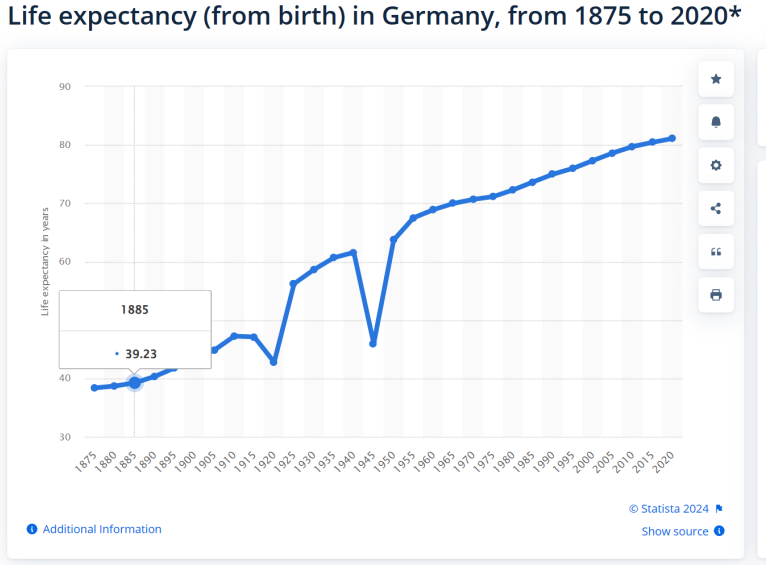
In a highly cynical gesture of caring by the German government, the retirement age was lowered to 65 in 1916, during World War I, although the life expectancy of German people at the time was 47 years. Put simplistically, almost all the citizens would be long dead before the retirement age was reached, so the government would never have to bother paying any retirement funds to its citizens.
During the Depression, in 1935, the United States implemented Social Security retirement benefits for its citizens, adopting the same age of 65 years as the minimum age for government benefits to kick in. That sounded very magnanimous except that the life expectancy of Americans was about 60 years at the time. I just love the true caring and compassion that our government showered on its hard-working citizens. They happily promised to pay people for their many years of service and tax contributions – knowing full well that most people would probably never live to collect any of the benefits. Now that people are living longer, the US government has shifted the goal posts by simply destroying the retirement plans of Americans through their inflationary and spendthrift policies. More and more people will receive money worth less and less.
Is the fiscal time bomb going off a certainty? Absolutely not. If the US were to embrace a semblance of fiscal responsibility and reduce the relative deficit expansion by roughly 1 1/2% of GDP a year, then the overall deficit could remain manageable. We don’t need to reduce the absolute value of the deficit per se, but rather we need to cap the debt-to-GDP ratio and then slowly reduce it back to a maximum of 100%. Continued economic growth would enable this to happen. This can easily be accomplished with a disciplined government that doesn’t commit to a further fiscal expansion based on unrealistically optimistic growth forecasts.
Unfortunately, most administrations seem more committed to being popular and satisfying the special interests of their constituents, rather than taking the prudent steps required to maintain a healthy, manageable fiscal future. The bomb is ticking, and it will absolutely go off unless steps are taken soon. Depending on the entity which is doing the economic modeling, the range of US public debt forecasts for 2050 ranges from 150% of GDP (CBO) to 200% of GDP (GAO). Neither of those levels is sustainable.
Is it possible that the US experiences a massive surge in productivity which allows it to grow its way out of the problem? Yes, it is possible, but highly unlikely. The demographics in the US are not supportive of that scenario.
Going forward, I will focus on some shorter-term trading opportunities, There are many interesting trades that are setting up in stocks, commodities, fixed income, and currencies. Some of these trades are shorter-term, while some are quite structural and longer term. Nearly all of them involve the usage of options.
In the meanwhile, wishing you the very best of luck.
Andy Krieger