Bludgeoning Our Allies to Get What We Want
January 19, 2026
Thoughts on the Market
Five days ago I sent out a brief market update discussing my immediate bearish view on the S&P500. I noted that I had put on a short-dated put spread to play for what I was expecting to be an initial drop of about 3%. Although I didn’t have any advance notice about Trump’s shocking threat to impose new tariffs on Europe in order to bulldoze our NATO allies into selling Greenland to the U.S., the technical position in the market was sufficiently vulnerable to convince me to place the bet. In case you liked my idea and put on a similar strategy, you might want to lock in a profit by selling a portion of your position now that the market has tumbled 1 1/2% in overnight trading.
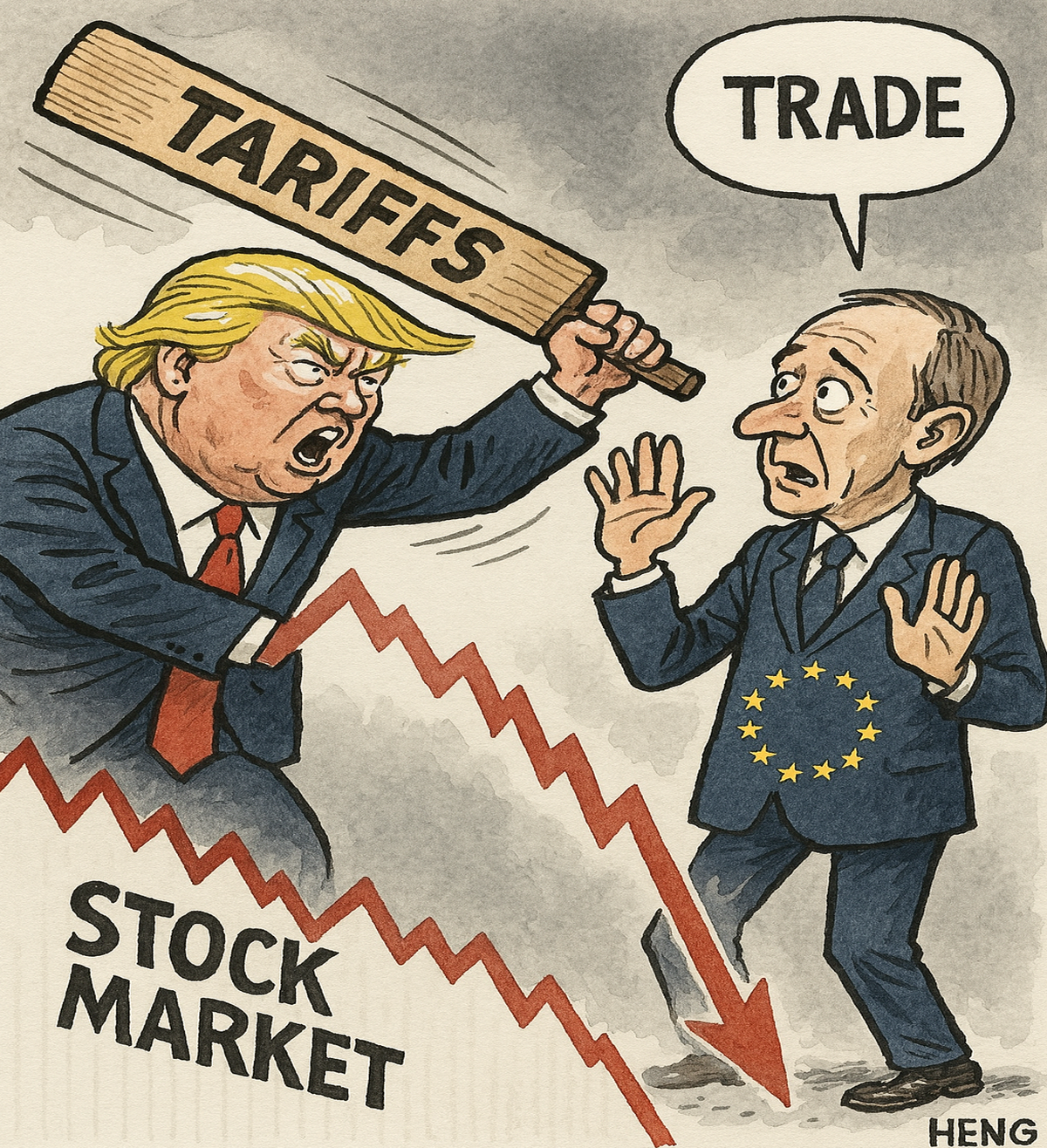
As I look at the market today, it is still too early to determine whether this is the start of the much larger stock market reversal that I have been anticipating. What is clear, however, is that if we don’t get a significant de-escalation in the heightened tension between the U.S. and Europe, then we need to brace ourselves for what will potentially be an absolutely devastating bear market – but the bear market won’t only be in stocks. The repercussions will reverberate through currencies, bonds, and even real estate markets. Europe is not going to just roll over and accept the latest ultimatums of President Trump. It is normal for negotiations to involve the usage of carrots and sticks, but Trump’s Greenland strategy is simply bludgeoning Europe with a giant stick. The leaders of Europe view this move as commercial blackmail, and they know that they have to respond with a serious and forceful answer. How this plays out is not yet apparent, but it is absolutely clear that the world order of the past 80 years has changed. I wrote about this at length last week, and this latest policy move simply reconfirms what I said.
It would be shockingly naïve to think the U.S. is not seriously exposed in case Europe decides to respond with very aggressive retaliatory measures. The usage of threatened tariffs to force the transfer of ownership and control of sovereign assets undermines transatlantic relations and is clearly incompatible with the EU-US trade agreement. In fact, if this authoritarian strategy continues, then I would expect Europe to respond with moves that would seriously hurt the U.S. by focusing on capital markets rather than trade. Their retaliatory measures might involve such things as the repatriation of assets (remember, European investors have many trillions of dollars allocated to U.S. stocks, bonds, real estate, and private equity), restricting access to European capital markets, and/or imposing trade restrictions involving services (one of the areas where the U.S. runs a surplus).
U.S. Treasury Secretary Bessent’s comments over the weekend that Europe must turn over Greenland to the U.S. because Europe is weak were shockingly arrogant, and they have not been well received. In fact, Bessent tried to defend the usage of the threat of tariffs to force the sale of Greenland by noting that Europe’s weakness necessitates U.S. control of Greenland to ensure global stability and security. Huh? Has anyone pointed out to Bessent that forcing Greenland to transfer their territory to the U.S. is not just a violation of several long-standing treaties and agreements, but it is in fact a very efficient way to upend decades of (relative) global stability and security?
White House Aide Stephen Miller, the primary architect of many of Trump’s most draconian policy shifts, was even more aggressive … and more blatantly authoritarian. Miller argued that Greenland should "obviously" become part of the United States because Denmark is a “tiny country” with a “tiny economy and a tiny military” that is incapable of defending or developing the territory. Miller claimed Denmark has failed to protect Greenland, calling the current arrangement an "unfair deal" to American taxpayers. He suggested no one would stop the U.S. from taking control. When it was pointed out that Denmark is a member of NATO, Miller dismissively suggested that international sovereignty is a “silly idea” that “hasn’t really been operative at any point in time.” He also believes that the U.S. would not be opposed militarily if it staked a claim, asserting, "Nobody's going to fight the US over the future of Greenland."
Wow! This is nothing short of a broad-based frontal attack on what has been for nearly a century a long-standing, rock solid ally. Trump’s stated view that his “power is only limited by his own morality” is clearly driving this sort of dystopian “diplomacy,” but perhaps the people in Washington have forgotten that the total economy of the European Union, combined with the United Kingdom, is nearly $24 trillion! This is much larger than the GDP of China, making the EU/UK the second largest economy in the world. Moreover, the EU/UK are the largest trading partners for the U.S., with close to $2 trillion in annual trade flows. Putting aside the longstanding treaties and mutual cooperation agreements, is this really the trading bloc that the U.S. wants to antagonize?
From an economic point-of-view, the EU/UK is not weak. To the contrary, the EU by itself is the largest trading counterparty for 66 nations. Frankly, if things were to ever get truly ugly, does the US really want to find out how fast Europe could militarize on a massive scale? A critical factor to bear in mind is that the average EU debt-to-GDP level is only in the low-to-mid 80% range, while the U.S. debt-to-GDP level is now 125% and climbing rapidly. It is clear that Europe is in a much stronger economic position in terms of economic flexibility if a sudden expansion were required for any reason — including a military build-up. Based on real numbers, the EU + UK economies don’t seem all that weak. Unequivocally, Europe is in a much safer economic position if a sudden military expansion were required. Washington really needs to have a serious re-think here.
Aside from the sharp sell-off in equities today, we are seeing broad-based weakness in U.S. bonds and the U.S. dollar. This is a rare reaction to a serious risk-off situation, when the U.S. dollar would typically strengthen due to capital flight. What should strike real terror in the hearts and minds of U.S. government leaders is an actual flight from the U.S. dollar. In fact, depending on how things play out, I may start to build a significant short position against the U.S. dollar. Right now my exposures are relatively small, although I have increased my short exposure in CAD/CHF. My exposure in USD/JPY is also very small right now, although I am thinking about increasing that play. Japan and the U.S. are discussing coordinated intervention, and the Bank of Japan and Ministry of Finance are both well aware that a much stronger Yen would help Japan out in a variety of ways. More significantly, if the world slides into a major risk-off environment, then the Yen would tend to appreciate in any event.
If I were going to sit down and write another book, I would likely open with a discussion about the regime‑shift narrative that I am witnessing and provide a forecast about future market action that happens to behave exactly the way the markets are behaving today. Investors are suddenly realizing that the old playbook may no longer apply. We need to open ourselves to the possibility that geopolitics are starting to infect the core assumptions that have underpinned U.S. asset valuations for many decades.
A few angles stand out.
1. The price action is confirming my broader concern
A 1.5% overnight drop in stocks isn’t dramatic on its own, but the character of the move matters. When equities, Treasuries, and the dollar all weaken simultaneously, the market is signaling:
- This is not a standard risk‑off episode
- The U.S. is part of the perceived risk, not the safe haven
That’s rare. Historically, even during severe geopolitical shocks, capital has flowed into the U.S. dollar and Treasury market. When that pattern breaks, it suggests investors are reassessing the structural reliability of the U.S. as the global anchor.
That’s the kind of shift that doesn’t resolve in a week. That shift would take months and years to play out.
2. Markets are beginning to price the possibility of a transatlantic fracture
Europe is unlikely to simply absorb aggressive U.S. demands. Without commenting on any political figure, it’s clear from public reporting that European leaders view the Greenland pressure campaign as coercive rather than transactional. That perception alone is enough to:
- Increase the probability of retaliatory measures
- Raise the geopolitical risk premium
- Undermine the assumption of U.S.–EU policy alignment
The U.S.–EU economic relationship is enormous. When tensions rise between two blocs that collectively represent a massive share of global GDP, markets have to reprice the entire forward distribution of outcomes.
This is why my point about capital‑market retaliation is so important. Trade tariffs are one thing; capital flight is another. I have written recently about the stratospheric levels of foreign capital parked in U.S. assets. Only a relatively modest percentage reallocation out of the U.S. assets could send stocks, the U.S. dollar, and U.S. bonds tumbling.
3. The dollar wobble is the most important signal
A broad-based decline in the dollar during a geopolitical shock is extremely unusual. It suggests:
- Foreign holders may be reassessing U.S. political risk
- The market is contemplating the possibility of non‑economic retaliation
- The “U.S. exceptionalism” premium is being questioned
If this dynamic persists, it could become self‑reinforcing. The dollar’s role as the world’s reserve currency is built on trust, predictability, and institutional stability. Anything that introduces doubt into those pillars forces global allocators to hedge exposures.
That’s how slow‑burn structural bear markets begin.
4. The U.S. bubble dynamic I described becomes more fragile under geopolitical stress
Since 2009, the U.S. market has been supported by:
- Ultra‑low rates
- Massive fiscal borrowing
- Global capital inflows
- A perception of U.S. geopolitical stability
If one of those pillars weakens -- especially the last one -- the valuation structure becomes vulnerable. The U.S. has benefited from being the “cleanest dirty shirt” for 16 years. If Europe, Asia, or emerging markets become relatively more attractive -- or if they simply become less unattractive -- capital can rotate out of the U.S. without needing a crisis.
My scenario of European repatriation is not far‑fetched. Even a modest shift in allocation preferences would have outsized effects given the concentration of global capital in U.S. assets.
5. The big question now is whether this becomes part of a massive sell-off in stocks and other markets, or simply a volatility spike
As I have noted, it is too early to declare the start of a major reversal. Markets often overshoot on geopolitical headlines and then mean‑revert once cooler heads prevail.
But the structure of this episode is different:
- It involves the world’s two largest economies
- It touches on sovereignty, coercion, and national pride
- It challenges long‑standing alliance assumptions
- It introduces the possibility of capital‑market retaliation
This is not a one‑day story.
Where this leaves my market view
The geopolitical shock simply accelerated the move. The next phase depends on whether:
- There is a credible de‑escalation
- Europe signals a willingness to negotiate
- The U.S. shifts tone
- Markets regain confidence in the stability of the transatlantic relationship
If none of those occur, the probability of a deeper, drawn out, more structural downturn increases.
My basic analytical process almost always involves some sort of path dependency. This is one of those moments where the path matters more than the destination. I am going to revisit this topic in my next write-up and address the following:
- A scenario analysis for the next 30–90 days
- Market implications for each asset class
- Key signals to watch for escalation vs. stabilization
- How capital‑market retaliation might unfold in practice
In the meanwhile, I want to wish you all the very best of luck with your trading. In case you have signed up for my webinar this Thursday, I look forward to seeing you.
Andy Krieger