Failed Negotiations In Islamabad Were Almost Inevitable
Thoughts on the Market
April 13, 2026
Overview & Current Positioning
Last week I wrote about the resilience of the U.S. stock market, and how I was taking advantage of the market's short-term recovery to begin rebuilding some of my limited-risk, bearish market exposure. My assessment was that the market was too sanguine about a broad array of serious risks, not merely the headline uncertainty stemming from the ongoing conflict with Iran. The working hypothesis remains unchanged:
at some point, the market will turn decisively lower — perhaps with a renewed vigor that will prove quite shocking — although I am not committing significant capital to that view until I see confirmed weakness.
In the meantime, watching the market's reaction to news headlines continues to be instructive. It is evident that speculators are extremely bullish. There is, in a certain sense, an internally coherent logic to that posture. We have a President who is hyper-focused on stock market performance, and a Federal Reserve and U.S. Treasury Department that have stepped in to support every significant market sell-off since the Great Financial Crisis of 2008. Given those underlying conditions, a degree of optimism is not entirely irrational.
The problem, as I have outlined in recent weeks, is that the deteriorating underlying economic fundamentals are becoming increasingly divorced from the stock market's outward performance. I am structuring my portfolio carefully: overall, I would be quite content if the market continues to grind higher. But spending a modest amount on downside exposure strikes me as prudent diversification — and one I believe will ultimately pay off.
The Iran War and the Strait of Hormuz
The so-called 'TACO' President seems increasingly uncomfortable with the trajectory of the Iran war, and his strategic intent remains opaque. He is now threatening to impose a complete naval blockade on the Strait of Hormuz — a move that would inflict severe pain on the global economy broadly, not on Iran alone. There is a quality of improvisation to this approach that, as strange as it may seem, is at least intellectually interesting from a trader's vantage point. Whether the administration genuinely expected Iran to capitulate quickly to U.S. demands is unclear, but what is clear is that Tehran has shown no appetite whatsoever for accommodation.
I seriously doubt that the Iranian leadership will yield quickly to the pressure that a full naval blockade might generate. A regime that has demonstrated willingness to slaughter tens of thousands of its own citizens for peacefully protesting will almost certainly demonstrate an equally iron willingness to allow ordinary Iranians to suffer prolonged hardship before conceding to outside demands. This is not a government that responds predictably to economic coercion.
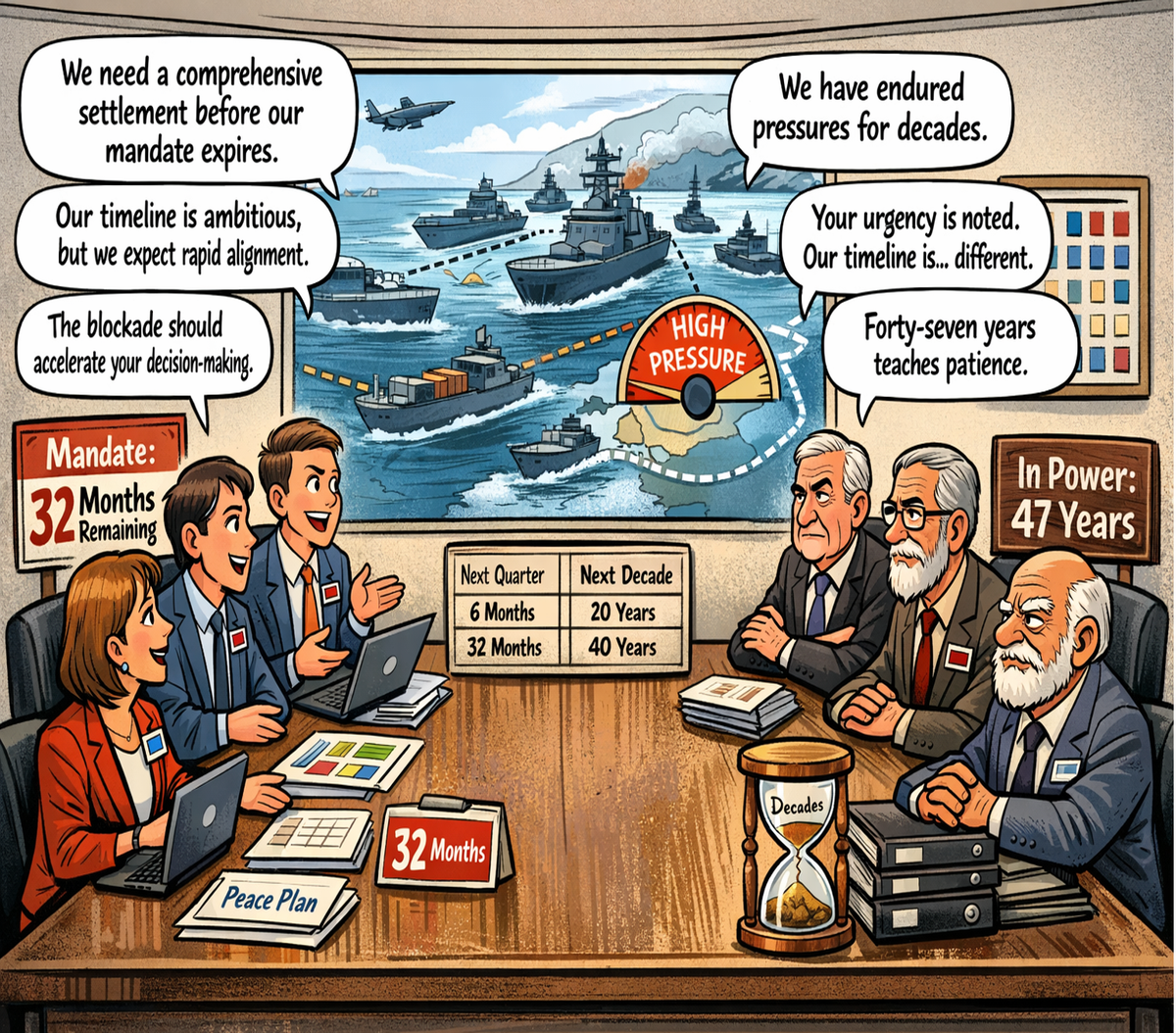
The ruling powers in Iran have had an iron-clad grip on their nation for forty-seven years. With that power and that institutional inertia, it is silly to expect rapid responses and rapid change. Their time horizon and their objectives are dramatically different from those of the current administration in Washington, so our leaders need to approach this conflict with a different perspective. They need to stop expecting Iranian leaders to think and behave like them. The wild card in this equation might be the reaction of China, the largest buyer of Iranian crude oil, to this development. However it plays out, no one can deny this is a risky move.

If the Hormuz blockade continues for much longer, the supply shock from the world losing more than 20% of its normal supply of crude and LNG will have catastrophic consequences for a wide swath of the global economy. The surge in energy prices will permeate virtually every aspect of daily life. This is, by any measure, the largest energy supply shock in history — and the U.S. threat to extend that blockade further is simply going to exacerbate an already dangerous situation.
One has to question the internal logic of trying to force Iran to reopen Hormuz by closing it more completely and cutting off their income stream. Blockades can be effective, but they usually only work after protracted periods of suffering. The U.S. seemed intent on a quick win of some sort when they attacked Iran, but this strategy seems logically inconsistent with administration goals. Unless the president ultimately chickens out, I can easily envision crude oil reaching $140 per barrel — or higher. That is not, by any stretch, a pathway to the lower cost of living that was the administration's central campaign promise. Nor do I see how this approach advances the other stated objective of forcing Iran to abandon its nuclear weapons ambitions. If anything, a strategy of this nature is more likely to harden Tehran's resolve and accelerate their weapons development timeline.
Consumer Confidence: Historic Collapse
The University of Michigan Consumer Sentiment Index collapsed to a preliminary reading of 47.6 in April 2026 — the lowest level in the survey's 74-year history, dating back to 1952. These numbers are outright alarming, particularly given that there is no clear end in sight to the hostilities that have generated the surge in gasoline prices now approaching $4.15 per gallon.
|
Indicator |
Reading /
Change |
|
Headline
Sentiment Index |
47.6 (↓ from 53.3 in March, –10.7% MoM) |
|
Current
Conditions |
↓ ~10% from
March; ↓ ~16% year-over-year |
|
Business
Expectations |
Worst level
since mid-2022; ↓ ~20% MoM |
|
Personal
Finance Expectations |
Off ~11% —
worst reading since 2009 |
|
Year-Ahead
Inflation Expectations |
4.8% (up from 3.8% — largest 1-month jump on
record) |
|
S&P 500
(since conflict began) |
↓ ~8% |
|
Gasoline
Prices |
↑ ~39%, to
approximately $4.15/gallon |
|
Respondents
citing global instability |
90% |
Several aspects of this data warrant emphasis. First, the 100-basis-point jump in one-month inflation expectations is unprecedented in the survey's history — and it is occurring at a moment when the underlying inflationary impulse is still accelerating, not decelerating. Second, the collapse in personal financial expectations to the worst reading since 2009 suggests that this is not a narrow confidence problem; it is becoming a broad household balance sheet concern.
It is only a matter of time before the energy price shock filters into food prices. When that happens, the howl of angry consumers will become difficult to ignore politically. The cumulative inflation since COVID was the single most powerful force that drove American voters to elect Donald Trump. Their paramount priority was an increasingly unaffordable cost of living, and Trump promised to fix it. With inflation surging and consumer confidence at a generational nadir, it is apparent that tens of millions of Americans are deeply, and justifiably, unhappy.
Macro Backdrop & Federal Reserve Constraints
The worsening consumer sentiment data is symptomatic of a broader deterioration in underlying economic fundamentals that I have been tracking for some time: a stagflationary dynamic that is structurally inconsistent with the current level of equity valuations. The intersection of the Iran war shock, pre-existing tariff pressures, and a Fed that entered this crisis with limited policy flexibility creates a particularly hostile macro environment for risk assets.
At the same time, if the economy starts to genuinely crater, it is very difficult to envision the Federal Reserve cutting interest rates when inflation is running well above their 2% target — and accelerating. In a stagflationary environment, the Fed's ability to serve as the market's backstop, which has been so reliable over the past fifteen-plus years, is severely constrained. Easing into a surging inflationary impulse risks an unanchoring of longer-term inflation expectations that could prove extremely difficult to reverse. The central bank is, in effect, boxed in.

Market Positioning & Strategy
Against this backdrop, my positioning philosophy remains one of disciplined asymmetry. The structural macro case for a significant market repricing is compelling. However, I am also cognizant of the powerful near-term forces arrayed on the other side: a president whose political fortunes are closely tied to equity performance; a Treasury and Fed institutional reflex toward market support; and a speculative community that has been well-rewarded for buying every dip over the past decade and a half.
The key strategic principles guiding my current posture are as follows:
• Maintain limited-risk bearish exposure that does not require immediate market deterioration to avoid significant loss. Capped-loss structures are essential given the overnight gap risk in this environment.
• Avoid over-committing to the downside before seeing confirmed technical deterioration. The market has shown a remarkable ability to shrug off bad news in the short term, and fighting that tape prematurely is expensive.
• Recognize that the current speculative consensus — heavily bullish, policy-backstop dependent — represents exactly the kind of crowded positioning that tends to produce violent reversals when sentiment finally turns.
• Monitor energy prices, food inflation data, and consumer credit stress as the most likely early-warning indicators that economic reality is beginning to overwhelm the bullish narrative.
Currencies: The Dollar’s Tipping Point
Since the outbreak of the Iran war, the U.S. dollar has performed its traditional role as the world’s preeminent safe-haven currency. Investors have rotated aggressively into dollar-denominated assets, and that demand has been powerfully reinforced by the sharp rise in U.S. Treasury yields. On the surface, the dollar’s strength looks entirely rational: higher yields, a flight-to-quality bid, and the implicit backing of the world’s largest military force all argue for dollar demand.
But I believe there is a tipping point approaching — a moment when investors begin to turn on the dollar and sell it aggressively. The conditions for such a reversal are not yet fully in place, and I am not predicting that it is imminent. What I am saying is that the setup for a major dollar reversal is becoming more compelling over time, and that when it comes, it is likely to be a violent and disorderly move. The crowdedness of the long-dollar trade, the fiscal trajectory of the United States, and the growing unease among foreign creditors about Washington’s reliability as a counterparty are all factors that could catalyze such a shift.

The structural argument for yen appreciation is reinforced by Japan’s current account dynamics, the Bank of Japan’s gradual but unmistakable pivot toward policy normalization, and the sheer scale of yen-funded carry positions that remain outstanding globally. A disorderly unwind of those positions would generate yen buying of extraordinary magnitude. I continue to watch for the catalyst that sets this in motion.
|
Indicator |
Reading /
Change |
|
USD: Current
Posture |
Safe-haven
bid intact; yield differential supportive |
|
USD: Key Risk |
Tipping point
— fiscal credibility, crowded positioning |
|
USD/JPY:
Directional Bias |
Lower over
medium term; target: low-140s |
|
Yen Carry
Trade |
Massive
outstanding positions; unwind risk is severe |
|
BOJ Policy |
Gradual
normalization; rate hike a potential catalyst |
|
Move Timing |
Not imminent
— but violent when it occurs |
Bitcoin: Further Downside Ahead
I have warned readers for many months about the downside risk embedded in Bitcoin. For an extended period, Bitcoin served as the quintessential leading risk-on indicator, a real-time barometer of speculative animal spirits. Its crash from approximately $126,000 has been dramatic, and yet — somewhat surprisingly — it has not precipitated the broader risk-off cascade that one might have expected from a collapse of that magnitude in such a widely-held speculative asset.
My reading of this divergence is not that Bitcoin has proven more resilient than feared. It is that the broader market has not yet fully absorbed the implications of what Bitcoin’s move is signaling. In my view, Bitcoin has significantly further to fall. A test of the $50,000 level seems probable, and I would not be surprised to see prices well below that threshold if risk appetite deteriorates more broadly. The speculative froth that drove Bitcoin to $126,000 was a function of the same excess liquidity and policy-backstop confidence that inflated virtually every other risk asset. That liquidity is being withdrawn, and the confidence is eroding.

Gold: A Long-Term Bull Taking a Measured Pause
My relationship with gold is a long one, and my long-term conviction in the metal remains intact. But I want to be candid with readers: my view has been shifting at the margin over recent months, and intellectual honesty demands that I say so explicitly.
I warned readers months ago that I was taking profits on my multi-year long position. The rationale was straightforward: the market had become dramatically overcrowded. The narrative had become self-reinforcing to a dangerous degree; every geopolitical headline, every Fed pivot speculation, every piece of dollar weakness became a reason to buy more gold. When a trade becomes that consensual and reflexively popular, it is time to exercise discipline, regardless of one’s long-term views.
The structural tailwinds for gold remain powerful. Central banks around the world have been shifting significant reserves out of U.S. Treasuries and into gold — a trend that represents a slow but meaningful de-dollarization of the global monetary system and provides durable underpinning to gold demand over the medium and long term. The broader geopolitical environment — with its energy shocks, fiscal excess, and eroding institutional confidence — is also fundamentally gold-constructive.
But long-term bullishness does not preclude near-term price risk. What happens to gold if we see a significant equity market drawdown? Historically, gold has sometimes sold off sharply in the early stages of a risk-off event as investors liquidate positions to meet margin calls and raise cash. I cannot rule out that dynamic here, particularly given the degree to which gold ownership has become crowded across the institutional investor community. I envision gold’s role as a safe-haven asset increasing over time, but that doesn’t mean its price cannot decline further from current levels. Long term, I remain a committed bull. Near term, I would not rush to buy.

|
Indicator |
Reading /
Change |
|
Gold:
Long-Term View |
Bullish —
structural tailwinds intact |
|
Gold:
Near-Term Posture |
Cautious —
overcrowded, profit-taking warranted |
|
Central Bank
Buying |
Ongoing shift
from UST to gold; supportive long-term |
|
Key Near-Term
Risk |
Equity
drawdown liquidation; crowded positioning |
|
Current
Stance |
Not adding —
waiting for a better entry point |
Conclusion
The global economy was measurably better off before this war than it is today. The Strait of Hormuz crisis, the tariff-driven inflationary overhang, a structurally constrained Federal Reserve, and a consumer base whose confidence has just recorded the worst reading in three-quarters of a century — these are not factors that support current equity valuations. They are factors that, taken together, argue for caution, for asymmetric positioning, and for patience.
Across asset classes, the picture is one of unusual complexity. The dollar looks strong but is approaching a potential inflection point that could prove violent when it arrives. The yen is coiled. Bitcoin is signaling continued risk-off pressure that the equity market has not yet fully priced. And gold — a long-term conviction — demands patience and discipline at current levels rather than urgency.
I remain watchful. The market may well continue grinding higher in the near term, buoyed by the same reflexive optimism that has served bulls well for over a decade. But the fundamental divergence between economic reality and asset prices is widening across virtually every market I follow — and in my experience, divergences of this magnitude do not resolve gently.
I wish you the best of luck in your trading,
Andy Krieger
DISCLAIMER
This report is published by Edenridge Trading LLC for informational purposes only and does not constitute investment advice, a solicitation, or an offer to buy or sell any security or financial instrument. The views expressed herein reflect the author's personal opinions as of the date of publication and are subject to change without notice. Past performance is not indicative of future results. Trading involves substantial risk of loss. Recipients should conduct their own due diligence and consult with appropriate professional advisors before making any investment decisions.
From Imre Gams:
My Framework
I treat markets as auctions, not prediction machines.
Most sessions on a day-to-day basis are balanced.
Edges form at the extremes of value.
I trade acceptance and rejection at those edges.
If value migrates, I align with it.
If it fails, I trade the rotation.
I am not in the business of forecasting.
I am in the business of validating participation.
_________________________________________________________
Buyers found their footing early in the week, holding the first defence zone at 6584 to 6600. Then came Tuesday's ceasefire announcement. What followed was a swift and decisive move higher — every remaining upside target fell in sequence. The 200-day moving average was reclaimed. The week closed at 6834.
Right on cue.
The onus now shifts to buyers. Hitting targets is one thing. Holding the ground you've taken is another.
The 6765 to 6780 zone is the first line of defence. Buyers need to keep the auction above it. A break back below the 200-day moving average would signal sellers reasserting control — and would put the recent recovery in serious doubt.
If buyers can maintain their footing, the upside targets for next week come in at 6902, then 6960, and finally 7013.50.
That last level matters. A reclaim of 7000 would represent a significant structural statement — the market recovering territory it hasn't held since the selling began in earnest.
For now, buyers have earned the right to press higher. The question is whether they have the conviction to follow through.
Gold is holding its ground.
The 4612 to 4661 zone has now been tested multiple times. Each time, buyers have defended it. That kind of repeated defence at the same level is not something to dismiss. It tells you where the market has decided to draw the line.
As long as buyers hold above 4661, they remain in control. The upside target hasn't changed — the major distribution zone spanning 5085 to 5207. That's where this breakdown originally began. Reclaiming it would be a significant statement.
A break below 4612 changes the picture. Sellers would then have 4411 in their sights as the next downside objective.
For now, the zone is holding. Until it doesn't, the bull case stays intact.
Last week the call was for consolidation and a rotation back toward the prior balance zone between $93 and $100. That's exactly what happened.
Right on cue.
No crystal ball. No guesswork. Just auction market mechanics doing what they do.
What comes next is where it gets interesting.
The market is currently sitting inside that balance zone. The next directional move will tell us a great deal about where crude wants to go from here.
If sellers can drive acceptance below $93, value migration lower becomes the likely path. The next significant destination is a major high volume zone spanning $71.44 to $77.55. That's a meaningful drop from current levels.
If buyers reassert themselves and push back toward previously rejected prices, the $110 to $114 zone comes back into play. Above there, $119.49 remains the extended upside target — the emotional spike high that started this whole move.
Two clean scenarios.