Finding Opportunity Amid the Chaos
Thoughts on the Market by Andy Krieger
November 18, 2026
There is a well-known line that system engineers use which has been thrown around quite a bit this past week: “Once is an accident; twice is a coincidence... Three times is enemy action.” Between Thursday, November 12 and Tuesday, November 17, there were seven major outages. Every company or agency that has explained its failure has given a different cause, and none has been confirmed to be a cyberattack. You are no doubt all familiar with the events, but sometimes it is helpful to put things together in a summary. Clearly, the “outages” have created a legitimate high level of fear and anxiety across the investor spectrum. (On the lighter side, conspiracy theorists now have a new treasure trove to enjoy.)
Thursday, Nov. 12 – Microsoft 365
- What broke: Outlook and Teams went first, then SharePoint Online, Microsoft 365 Copilot and Microsoft Defender.
- How long: Just under 24 hours, from 4:20 PM UTC on Nov. 12 to 4:10 PM UTC on Nov. 13
- Stated cause: Microsoft’s preliminary report attributes the issue to a software bug introduced in July via a network gateway update. It was worsened by traffic after a Teams failover and by reduced server capacity. Microsoft says the outage wasn’t linked to any cyberattack or AI malfunction, and a final report is expected by Nov. 20.
Friday, Nov. 13 – FAA nationwide ground stop (the biggest one)
- What broke: 17 of the FAA’s 22 Air Route Traffic Control Centers became unstable, and the problem spread into several Terminal Radar Approach Controls.
- How long: The stop began around 3:30 p.m. ET. It was lifted at 8:15 p.m., making it the longest nationwide ground stop since the September 11, 2001, attacks.
- Impact: About 3,500 aircraft were in the air, and all landed safely. Operators canceled roughly 12,462 flights, including 9,082 by major airlines. Disruption carried into the weekend.
- Stated cause: Excessive traffic overwhelmed older equipment, with possible sources found at sites in Texas and Arkansas. L3Harris, which runs the FAA’s telecom network, had been installing a new router at the Arkansas site. Transportation Secretary Duffy said investigators are trying to determine whether L3Harris made an installation error or installed a faulty router. The router was sent to an L3Harris lab in Florida, and the FAA is working with the FBI and other law enforcement.
Friday, Nov. 13 – Workday (HR and payroll software)
- What broke: Employees—including critical government agencies like the Department of Defense and the Department of Energy —at the more than 11,500 organizations that use Workday couldn’t log in, clock in, or check their pay. Some companies also use it for open enrollment, so benefits sign-ups were blocked.
- How long: About 18 hours. Service was restored by 11 a.m. EST on Saturday, Nov. 14.
- Stated cause: Workday’s status page said systems at its disaster-recovery site “unexpectedly connected to Production databases.” In plain terms, a test of its backup systems ended up touching live data, leaving some of it in an inconsistent state.
Monday, Nov. 16 – Banks
- What broke: Thousands of Chase, Bank of America, Wells Fargo, and U.S. Bank customers reported problems with online banking and mobile apps, and complaints about Zelle also spiked. Wells Fargo kept ATMs and branches open, and Zelle blamed its transfer problems on “a Chase issue.”
- Stated cause: Around 6:30 p.m. ET, Chase said transactions were posting normally after a software bug. Bank of America didn’t give a cause. There was no evidence on whether the problems at different banks shared a cause.
Monday, Nov. 16 – United Airlines
- What broke: Crews at multiple airports couldn’t obtain the final weight-and-balance figures they need before departure, delaying mainline flights. United Express and flights already in the air weren’t affected.
- How long: United said it resolved the problem the same day but didn’t explain the technical failure or say how many flights were delayed.
- Cyber link: A spokesperson said there was no indication of a cybersecurity incident.
Tuesday, Nov. 17 – NSA classified network
- What broke: NSA Net, the agency’s internal classified network. A US official said it saw “temporary degradation during scheduled routine maintenance.”
- Status: CNN’s live coverage today reports that NSA network patching is going “slower than expected.”
Tuesday, Nov. 17 – Apple
- What broke: Problems began around 11:45 a.m. ET. Users couldn’t get into their Apple Accounts, and retail stores couldn’t complete purchases. The App Store, iCloud, Apple Pay, Apple Support and iPhone Activation were affected.
- Stated cause: Apple blamed an unspecified “internal update” and said it was not a cyberattack.
- Fixed: Apple’s status page was all green by 5:46 p.m.
Smaller incidents in some round-ups: A few lists also include Anthropic’s Claude and AWS us-east-1, plus Marriott International and Japan’s NTT Docomo. These got much less coverage.
What it adds up to: The pattern is a run of changes and maintenance that went wrong, with separate causes: a bug, a router installation, a backup test, an internal update, and routine maintenance. No common cause connecting the incidents has been publicly established. The banks have provided few details, and Cabinet ministers are throwing out utterly different theories about the causes.
The US has previously had clusters of unrelated outages that set off fears of an attack, and in the past, it has had single failures bigger than any one of this week’s. What’s new is the combination: several major systems across aviation, banking, software and a national security agency failing within six days.
The closest match: July 8, 2015
On one day, the New York Stock Exchange suspended trading at 11:32 a.m. ET, a United Airlines “network connectivity” problem grounded seven flights and delayed 267 more, and the Wall Street Journal’s homepage went down. Social media and online forums buzzed with concern that the NYSE and United outages were part of a coordinated cyberattack.
It turned out to be a coincidence. The NYSE blamed a configuration issue, and United said it had “fixed the router issue.” The WSJ’s homepage may simply have crashed under the traffic from people reading about the NYSE. The next day, US security officials said they had no evidence that the problems were anything other than glitches. The pattern is very close to this week’s: separate failures, a router in the mix, officials ruling out an attack, and a nervous public. The 2015 cluster lasted one day, though, not six.
Nationwide ground stops
Last Friday’s was only the second nationwide ground stop since 9/11. The other was in January 2023: it lasted 90 minutes, disrupted 11,000 flights, and was caused by a government contractor accidentally deleting files. That’s another contractor error, like the L3Harris router now under investigation.
Bigger single failures
- CrowdStrike, July 2024: A botched software update from the security company CrowdStrike crashed an estimated 8.5 million Windows computers. It is often called the largest IT outage in history, hitting airlines, hospitals and banks worldwide. It was a single cause, not a cluster. Even then, a separate Azure outage happened around the same time and looked related, but wasn’t.
- AT&T, February 2024: A nationwide cellular outage prompted then-Senator Rubio to post that he didn’t know the cause, but a Chinese cyberattack on the eve of a Taiwan invasion would be “100 times worse.” The FCC later traced it to an employee adding a “misconfigured network element” without the required peer review.
- Northeast blackout, August 2003: About 50 million people lost power for up to two days. Coming less than two years after 9/11, it was quickly feared to be terrorism. It was actually a software bug in a utility’s alarm system combined with power lines sagging into trees.
When it really was an attack
Real cyberattacks have looked different. The 2016 attack on the internet company Dyn knocked major websites offline, and the 2021 ransomware attack on Colonial Pipeline shut down fuel deliveries on the East Coast. In both cases, attackers or investigators identified the attack fairly quickly, and the cause was one coordinated hit rather than a string of unrelated failures.
The takeaway
Historically, a cluster of unrelated outages has almost always turned out to be coincidence plus ordinary errors: botched updates, misconfigurations, contractor mistakes. Experts say outages like these happen regularly; we notice them when several fall in the same week. That fits what officials are saying now. Two things make this week stand out, though: the incidents span six days and several sectors, including government systems (the FAA and the NSA). Those are reasonable grounds for scrutiny until the final reports are in, even if no one has shown the incidents are connected.
Today we have seen Secretary of State Marco Rubio trying to calm the waters by pointing out that the government has zero evidence linking these many outages to a cyberattack. DHS Secretary Markwayne Mullin has floated the theory that these outages could be the unintended result of AI programs overloading various systems. Mullin has provided zero evidence for his theory, so for now the outages remain a mystery. The fact that these outages have occurred in conjunction with loud warnings about potential Iranian dirty bomb attacks on Washington has helped fuel some very nervous liquidations of stocks. They have also triggered widespread inquiries among various service providers about installing bunkers, safe rooms, shelters, and other forms of doomsday-preparedness spaces in private homes.
As if these factors weren’t enough to trigger some heavy liquidations of stocks, we have had the added fuel of Jensen Huang being booted out of Nvidia under a rather ugly cloud of extramarital affairs, which he originally denied. It turns out that Jensen has had intimate relationships with at least two employees, as well as with a woman whom US intelligence agencies tagged as a spy working for the Chinese government. Despite intelligence from his own agencies, the Trump administration ignored reports of the potential spying and allowed Jensen to keep selling highly advanced Nvidia chips to his lover’s shell company in Singapore. The impact on Nvidia’s stock price has been dramatic. In mid-September, Nvidia was worth about $5.4 trillion, ahead of Apple at $4.6 trillion and Alphabet at $4 trillion. Today, the company is worth about $3.54 trillion. I think it’s safe to say that these affairs have been the most expensive extramarital relations in history, having triggered a loss of nearly $2 trillion of market value.
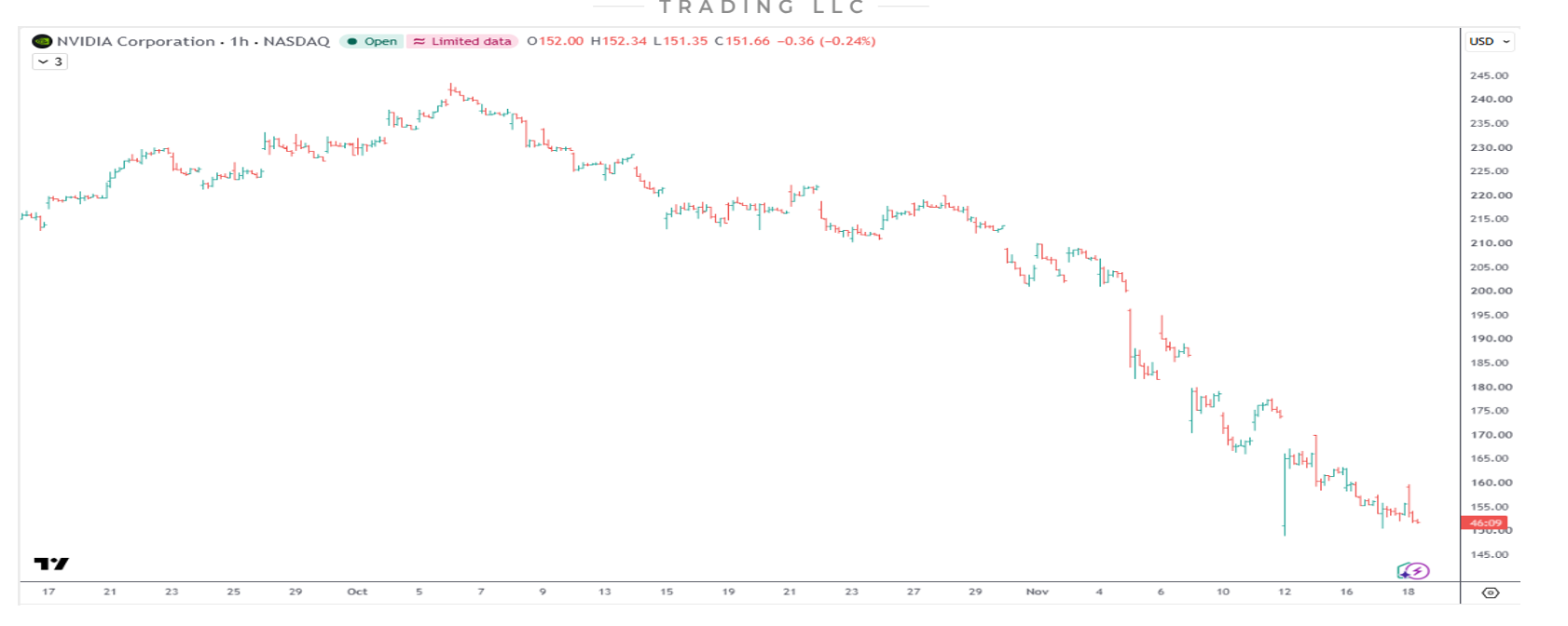
Rumors are now swirling about self-dealing and conflicts of interest between Secretary of Commerce Lutnick, his sons (who are running Lutnick’s former firm, Cantor Fitzgerald), and Nvidia. In fact, complaints about alleged corruption by the President and others in his cabinet are one of the major factors that led to the historic shellacking the Republicans experienced in the recent midterm elections. Going forward, the Democrats will be busy investigating all sorts of suspicious dealings, but we should assume that Trump and his inner circle will be extremely uncooperative in the investigative process.
So where does this leave us? Have I shifted my thinking about the huge sell-off in equities that I’ve been forecasting? Do I believe it is now underway? My long-term negative outlook on equities – and certain other risk assets – is so strong that I’ve been happy to establish long-term hedges against my long stock holdings. This should be news to no one, as I have been writing about this for many weeks.
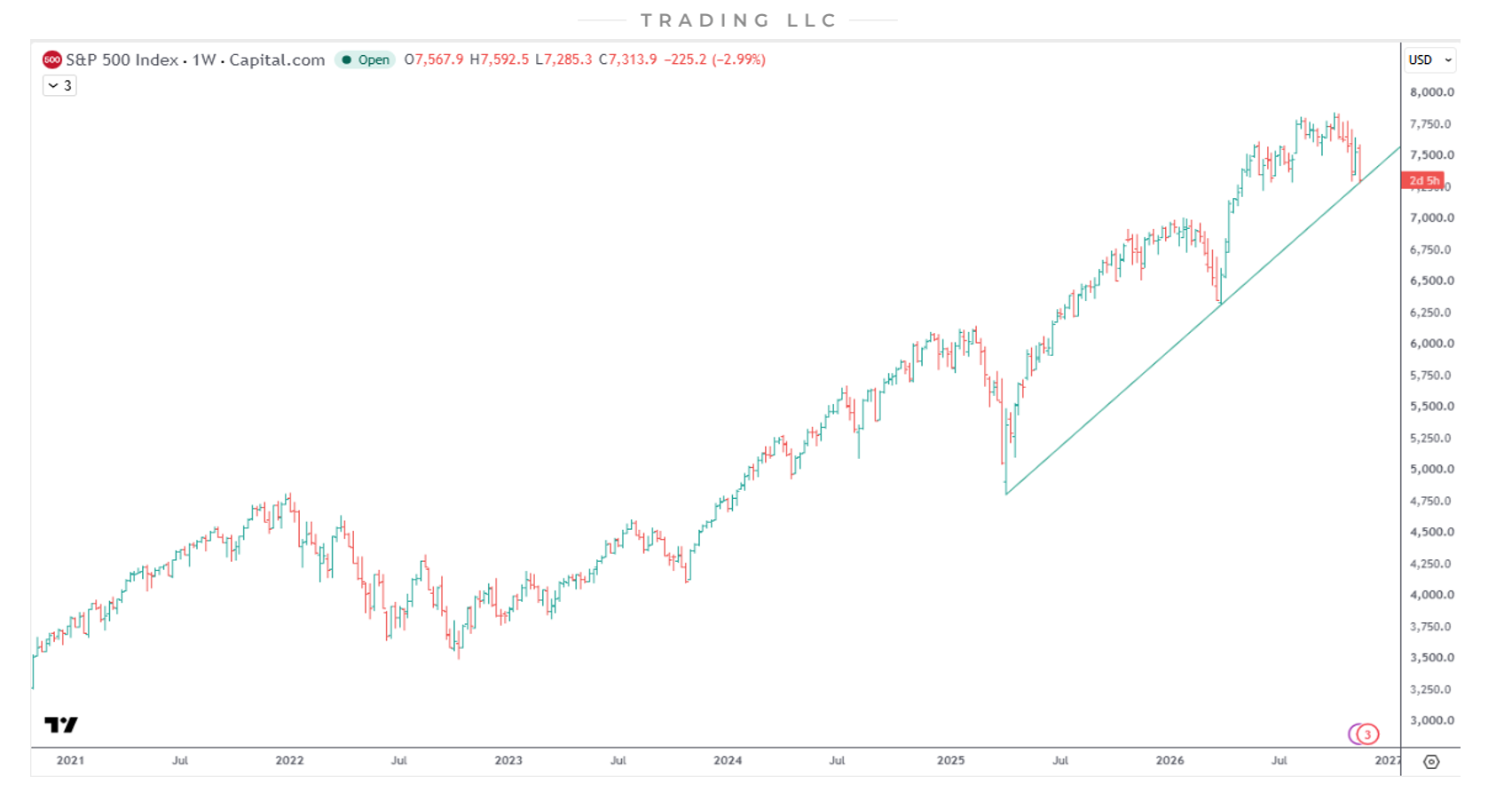
My current thinking is that