What to Expect When Market Valuations Reset
I have been consistently warning about the growing bubble in the US equity markets, and the extreme overvaluation of the Magnificent Seven.

As my regular readers know, I have been a long-term bear on Tesla stock. On August 8th of 2023, for example, I said that I had gone short Tesla when it was trading around $251.50. My bearishness, however, goes back way before then. Towards the end of 2020, when Tesla had a market cap of $639 billion, I wrote about the insane overvaluation of this stock. Its revenues for the prior year only totaled $28 billion, while at the same time, Volkswagen, General Motors, Ford, BMW, Daimler, and Toyota had a combined market cap of approximately $530 billion!! The combined revenues of these six companies in the prior year totaled $869 billion. The numbers just didn’t make any sense.
I literally had trouble getting my mind around the comparative numbers between Tesla and the older, more established car companies. For example, in 2020, Toyota and Volkswagen alone sold nearly twenty-two million cars, while Tesla sold a total of five hundred thousand cars. In fact, given the number of cars Tesla was selling at the time, the sale of each car equated to roughly $1.25 million per car. I thought this relative valuation was a bubble of historic proportions, and I couldn’t justify the valuations under nearly any assumption. It was just a matter of time before the other car companies developed first rate electric vehicle technology which they could offer at competitive prices. This relative valuation was so distorted that I knew this mispricing was bound to correct and adjust sharply at some point. The long-term infrastructural power and expertise of these other great companies was vast, and I was sure it was just a matter of time before the valuations would normalize to more sensible levels. Sure, Tesla had a big advantage as it was a first mover in the electric car space, but that advantage would dissipate over time. Bottom line, I maintained that Tesla was in a bubble, and the speculative fervor behind its valuation was bound to end in tears.
Like all other bubbles, the Tesla bubble finally burst. The stock is down about 65% from its all-time high in 2021, and it is down about 53% from its more recent high in July of 2023. At the same time, the stocks of these other companies have either gone sideways or appreciated.
Playing for these massive market re-pricings is very tricky, and I almost always prefer to use limited-risk option structures to play for these sorts of long-term market recalibrations. These moves can take a long time to work themselves out, and the normalization process is almost inevitably very, very volatile. This makes it very challenging to hold onto standard long and short stock positions. Tesla’s stock price is finally starting to approach more realistic levels on a comparative basis, but it probably has more to go.
The chart below shows the relative performance of Tesla versus Toyota. The numbers are overwhelmingly compelling. The other car companies are also seriously outperforming Tesla on a relative basis, although Toyota has been a stellar outperformer.
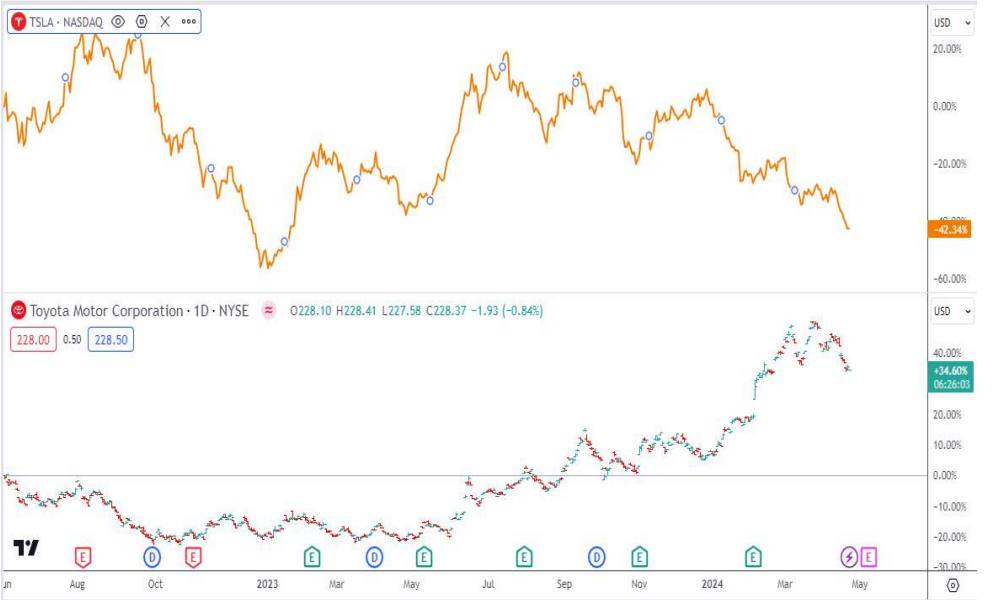
These big picture, macro views often take a long time to play out, so I hope my readers understand that my macro forecasts don’t usually play out as fast as the recent forecasts in precious metals, for example.
For the past several months, I have been consistently warning about the growing bubble in the US equity markets, and in particular, the extreme overvaluation of the Magnificent Seven. As I have written extensively, bubbles can carry on a long time and expand to levels that are unjustifiable by any sensible measure of valuation, but as noted, playing for reversals of bubbles is a dangerous game that should usually be played with limited-risk option strategies.
As I have written in prior letters, I have been building a bearish basket of option structures for over a month now, playing for a sharp sell-off in the individual stocks that comprise the Magnificent Seven. I have been careful to point out that I believe that nearly all of these companies are excellent companies, and I have been very clear that I think Nvidia, in particular, is an excellent company. That, however, doesn’t mean their prices can’t become dramatically overvalued due to irrational market euphoria. As I pointed out in prior write-ups, even great stocks like Apple, that have had long-term parabolic rises, will periodically have vicious, parabolic declines. The recent sell offs in Nvidia and the other Magnificent Seven stocks have been largely as expected, but the piercing of bubbles usually takes place in multiple steps. The speculators won’t let go of an idea very easily, and I expect a tremendous amount of choppy, volatile price action as the valuations re-set.
Of course, the crazy surges in the valuations of the Magnificent Seven, and many other stocks, since the end of 2023 can be largely attributed to the Fed. In fact, I would say the Fed was masterful at fueling the market’s burst of insanity since the end of 2023. I really thought that after the Fed bungled things with their “inflation is transitory” mantra in 2021, they would be careful before suggesting that the taming of inflation was sufficient to start cutting rates. Boy was I wrong! Last December the Fed gave a median forecast for three quarter-point rate cuts in 2024 even though their own financial conditions index suggested conditions were so loose that interest rate hikes were more appropriate than cuts. The market almost immediately priced in the seventy-five-basis point interest rate reduction, and the stock market surged. The only question floating around the market was “when” the rate cuts would start, not “if” they would start. This was the perfect recipe for a stock market surge, and the speculators complied with absolute obedience, buying AI stocks and other tech stocks aggressively, pushing the valuations up to nose-bleed levels. The only problem was that no one seemed to notice that financial conditions were already so loose that there was no good reason for the Fed to lower rates at all! No one seemed to wonder what would happen if inflation proved sticky, and even started to tick higher, just like it did in the 1970’s under the astonishingly poor guidance of Arthur Burns. If the Fed was trying to engineer a market bubble, they did a great job.
Of course, the taming of inflation is a tricky matter, which is why I have long maintained that its drop would prove to be sticky. Former Fed vice chairman, Alan Blinder, summed it up beautifully in the 1990’s when he said, "If you're a business and you expect the inflation rate to be 5%, you're likely when it comes time to set the prices for the next year [to] go up 5%.” Blinder was a brilliant Princeton economist, so his logic should have been more deeply considered before the Fed started to forecast multiple interest rate cuts last December. The mindset of business owners and consumers is critical in this process, and it takes time to adjust from 5% or 8% wage increases to 2%. That adjustment won’t happen in an orderly straight-line sort of sequence. Even yesterday, for example, Delta Airlines agreed to a 5% wage increase when it set the minimum rate for its workers. Of course, we can expect price hikes from the businesses to cover their increased wage costs. Except in difficult economic times, or when wage increases are subsidized, rising wages lead to price increases as the business owners need to charge more money to cover their higher costs. This chain is hard to break, so it was foolish for the Fed to assume that everyone would accommodate their fantasy scenario. Moreover, with the dramatically heightened overall volumes of money coursing through the system and the Treasury borrowing and spending at a mind-boggling pace, it is more rational to expect further inflation than an immediate taming of it.
The recent inflation data has in fact destroyed the Fed’s plan to start easing any time soon, and interest rates have backed up aggressively. In turn, the Nasdaq and S&P 500 have seen some heavy selling. Do I think that this is the start of a huge sell-off in the equity markets? Probably not. We have already had a decent-sized move, and although I see further downside overall, I think this recent decline might prove to be more of an appetizer for some wild things to come after the elections in November. Sure, it has been a great trading opportunity, and it has given me a chance to lock in some nice profits on my bearish bets, but the likelihood of a bounce is high. The markets have become a bit oversold in the short term, and the authorities will likely do everything they can to try to make the markets look safe as we head into the elections in November. Therefore, I am expecting the stock market to trade in a choppy range with some further downside risk, but at the present time, I am not expecting a massive sell-off to come before the elections without further bad news.
My view, however, could change, for example, if we get some shocking inflation data. Investors and speculators are heavily long the market, so further bad inflationary data would likely prove very painful. Two-year rates are pushing up against 5%, and 10-year notes are testing the 4.65% level, and more inflationary shocks would likely trigger a move through these levels. I think such a move higher in rates would prove to be a catalyst for another sharp down leg in equities. Either way, I think there is good chance that market participants will eventually be forced to reduce their exposures, but for the time being, barring any more bad inflation reports, the markets will probably chop around for a while.
We could also get some surprising news in the form of weak earnings, but for the most part, most companies are expected to announce strong earnings. We could also see further escalations in political unrest in the Middle East or Ukraine, but continued status quo won’t cause any market disruptions. Therefore, I expect that the biggest short risk to the equity markets would be on the inflation front. As we approach the election, tension and political, however, the political rancor and fighting will likely heat up, and then I would expect heightened market volatility. This is probably going to be a very, very bitter fight in November.
In the currency markets, we are seeing overall US dollar strength, as the back-up in US rates is proving to be a powerful magnetic force that continues to attract a lot of buying against all other major currencies. The yield differential is just too strong at the current time, and the US economy is showing stronger growth numbers than its major trading counterparties. Moreover, the overall direction in interest rates is likely to lead to further dollar strengthening as rates in essentially all other countries, except for Japan, are likely heading lower, while US rates will probably hold steady for quite a while. The dollar’s strength is therefore likely to continue for the time being, but a major risk event could reverse that trend quite dramatically – particularly against the yen. It is unclear what the longer-term impact of intervention will do in dollar yen, but don’t be surprised if the Japanese authorities, in conjunction with the US, step in to stop further yen depreciation before we reach the 160.00 USD/JPY level.
In the meanwhile, I wish you the best of luck in the markets.
Andy Krieger