How Rate Cuts Could Push Markets to Historic Extremes
The stock market is valued at roughly 200% of GDP, close to its most overvalued level ever. Clearly, financial conditions are not restrictive right now
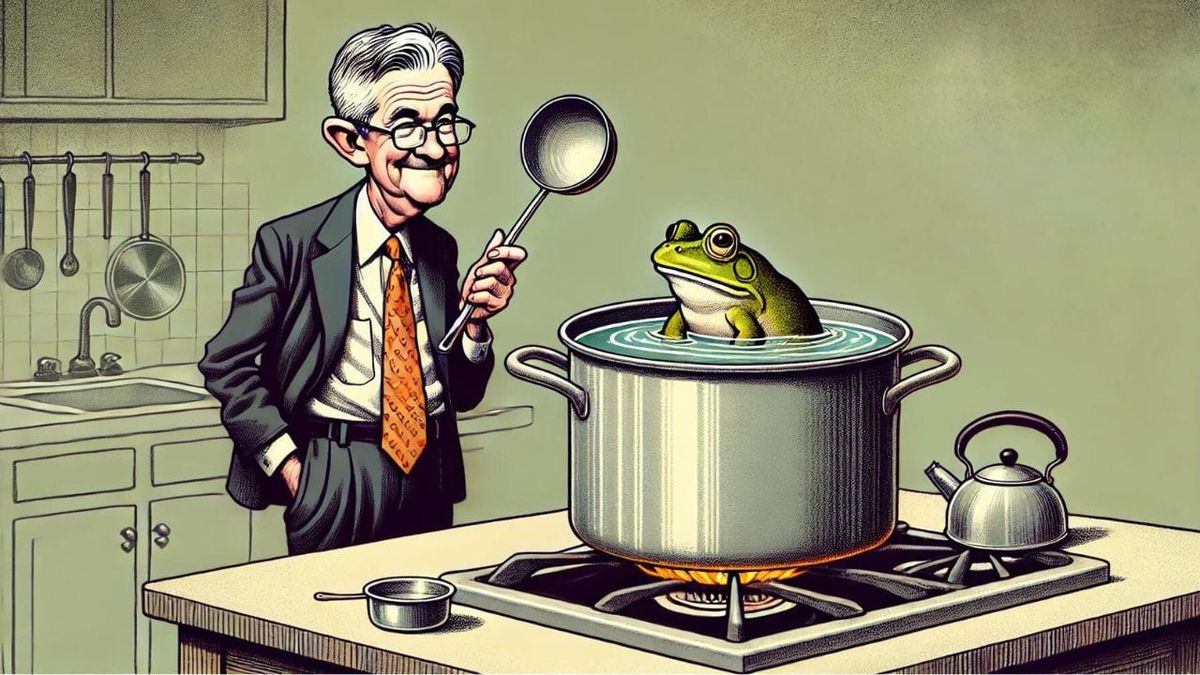
Last week I predicted that Powell would soon shift course by focusing on job growth rather than inflation. That shift would allow him to announce that the time had come to lower interest rates while glossing over the fact that inflation is still a full 50% above the Fed’s 2% inflation target. True to form, Powell spoke to us on Friday from Jackson Hole at the Fed’s annual economic conference and noted, “The time has come for policy to adjust. We will do everything we can to support a strong labor market as we make further progress toward price stability…My confidence has grown that inflation is on a sustainable path back to 2%.” Powell has been hell-bent on lowering interest rates, and he is going to start the next easing cycle in September.
Under Powell, the Fed had lifted its benchmark rate to the highest level in over two decades in order to get control of the nation’s worst inflation in more than forty years. He claimed that due to the Fed’s efforts inflation has come down steadily, and that, “There is good reason to think that the economy will get back to 2% inflation while maintaining a strong labor market,’' Powell sounded confident that the Fed would achieve a so-called soft landing — containing inflation without causing a recession. Yes, it felt totally disingenuous for him to take a victory lap considering how badly the Fed had bungled the management of the inflation almost three years ago, but Powell is a brilliant tactician, and investors love his persistent message that supports the stock market.
In fact, the decline in inflation has been anything but steady, as the Fed had been promising rate cuts since last year. The initial rate cut has been delayed for many months due to a sharp rise in inflation in the first quarter of this year. In any event, a rate cut in September is nearly certain, and the market is actually pricing in cumulative rate cuts of 100 basis points over the Fed’s next three meetings this year. As Powell, said, “The direction of travel is clear, and the timing and pace of rate cuts will depend on incoming data…”
Let’s examine what this all means and where things are heading.
First, I want to remind you that the notion that 2% inflation equals a stable monetary policy is absolutely spurious. A 2% inflation rate simply means that your buying power will steadily decrease by 2% a year. Over 35 years, your savings will have the equivalent buying power of one half of what they have today. As you will see, it is a very clever political ploy that accomplishes a few goals for the authorities but brings almost no benefits to the rest of us. Your dollar’s value deteriorates slowly enough that you won’t typically notice the loss, but over time, you will definitely feel the pain. It is effectively a cumulative, compounding tax the authorities use to trick people into thinking that things are much better than they really are. Central bankers love it because it deflects a lot of criticism about their mandate to maintain stable prices. The definition is vague, and the practice of building in a cushion is self-serving. It is only when the overall rate of inflation accelerates, as we have had over the past few years, that most people really notice the impact. Otherwise, it is more selective, with things such as insurance rates, health care, and education costs, which have had much higher inflation rates than other costs and accordingly received a lot of attention.
With the current inflation rate of 3%, you lose half of your buying power in less than 24 years. Therefore, boasting about the wonderful job they have done in reducing the rate of inflation is a remarkably cynical thing to do. Plus, since inflation is a cumulative cost, the pain of the very high inflation rate in prior years simply adds insult to injury as consumers really feel the pain of the overall price rises over the past few years.
Remember, this notion of a 2% inflation target resulted from an off-the-cuff comment from a newly appointed New Zealand central bank governor, Donald Brash, nearly forty years ago. Brash had no experience whatsoever in macroeconomic policy decision-making, although he had at least studied economics and done some undistinguished work as an economist. In fact, Brash studied economics and earned a master’s degree by writing a thesis about the damage that foreign investment inflicts on a country’s economic development. He then went on to earn his PhD in economics by writing a dissertation that had exactly the opposite conclusion. In a way, Brash was actually quite clever, as his academic path provided a perfect hedge – he was almost certain to be right in one of those papers. To that extent, he may have been well-suited for a career as a central banker – never take blame and never admit a mistake. Brash’s most senior job prior to becoming governor of the New Zealand central bank was serving as the managing director at the New Zealand entity which oversaw the export of kiwi fruit. This is hardly the career path of a man who would later have such a profound impact on central banks around the globe. In any event, he took the helm of the Reserve Bank of New Zealand in 1988.
Prior to Brash’s appointment, New Zealand had suffered with double-digit inflation for twenty years, and people were fed up. As the newly appointed governor of the central bank, Brash was poorly equipped for the job and clearly a bit overwhelmed. He only knew generally what he was hoping to accomplish, and he had almost no idea how he might achieve his poorly understood objectives. His command of high-level economic theory was limited, so when he was asked by a reporter about his inflation target, he was stymied. He stammered and fumbled about, trying to figure out what to say. Finally, he came up with the idea that his target would be between 0% and 2%.
He later confessed that he didn’t have a clue how to answer the question, and that he just pulled the number out of the air, literally making it up because he thought it sounded good. As luck would have it, inflation dropped sharply, and he was viewed as a central bank genius. His pronouncement of 0%-2% as an inflation target was a new idea at the time, but other central bankers jumped on the bandwagon and pronounced the same target. Quite quickly, inflation targeting of 2% became the accepted norm. It is amazing that nearly forty years later central bankers around the world still endorse the same target as if it were a divinely inspired revelation from the gods of economics. My bet, by the way, is that the aggressive interest rate cuts by the Fed will fuel a resurgence in inflation, and before long we will have central bankers shift the target higher – for example, to 3% or 4% -- “due to some new studies.” Remember, never take blame and never admit a mistake.
Aside from the obvious cynical effort of central bankers to want economic performance to look better than it really is, there is also the “greasing-the-wheels argument” which our current Treasury Secretary, Janet Yellen, used twenty eight years ago when she was a Fed governor. When businesses run into rough times, they may be inclined to cut workers’ pay. In practice, however, that doesn’t happen much as workers hate getting hourly pay cuts. Even in a severe downturn, businesses are more likely to cut hours, conduct layoffs or keep positions vacant than cut pay. That’s one reason recessions tend to lead to higher unemployment instead of lower wages. Inflation helps deal with this problem. When there is a bit of an inflation buffer built in, employers can hold workers’ pay steady during a downturn although the salaries will actually be lower in inflation-adjusted terms. Inflation thus creates a type of adjustment mechanism. For example, a worker may keep earning exactly $30 an hour through a downturn, but in inflation-adjusted terms that pay falls by 2 percent a year, which could make the employer a little less likely to resort to layoffs.
Of course, Yellen was also well aware that central bankers want to give a false impression that the economy is stronger than it really is, so she came up with this clever idea to help justify the practice of giving a 2% inflation target. This takes some of the pressure off the central bankers and helps them keep their cushy jobs. Bear these considerations in mind when current Federal Reserve chief Jerome Powell and other Fed central bankers talk about their near-sacred 2% inflation target, and remember that number is a completely arbitrary, made-up number by a guy with zero central bank experience.
It is important that we understand the broader context of the Fed’s “sacred” 2% inflation target. Unfortunately, more than a little cynicism is warranted, which is why in some ways it is so easy to forecast Fed behavior. One simply needs to analyze things with a cynical perspective, and central bank behavior becomes quite understandable. Once we throw into the pot the other sacred effort by the Fed to nearly always support the equity market, the job of forecasting Fed policy gets easier still.
In order to understand better what is really happening in the markets, we need to understand just how unusual the current fiscal situation is in the U.S. The average annual deficit of the federal government relative to the GDP since 1948 has been 2.57%. The record surplus of 4.5% occurred in 1948. The record deficit was 14.7% in 2020. Last year the US ran a deficit of 6.3% of the nation’s GDP. This is neither normal nor healthy. That is the sort of deficit that the US used to run when we were suffering from a disastrous recession with unemployment levels approaching levels between 8% and 10%. If the US economy were in a remotely healthy condition, then we should be running a worst-case deficit of 2.5% to 3%. This means that things are actually far worse than the authorities have let on. They are borrowing and spending as if we are in a severe recession to try to support the economy and the labor market.
This is one of the ways in which Janet Yellen has been able to offset the Fed’s aggressive hiking of interest rates. Although higher interest rates have negatively impacted certain segments of the economy, the government has stepped in with massive borrowing and spending to counterbalance the economic softening effect of higher rates. In fact, this is why I have long maintained that overall financial conditions in the US are not at all restrictive. Sure, commercial real estate is suffering, and residential real estate turnover has been lethargic – but residential real estate is stuck at all-time high prices! As you will see in the charts below, we have very rarely had federal deficits anywhere close to current levels – except during the most severe economic conditions. This strategy of boosting the economy to offset the normal slowing effects of higher interest rates is a clever ploy by the authorities, but it is not cost free. Aside from the massive deficit spending during World War II and in the aftermath The Great Recession, we have not run deficits anything remotely similar to the new “standard” deficit of our government.
The following chart summarizes this situation quite clearly. I wonder what our deficits are going to be when we have serious unemployment – not unemployment between 4% and 4.5%. What is going to happen to our economy when investors grow leery about our ability to manage our debt and start demanding higher interest rates in order to buy our government’s bonds? Then we are starting down the slippery slope to an eventual ratings downgrade and a potential default. There are solutions to this problem, but they are not cost-free. They involve either much higher taxes or more inflation – or some combination of both. Eventually, the problem can become almost impossible to manage, but that is a doomsday scenario that is fortunately a long way off.


Our record levels of federal debt and deficit spending have helped fuel the greatest levels of wealth disparity in our nation’s history. Homes are trading at their highest prices ever and the stock market is enormously overvalued. The release of ChatGPT in late 2022 triggered widespread investor interest in artificial intelligence, fueling explosive rallies in many Big Tech stocks, dragging the broader market to record highs. I expect that this process will end up with the same fate as past innovations, ranging from railroads to cars to the internet, with a huge initial bubble that finally bursts. The overall stock market is valued at roughly 200% of GDP, close to its most overvalued level ever. Clearly, financial conditions are not restrictive right now!! Looking at interest rates alone without examining broader economic conditions is foolish. What do the authorities really think is going to happen when they start aggressively cutting rates and thereby unleash still more frenetic buying of financial assets, blowing out these bubbles to unprecedented levels of overvaluation? Over time, gold will certainly benefit from irresponsible economic policies.
Stocks are dangerously expensive, and a recession is increasingly likely. I am not forecasting these things immediately as the authorities will do everything possible to try to make things look good – at least through the election and the end of the year. Remember, I have been calling for a potential blow-off top in equities. This would ideally lead to one more wild, crazy ride to new all-time highs based on irrational exuberance before a massive reversal and stock market decline. Multiple rate cuts from the Fed, or perhaps one rate cut along with the promise of more to follow, could certainly be the catalyst and do the trick. Then the inevitable implosion will follow. Either way, stocks will eventually have a very, very aggressive sell-off. It will hurt many investors, and the authorities will almost certainly panic.
On a personal level, I am seriously concerned that the worse things get, the more desperate the authorities will be to mask the problems. As a trader and investor, I find this situation fascinating. As a parent and grandparent, I find the situation scary. The dollar has broken lower against most major currencies, and this downtrend will likely continue for some time, albeit with periodic violent corrections. The dollar is very oversold in the short term, and we are due for some corrective price action. Overall, however, there should be significant amounts of dollar weakness to follow once the technicals become more balanced.
There are several caveats to this forecast. First, if we have a real financial crisis, then the dollar could initially be the beneficiary of huge capital inflows as a safe haven – even if the crisis emanates from the US. More likely, however, a crisis will induce the Fed to go hog wild and start aggressively slashing interest rates to try to stabilize a crashing market. This has been the Fed’s pattern for the past 40 years, so it is reasonable to expect more of the same behavior in the future. That would likely lead to a general dollar sell-off that could be quite dramatic.
It would be the next phase of this overall pattern when the yen takes charge and leads the currencies higher. Japan’s pent-up buying power is still a massive force, and for a number of reasons the yen, despite Japan’s fiscal burden, could still become the ultimate safe haven currency over time. In whatever way the macroeconomic scenario finally plays out, I am sure that the next decade will see nearly unprecedented levels of market volatility across many asset classes. Many markets are priced at extreme levels, and a crisis in any one sector could easily trigger seismic reactions in other sectors.
The chart below shows the powerful break lower that we recently had in the dollar index. The break lower is very clear in the chart, and it suggests that further weakness is likely to follow. The dollar could certainly bounce back and test the breakout level, but there are many factors supporting an eventual continuation of the dollar’s weakness after some technical corrections.

Finally, the chart below shows the Fed’s Financial Conditions Index. The Fed’s own index is very, very clear – financial conditions in the US today are at their loosest condition since BEFORE the Fed started hiking rates in 2002!! The Fed cutting interest rates right now is a very dangerous move with many potentially frightening repercussions. Unless we get an offsetting fiscal tightening – which has a very, very low probability – we are about to witness some of the biggest financial bubbles in history.

Remember, financial bubbles provide fantastic money-making opportunities. We are about to start a wild ride in many markets. Hopefully, we can all make some money together. In the meanwhile, I wish you all the best of luck with your trading. You will certainly have many, many wonderful opportunities across many markets.
Andy Krieger