How the Fed’s Reality Check Will Impact the Markets
The markets could very easily be in a state of chaotic disarray by year-end.

I have written for some time about the plethora of misleading economic headline data in the U.S., but it seems that the Fed might be starting to come clean. For example, after the recent shocking May jobs report, which portrayed an absurdly over-optimistic job market, Jay Powell confessed that the data “may be a bit overstated.” A bit? The employment data has been absolutely deceptive unless you dig into the weeds. I think the following chart from the Fed really sums up beautifully how strong the jobs market really is.
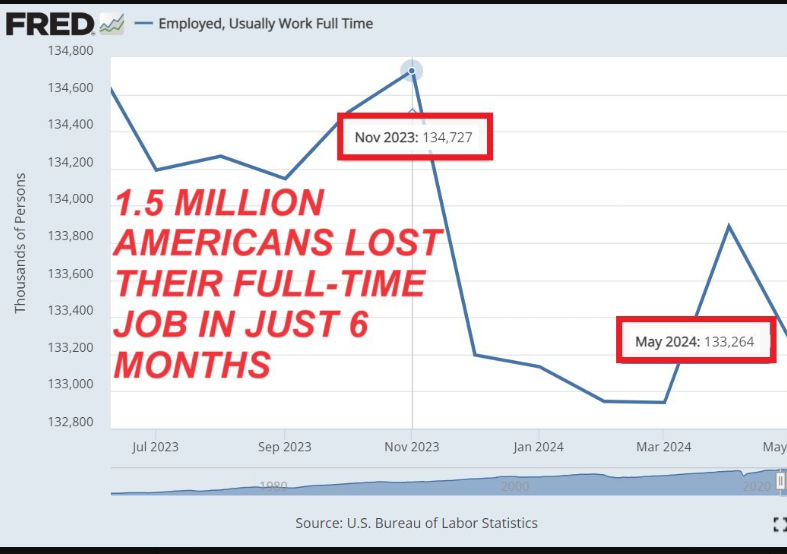
Remember, the Fed knew very well the real story. If this were a one-off exception, then I would have a different attitude. Consider the Atlanta Fed’s recent GDPNow GDP estimate for 2024. The GDP estimate has collapsed from 4.2% to 1.7% in less than two months. Wow!

I could go on and on with many examples. The Fed officials are masters of doublespeak. Sometimes I feel like I am stuck in some sort of dystopian, Orwellian future world. Then I remember that in fact I am here in the present, and I need to make the best of what we’ve got. At least the Fed is starting to represent things a little more objectively.
The political machinations in Washington, whether they be the misleading messages of Fed officials or government officials (***remember, the Fed is independent, but the details of that story that would require a book written anonymously, not a weekly update), the guiding principle at play is the same. The people in power want to stay in power. This doesn’t mean that all government and Federal Reserve workers are corrupt or morally depraved. To the contrary, most employees are absolutely committed to doing good; people who want to make a positive contribution to make the world a little better.
Many work tirelessly, putting in extremely long work weeks at the expense of their personal lives, and I have tremendous respect for that devotion and commitment. Unfortunately, certain key statistics and data points can be selectively ignored, or forgotten, or reconfigured with the not very innocent intent to deceive or misguide. Remember, to intentionally withhold certain key information can be just as bad as – or worse than – falsifying information. Clearly, the top Fed officials and the top Treasury officials know very well exactly how quickly our economy is sliding into a major problem.
Economic growth has been slowing for some time, and the job market has been dramatically overstating its strength. Strong growth and a tight job market sound like great mantras to explain away the persistent inflation that is eating away at people’s hard-earned salaries. If the authorities came out and spoke the truth about the inevitable weakening of the dollar’s purchasing power due to the insane deficit spending during times of economic growth – which was compounded by the equally insane ballooning of the Fed’s balance sheet – then the authorities would have to admit that they were making a radical experiment with the largest economy in the world – and the lives of our citizens -- and their experiment is not working out so well. In fact, the experiment with our deficit spending has been among the most irresponsible acts of government malfeasance since our country was formed. This sort of spending should only be reserved to help pull the economy out of an economic downturn.
Our country will need decades to clean up the mess we are in, and our children and grandchildren will look back and wonder what sort of idiots we were. This is not a condemnation of either political party. This has been a team effort, and it has taken the extremely skilled work of many, many people in Washington to produce a mess of this magnitude.
It wouldn’t be very hard to write a prescription for our nation’s illness, but that would require something the authorities aren’t keen on producing: a blunt and honest appraisal of where we actually stand fiscally. For sure the path we are on is unsustainable and something has to give. By way of example, in 2023, our federal government spent $6.13 trillion dollars, which was $1.7 trillion more than it received. Call me crazy, but I think that $1.7 trillion dollars is a LOT of money. The projected deficit for 2024 is about $1.6 trillion, but it is projected to steadily grow thereafter. By 2054, federal debt is projected to grow to 172% of GDP. That is clearly not sustainable and not something that our government can handle. Unfortunately, we will reach those numbers much sooner than the CBO projected. These projections assume steady GDP growth every year with no recessions!! Dream on CBO!! Only one country in history has avoided a debt restructuring or outright default with numbers like that, and that is Japan – a very special country with very special circumstances.
Below is the top 10 list of countries with the highest debt-to-GDP ratios. The United States has already joined the list, and it is not a very great honor to be a member of this grouping. We will shortly be climbing up that list to join other nations who are suffering from fiscal disarray.

In fact, as noted, the numbers are far worse than the CBO is projecting. If we continue to grow our deficit by $1 trillion every 100 days (the current pace), then our debt will double in less than ten years. Bank of America research suggests that our debt will double in 8 ½ years. Mandatory spending for Social Security and Medicare will rise, but the CBO expects (hopes?) that discretionary spending will decrease as a percentage of total spending. The CBO projections are excessively optimistic in nearly every regard. The assumed cost of interest on this ever-growing mountain of debt is likely unrealistic, as it is quite low. Also, the assumption that we will never slide into a recession, let alone a prolonged economic downturn, is ludicrous. The little table below would be relevant except for the fact that our debt is growing faster than these other economies.

The fact is that the United States is in a unique position as the world’s hegemon. As long as we maintain that geopolitical status, we can continue to borrow and print money at a senseless rate. At some point, however, lenders will not tolerate the deficits without demanding a much higher insurance premium from the borrower – the US government – in the form of higher interest rates. That tipping point is what we need to avoid at all costs.
In the meanwhile, unless the government decides to do something radical like tell us the hard, tough facts, we need to assume that the dollar’s buying power will continue to erode – perhaps at an accelerated pace. The illusion of prosperity can continue for quite a while even though housing will become progressively less affordable, and retirement will become more and more difficult for the elderly. The nominal cost of everything will continue to climb and our foreign enemies will challenge us more and more over time, testing our resilience and our resolve.
Are there solutions? Yes, but they are somewhat radical, and they would require a very strong and committed government to effectuate. These solutions are a topic for a different day, but in the meanwhile, let’s focus on how to make money from this inexorable devaluation of the dollar’s purchasing power.
First, when the Fed talks about tight interest rates, please disregard that talk as total bollocks. The Fed knows full well that financial conditions are super easy right now. Interest rates are only a small part of the whole story. Sure, for the people who are saddled with lots of credit card debt and working three jobs to pay the rent and the bills, monetary conditions feel very tight. For the wealthy and the financially comfortable people, financial conditions are remarkably easy now. The higher interest rates are great for net savers, and their home values are holding up very well despite the residential housing market’s extreme slowdown in turnover. In fact, increases in home values have far exceeded the rate of inflation over recent years. Other “real” assets are likewise holding up well, so we clearly have two different economies right now.
The Fed’s own financial conditions index continues to soften, meaning, by their own measure, conditions are getting easier and easier. Inflation has slowed somewhat, but it is still way too high for the average consumer. Unfortunately, I think we better gird ourselves for a possible push higher in inflation. It is not a certainty, and there are conflicting signals, but it is a very real possibility.

Economic conditions are softening quickly. Job vacancies have dropped sharply. Commercial real estate valuations have been crushed, and occupancy rates are disastrous. Commercial real estate will stay under a very heavy and dark cloud for quite a long time. Huge amounts of refinancings are scheduled, and the cost of these refinancings will be devastating to many participants in the space.
Residential real estate is softening. A full 7% of the currently listed homes have already dropped their price at least once, and that number looks set to rise. Home builders already offer low mortgage rates and sales and prices are flat at best. There are nearly 500,000 new homes for sale as of the end of May, the highest level since 2008. US pending home sales overall just hit a record low. The market is stuck, and it is in trouble without rates coming down sharply – and soon.

So why am I expecting a possible jump in inflation? Even though there has been a sharp decline in demand, the supply side of things might get a bit ugly. Shipping and freight costs seem to have bottomed, and they are trending sharply higher. Moreover, Oil and gas prices are climbing again, and it looks like they are set to continue rallying sharply.

Oil has been basing for the past two years, and it looks like it is ready to rally quite a bit more. It has rallied sharply over the past month, and $80 should hold on the downside. The upside potential is quite interesting. I am expecting a possible move up toward $95, and possibly a retest of $99 or $100 per barrel. Coming into the active travel months of the summer, this would be catastrophic timing. Political and weather-related factors can easily drive the pricing of oil up to these higher levels, and beyond, and it seems that the U.S. government’s strategy to artificially depress the market price by unloading its strategic reserves is nearing the end as these reserves are nearly depleted.

The Fed is going to cut rates as the economy continues to weaken, and they will come up with every possible excuse as to why that move is consistent with the overall declining price pressures – even if the declining price pressures are illusory. The Fed is well aware of the pending time bombs sitting out there in the real estate market, and they will make the bet that the softer economic data will dominate the tighter supply pricing. For everyone’s sake, I hope this bet proves to be correct.
Gold and silver will likely begin their next rallies at that time, and a pickup in inflation will simply turbo-charge their rallies. Other commodities will likely rally as well, as the cheaper funding costs will spill over into many markets The problem is that the stock market rally that follows the first Fed cut will likely lead to the blow-off top that I am expecting. The stock market’s bubble will finally burst when people realize that valuations are so far removed from reality that a massive liquidation will be inevitable. The AI sector and the Magnificent Seven will appear far less magnificent once this starts. The chaotic run-up to the presidential election will add fuel to this stock market sell-off, and the markets could very easily be in a state of chaotic disarray by year-end.
The dollar will finally put in a major top once this scenario plays out. The yen will have a savage recovery that will be almost breathtaking in its force. The unwind of current positions will take many, many weeks and months, and this unwind will accelerate with each passing week and each further decline by the dollar. The dollar has risen against the yen 15 of the last 19 days, but it has hardly made any net progress. Once the dollar decline begins in earnest, the dollar will likely drop by at least a yen every day, maybe much more.
The dollar will weaken against the other major currencies as well, but the yen will surge to the top of the podium. The Swiss franc will also do well, as well as the Australian dollar. The euro and the British pound will face their own internal political chaotic conditions, but they, too, will outshine the dollar. The Canadian dollar will likely become quite weak on the crosses against the other major currencies, but it too will outperform the US dollar.
In case you are wondering how far stocks can drop in this scenario, just consider the historical valuations and multiples from the chart below and think about the percentage drop in the market we would need to reach some of the lower multiples. The numbers are seriously frightening once you do the math.

Overall, there are lots of ways to make excellent profits in the coming environment. Option strategies are best in this type of environment so that you can relax with a limited downside risk while waiting for the markets to turn. I like to use one-year durations for some of my big picture ideas, but normally nothing less than six months. The profit-making potential in this scenario is massive, and once these moves start, then I will pile in with shorter-dated option plays. Whether you choose to play one of the above-referenced markets or all, the limited-risk strategy is the best and most sensible.
In my next write-up I will discuss something I rarely write about – Bitcoin. The last time I wrote about it, I warned that Bitcoin’s surge above $70,000 was overdone and due for a serious correction. We have had two and a half months of corrective consolidation. I think that market is getting interesting now.
In the meanwhile, I wish you all the best of luck.
Andy Krieger