Iran, Inflation, and the Discipline of Reading Through Noise
Thoughts on the Market by Andy Krieger
July 13, 2026
I. The Unraveling of the U.S.–Iran MOU
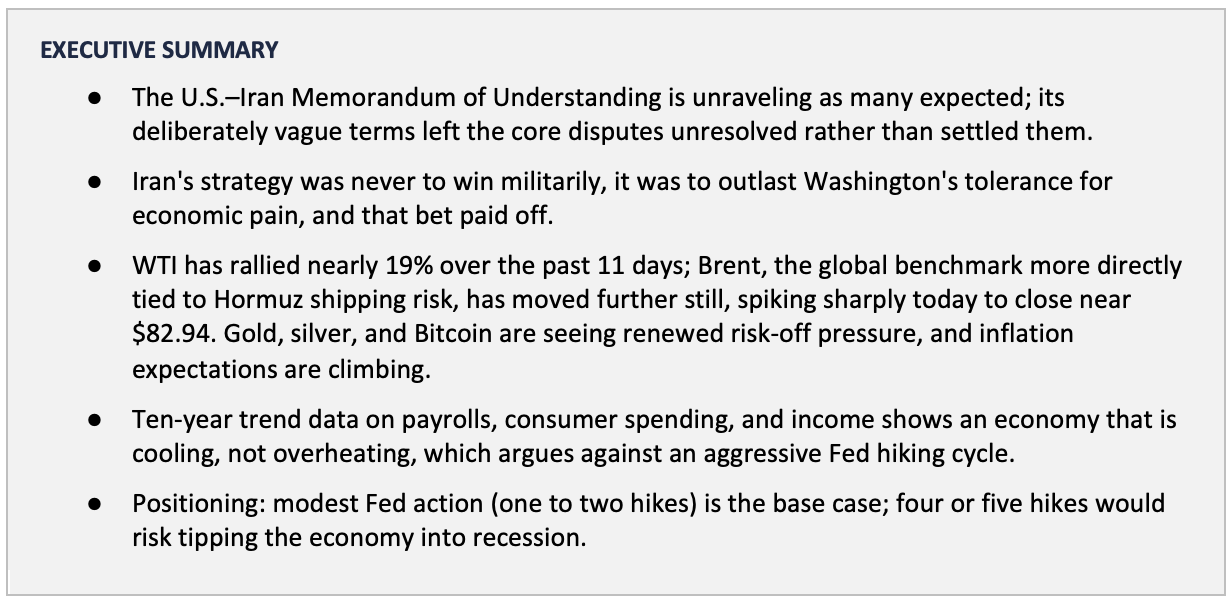
It should come as no surprise to my readers that the hastily executed Memorandum of Understanding (MOU) between the United States and Iran is unraveling quickly. Aside from being drafted in a remarkably vague manner — with nearly all salient terms left open for debate — I have long maintained that Iran harbors a deeper agenda: inflicting maximum pain on President Trump and the United States. This conflict stands as a textbook case of how a militarily dominant force can be thwarted – even defeated – by an overwhelmed adversary wielding the right strategy.
As a result of this development, the markets have reacted violently, and there are some very important trading lessons to be learned from this entire episode.
The United States entered this war without properly assessing its enemy, and the consequences of that miscalculation will be felt for a long time. Trump correctly judged that combined U.S. and Israeli air power could inflict severe damage on Iran -- and it did. Iranian leadership figures were killed, Iranian naval forces were largely decimated, and Iranian infrastructure absorbed heavy damage. That part of the plan was the easy part; U.S. and Israeli air forces are simply dominant. Where the strategy broke down was in failing to do a sufficiently deep dive into the mentality and perseverance of the Iranian leadership. Empathy — in the sense of genuinely understanding how an adversary will think and react — is required when planning a major military operation, and that step appears to have been shortchanged.
Iran's remaining leadership quickly recognized this was a battle for survival. Unable to win a head-to-head military contest, they had no choice but to inflict maximum economic — and therefore political — pain on the United States. From that point forward, it became a waiting game: which side could endure the greater suffering? Iran is not Venezuela, and assuming a comparable response to a well-executed initial strike was a strategic misjudgment.
Projecting our own logic, behavioral construct, goals, and aspirations onto our enemies is an astonishingly foolish thing to do.
Iran's leadership has spent forty-seven years demonstrating a willingness to inflict enormous suffering on its own people. Expecting immediate capitulation was an overly optimistic assumption. Iran's only realistic path to survival was to impose economic suffering on the U.S. and its allies — by closing the Strait of Hormuz, striking U.S. allies in the Gulf with drones and missiles — and then wait.
As the war dragged on, U.S. allies grew increasingly frustrated with the economic and infrastructural damage they were absorbing. The domestic reaction inside the United States was equally severe, with a supermajority of Americans expressing displeasure with the war. Boots on the ground — likely required to achieve the strategic objectives of regime change and a permanent reopening of the Strait of Hormuz — would have driven that displeasure even higher, and Trump remained acutely focused on Republican prospects in the upcoming midterms.
As oil prices and fertilizer costs climbed, Iran calculated that the U.S. would blink first. They were right. The resulting MOU was vague enough that both sides could claim victory, but in substance it achieved little beyond a pause while each side reassessed its next move.
A Fractured Domestic Reaction
The reaction in Washington has been telling. Hawks in Congress were furious the U.S. did not “finish the job.” Others were horrified that tens of billions in government funds and heavily depleted strategic missile reserves were spent on what they view as a pointless exercise that only emboldened the remaining Iranian leadership. Still others were incensed that the U.S. went to war without Congressional consultation. By any measure, this has been a deeply unpopular episode.
Trump revealed his hand during a recent interview, admitting concern that the war could tip the global economy into a recession — or worse — and that he was determined not to be remembered as a modern Herbert Hoover. This was precisely the assumption Iran was banking on, and Trump's comments removed any doubt about how vulnerable the U.S. felt to continued Iranian pressure on the Strait of Hormuz.
Iran made a large bet on the importance of economic stability to Trump and U.S. leadership, wagering correctly that his tolerance for sustained pain would be limited. As I have written previously, my expectation is that Iran will reactivate this point of leverage as the U.S. heads into the midterm elections. The U.S.-Israeli attacks, ordered by Trump, killed the Ayatollah and a number of other senior Iranian leadership figures — including the father of Iran's current leader. To assume that the son harbors no desire for retribution is likely another tactical miscalculation in this strange game of geopolitical chicken.
II. Market Reaction — and Lessons We Should Learn
Despite plenty of reasons to be cautious about the durability of the MOU, short-term speculators reacted very quickly and very aggressively to the apparent calm of the agreement. Oil prices initially crashed lower, and markets went risk-on almost immediately. Now that the MOU has been put on hold and hostilities have restarted, markets are reversing those initial reactions quite dramatically.
Oil prices have recovered sharply, with WTI rallying nearly 19% over the past 11 days off its recent low. Brent — the global benchmark more directly exposed to Strait of Hormuz shipping risk — has moved further, sliding to a low near $70 in early July before spiking sharply over the past two sessions, touching an intraday high of $83.86 today, to close near $82.94. Gold and silver have resumed their risk-off declines, and Bitcoin looks poised to follow with its next leg lower. Inflationary fears are rising again, and bond yields are moving higher in response. Expectations for Fed rate hikes are climbing as well, providing near-term support for the dollar — and, for now, putting a cap on equity markets.

III. The Discipline of Reading Through Short-Term Noise
One thing that continues to astonish me is how quickly traders react to short-term market noise. Unexpected jobs data, inflation prints, and trade figures routinely trigger outsized short-term reactions. What makes this so striking is that central bankers, as a group, are not reactive to short-term anomalies. They focus on long-term trends, well aware that certain data sets — job data especially — are notoriously unreliable in the short run, and that inflation readings can look dramatically different depending on methodology. The standard reference point for most policymakers is how current data compares to long-run averages, such as the trailing ten-year mean.
When I form market views and decide where to deploy capital, I try to build positions on facts and information — things that are knowable, not assumed. That means examining the same long-term data sets policymakers rely on, so I am not reacting foolishly to short-term noise.
Outlier reports have a minimal impact on a ten-year average almost by definition. What is difficult is having the discipline to ignore the short-term noise and make an informed decision anyway. Below is the kind of analytical process I go through when forming a big-picture view.
Labor Market
Non-farm payroll data, viewed against its ten-year average, has been remarkably stable apart from the extreme spikes tied to the COVID shutdown and subsequent reopening. That said, the longer-term hiring trend is gently declining, and business owners' hiring plans for the next three months are at their lowest level since May 2020. That detail rarely appears in the headlines. Skilled job openings remain plentiful and unfilled, but there is no evidence of an overheated labor market.
Consumer Spending and Income
U.S. real consumer spending is running well below its ten-year average, and hiring plans among cyclical-industry companies are soft. On the income side, nominal income growth — estimated from income-tax withholding trends — is running roughly in line with long-term averages, though slightly weaker than trend.
Putting It Together
Two conclusions follow. First, the labor market and consumer income — the two primary inputs to core U.S. growth — are not running hot. Second, the dollar's recent recovery is helping offset a portion of the supply-side inflationary pressure created by the rise in oil prices. Housing CPI, meanwhile, has been trending sharply lower for several years.
Taken together, while the Fed has arguably mismanaged policy over the past five years, betting on a hyper-aggressive tightening cycle from here does not look like the clever trade. Supply shocks from oil — and the derivative shock to food costs — will create some persistent price pressure, but I expect the Fed to move deliberately, one step at a time. One or two hikes is a reasonable base case; four or five would risk tipping the economy into an unpleasant recession.
This sort of objective, calm analysis allows me to make thoughtful decisions when the next set of data gets released. Does it help me make money day-to-day? Perhaps not. But it helps me make a great deal of money month-to-month, and that is what matters.
IV. Positioning and Options Strategy
This macro framework feeds directly into portfolio construction across markets. Technical factors and chart patterns still matter, but I want the macro thesis and the technical read to be aligned before finalizing my market view and sizing a position. The most attractive opportunities arise when my assessment diverges meaningfully from consensus market expectations, because that divergence is the real source of outsized returns.
I apply a parallel discipline to options trading, using volatility levels as a read on what the market is pricing in for future behavior. In equities, the VIX is a reliable gauge of risk-on versus risk-off sentiment. When volatility compresses meaningfully, I favor long-volatility positions that anticipate an eventual breakout from consolidation — a pattern that has held for decades. Conversely, once volatility has already spiked, that is typically a signal the violent move has occurred, and it’s time to take profits on long-volatility exposure.
My process is built around statistical probability, not prediction. I do not need to know whether markets rise or fall tomorrow, next week, or next year to construct positions that are structured, rather than guessed at. In practice, the trades I favor are typically sized so that a 3.5 to 4 standard deviation move would be required before the position becomes unprofitable; that threshold is calculated using assumed volatility levels more than double what the market is currently pricing. That combination of margin for error and conservative volatility assumptions is what allows these structures to hold up across a wide range of market environments. These are not get-rich-quick trades, they’re structures built on decades of market data and a deliberately conservative risk buffer.
Let’s put that margin in perspective: under a standard, textbook statistical distribution, a 3.5 standard deviation move happens roughly once every 4,300 trading days, or about once every seventeen years. A 4 standard deviation move is rarer still, occurring closer to once every 31,500 trading days, or roughly once every 125 years. Real markets, of course, do not behave like a textbook distribution — extreme moves happen far more often than a simple bell curve would suggest, which is precisely the fat-tail problem Nassim Taleb has spent his career studying. That’s exactly why I price these structures off volatility assumptions more than double what the market is currently implying: it’s a deliberate hedge against the fact that reality tends to be messier than the model.
I also study black swan risk closely, having known Nassim Taleb since the 1980s and shared many conversations on fat-tail events. While our thinking overlaps in places, I prefer different structures for expressing these views. Black swan events are infrequent, but options remain the most efficient way to position for them — and selling options naked is, without question, the worst way to bet against them. In fact, there are far shrewder — and safer — ways to bet on them not occurring which take into account possible dramatic movement over short periods. Separately, there are far more effective structures for betting they will occur than simply buying out-of-the-money put options … but that is a discussion for a different day.
V. Conclusion
The Iran conflict is a reminder that military dominance does not guarantee strategic victory when an adversary is willing to absorb — and inflict — economic pain over a long horizon. The MOU bought time, not resolution, and the risk of renewed escalation around the midterms should not be dismissed. On the macro side, the underlying data does not support fears of an overheating economy or an aggressive Fed response. The disciplined approach — filtering signal from noise, aligning macro and technical views, and structuring option exposure around probability rather than prediction — remains the foundation of how we are positioning client portfolios through this period.
I haven’t focused on specific market forecasts in this write-up as I felt it was important to address a variety of questions that some of my clients have recently posed. We are all looking for the holy grail, the solution to trading that will generate outsized profits over time with controlled risk. Separating facts and knowable information from assumptions is, for me, the best place to start. I am very familiar with many types of technical trading systems, mean reversion strategies, trend-following strategies, and so forth. But I’m also well aware that most people have not done proper back testing on their hypotheses. Therefore, I want to emphasize how strongly I believe that regardless of the underlying trading strategy you might use, dealing with facts and measurable information is essential. I can take any technical trading indicator and back-fit a data set to make it look like a fantastic strategy. In the same way, I can make almost any option trading strategy look good – until I provide the appropriate stress tests.
I will focus my next write-up on some specific trade opportunities that are setting up. Until then, I want to wish you the very best of luck and success with your trading.
Andy Krieger
This report is provided for informational purposes only and does not constitute investment advice or a recommendation to buy or sell any security. Past performance is not indicative of future results. Please consult your advisor before making investment decisions.