Is the Market Ready to Return to Some Sense of Rationality?
The market is now nearly ready to return to some sense of rationality. It will be ugly, but sadly, it is inevitable.
In this article:
- A closer look at AI 'mania'... Is a fierce sell-off coming?
- A breakdown of my recent trend-following system positions
- My view on the currency markets
Thoughts on the Market - February 19, 2024
As the AI mania in the markets continues, I believe it is apt to quote Charles Mackay, a Scottish poet, novelist, songwriter, and one of my favorite authors. Mackay is best remembered for his book, “Extraordinary Popular Delusions and the Madness of Crowds.” He was born in 1814, but his analysis of people one hundred and eighty-three years ago is no less apt today when he noted that “men…go mad in herds, while they only recover their senses slowly, one by one.”
Mackay’s book is fantastic, and if you haven’t read it, I strongly recommend it. The book provides a great analysis of crowd psychology and panic, and as I have noted in recent writings, we are now well on the way to full-blown insanity in the markets. In whatever way we label these periods of madness, whether we use the term “bubbles” or “mania” or anything else, the result is the same. They all end in tears.
We are now moving with full force into a near-panic state in the markets, with AI, Nvidia, and the Magnificent Seven the primary beneficiaries of the latest herd mentality. Whether I speak with my uber driver, the air conditioner repairman, or the waiters in my favorite local restaurant, I hear the same questions about how high I think Nvidia stock will go. I frankly can’t think of a better warning signal to look out below.
I am more and more convinced the AI bubble will burst, and it will bring the stock market down with it. This is not to say, however, that AI does not already play a significant role in our lives. In fact, it is already very pervasive, probably more pervasive than most of us may realize. That, however, is a very different matter from buying stocks at valuation levels that essentially require perfect conditions and perfect performance without any meaningful disruptions for many, many years to come.
In 2022, the markets were unwinding their rare, multi-market bubble conditions quite nicely, with stocks and bonds selling off as predicted. The AI and technology bubble then emerged, disrupting the normal market corrective process in a very unusual detour. As I pointed out recently, the Magnificent Seven went on a tear, rallying 100%, or more, dragging the rest of the market along for the ride – quite reluctantly at first, but later with less resistance.
There is nothing historically normal about today’s market. The equity markets have surged with full employment and extraordinarily high PE ratios. Powerful, sustained rallies nearly always launch with unemployment up and PE ratios down. This is truly an extraordinarily rare occurrence. The mathematical reality is that higher prices mean lower returns, but that is over time, not during the bubble phase. We should gird ourselves for a decade of quite mediocre, overall equity returns, with lots of volatility along the way. There will also be more rotations than normal between various business sectors along the way.
This is not to say that I don’t like the sort of crazy market conditions we have had over the past thirteen months. I have made a lot of money over the years by following trends and getting on board moving trains, and this train has been surging in the same direction with only minimal pauses and minor corrections along the way. I love to capture market moves that are accelerating, but I also try to maintain some common sense. This means that I am careful to use trailing stops when markets are rising – or declining – parabolically, and I also believe that long-term averages must be respected.
The market is now nearly ready to return to some sense of rationality. It will be ugly, but sadly, it is inevitable. Markets always correct, and parabolic rises always have fierce corrections. There are natural rhythms and patterns in markets that tend to repeat over time, as ultimately, markets are driven by people, and people just haven’t changed all that much.
Consider the following chart from Bank of America’s Global Research Department. I don’t agree with all of their data, but it is more or less correct. (For example, the Nasdaq dropped by 83% from its peak, not 73%.)
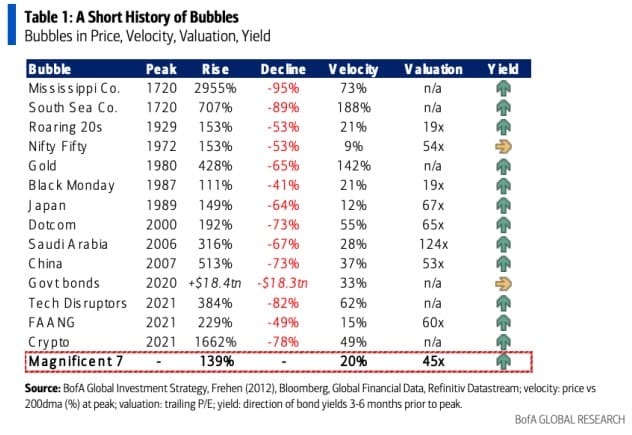
These violent corrections and sell-offs didn’t mean that there wasn’t underlying value in many of the stocks or markets that got pummeled. Rather, these corrections are just examples of markets that were insanely priced for a while.
For sure, AI is here to stay. It plays a growing role in education, healthcare, finance, law enforcement, education, e-commerce, social media, robotics, gaming, fashion, smart homes, travel, agriculture, banking, marketing, and manufacturing. Like other things, it will be used for good purposes, and it will be abused. The abuse doesn’t mean that it doesn’t have great value. At the same time, however, its beneficial applications don’t mean that the stock prices of the leading companies behind AI can only go up.
Nvidia, for sure, is a pioneer and leader in artificial intelligence. Their technologies are used in a variety of computing and generative AI applications. The company’s evolution from gaming to AI is, in a way, a natural evolution, as it specializes in the design of processors and chips, including graphics processing units (GPUs) for the gaming markets. This technology has found new applications, as its chips are used to train and run a number of large language models. Its data center revenues have grown substantially, and the company has invested heavily in research and development as part of its plan to expand and strengthen its product range.
The company has two main segments: “graphics” and “computer and networking.” The graphics segment has a heavy focus on GPUs for gaming and PCs, virtual GPU software (with applications for virtual computing), and IT entertainment systems. Its computer and networking area includes the products developed for AI and machine learning activities within cloud, edge, and data center environments, as well as processors with autonomous vehicles and robotics applications.
Nvidia does have competitors, including AMD and Intel, as well as Google and Microsoft. AMD and Intel are competitive suppliers of discrete and integrated graphics, and more competitors are sure to emerge. Regarding accelerated computing solutions, there are many startups specializing in AI chips. Gigantic tech firms like Alphabet and Google are starting to innovate in the AI chips space, while companies such as Qualcomm, Broadcom, and Tesla are also making inroads. Microsoft is investing huge sums in the AI space as it believes AI is the defining technology of our time. Microsoft has led with alliances and partnerships with OpenAI and the integration of ChatGPT tools used in research. They are also rethinking cloud infrastructure and seeking ways to further optimize their delivery of hardware and software services.
In fact, the world’s giant technology companies are all racing to become leaders in AI, and I would never bet against them over the long run. Google has invested heavily in self-driving technology through Waymo, and it reconfirmed its commitment to deep learning when it purchased DeepMind. DeepMind has learned how to play dozens of Atari games, and its AlphaGo program was the first to beat a professional player at Go. Its Google Duplex is another innovation that uses natural language processing. With an AI interface, it can schedule appointments and make phone calls. Google is also integrating AI and machine learning into its basic operations.
AI is being used extensively by e-commerce platforms such as Alibaba. You may not be aware that Alibaba sells more products than Amazon and eBay combined!! Alibaba uses artificial intelligence in its daily operations to predict what customers might want to purchase. It also uses natural language processing to generate product descriptions for its sites.
Alibaba also has a project called City Brain, which it uses to design smart cities. The project uses AI algorithms to help reduce traffic jams by monitoring millions of vehicles in the city. This same technology is also being used to help farmers monitor crops, improve yields, and cut costs.
Amazon is another heavy user of artificial intelligence. Aside from its digital voice assistant, Alexa, Amazon uses AI actively in its regular business operations. In fact, Amazon is so confident in its analysis of people’s buying habits, that it even ships some items before they have even been ordered!! Amazon uses this technology to recommend items to people even before they realize they might want the items or need them. Their stores use AI to track items and goods and integrate the monitoring of customers with its cameras to accelerate the purchase process.
If you want to consider a technology with scary applications, consider the voice cloning capacity of Baidu which needs a total of 3.7 seconds of audio to clone any voice!!
Facebook, Apple, IBM, Microsoft, and others all use artificial intelligence actively in their business operations. They use this technology in a wide variety of ways, and their resources to develop new applications and new technologies are astounding. Just as Tesla had a big advantage in the electric car space by being a first mover, so too does Nvidia have an advantage in its niche. Being a first mover, however, doesn’t mean that other formidable competitors won’t arise and take away significant market share. It also doesn’t mean that the stock price can’t languish for a long time as fundamentals catch up with the technical conditions in the market. We saw this pattern play out in Tesla, and at some point, we will likely see something similar in Nvidia.
The list in Table 1 above is far from comprehensive. Below is another chart that includes a few of my other favorites such as the housing bubble, ARKK, and the Asia bubble.
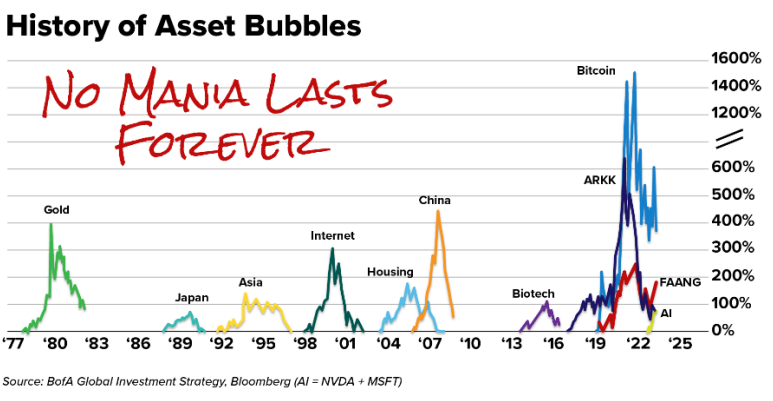
My all-time favorite was probably Tulip Mania during the 1600s in Holland when people literally went mad with a crazed desire for tulip bulbs. They traded their homes for one prized tulip bulb. They swapped 1,000 pounds of cheese for a single tulip bulb. Eventually, the economy collapsed, the mania passed, and people slowly started to rebuild their ruined lives.
Looking at Nvidia, I wonder how steep a correction we might see. The stock traded in October of 2022 at $108 per share. Sixteen months later it is trading at $730 per share with a market cap of $1.8 trillion. In 2024 alone the stock is up over 50% -- with no news! Is Nvidia a great company? Yes. Am I nervous about being long right now? Very much.
Nvidia has been investing in other technology companies. We recently learned, for example, that it has stakes in Arm Holdings (ARM), Recursion Pharmaceuticals (RXRX), and SoundHound AI (SOUN). ARM licenses its semiconductor chip designs to other companies, and this company seems to be doing very well. Nvidia tried to acquire ARM a few years ago, but that transaction was blocked for regulatory reasons. RXRX is an early-stage biotech company that uses AI to process genetic data and find new drugs. The company seems quite interesting. SOUN offers an AI voice assistant that seems quite similar to what other tech companies already offer. These are interesting side plays that prove to be important over time, but right now, they are scarcely rounding errors. In any event, Nvidia’s profit margins are terrific, but it has to do an awful lot of growing in order to justify anything close to its current valuations.
Below you will find a list of some of my current exposures. Please note that I am not telling you to replicate my positions. Instead, please consider these positions as indicative of the sorts of trades that my shorter-term trend following model might take. I am sure you will see that my short-term trading positions don’t necessarily match my longer-term structural views on the markets. As I explained in my prior letters, I run some trend following models that are independent from my longer-term option-based strategies.
These positions can last for a few days, or a few months, depending on the market action. 2023 was a fantastic period for this strategy since we had what was largely a one-way market in many stocks. Right now it is more mixed. I also trade crypto, stock indices, and fixed income markets, but this should give you a good idea of how varied some of my exposures can be…and yes, there are plenty of times when my trend following strategies directly conflict with my fundamental, macro views.
Stocks:
- AAPL short
- AMD long
- AMZN flat
- ANET short
- COIN long (nervously long with a trailing stop)
- GOOGL short
- LEN short
- LLY long
- LULU short
- META long
- MSFT short
- NVDA long (heavily reduced exposure due to volatility…plus a trailing stop)
- NFLX long
- TSLA long (nervously long with a trailing stop)
Commodities:
- Copper long
- Crude long
- Gold long
- Natural Gas (tiny short due to volatility with trailing stop)
Currencies:
In general, I prefer to play in markets that are lively and full of energy. Right now, the currencies are very stable, and I think this stability may persist a while longer. Therefore, I am largely flat. We had some nice trends in January with the dollar’s sharp recovery against the yen and the Swiss franc’s overall strength, but the lack of volatility actually increases the risk in some of the strategies I prefer. The market’s overall short yen exposure is massive, and at some point, I will want to start building a variety of limited risk option positions to play for the unwind of this exposure, but I am not in a rush. The size of the move that I am expecting is so large that I don’t feel any pressure to jump into the market right now.
I will write more about currencies next week. In the meanwhile, I want to wish you all the best of luck in the markets.
Andy Krieger