Markets at a Crossroads: Inflation, Employment Data, and Geopolitical Risks
The Fed’s battle with inflation is far from over, and yielding to political pressure will come back to bite them

There are a number of things I would like to address this week.
In my last write-up I noted that the Chinese stock market would rally sharply on the back of the recent policy moves, and the markets responded with their continuation of a 25% surge. The Chinese market had already exploded off the recent lows when I wrote this, but the move continued. (***See the chart of the Shanghai stock market below.)
Going forward, I have some doubts about whether the policy moves by the Chinese authorities will really solve the massive problems in their economy. Sure, the interest rate cuts and the de facto put on the stock market will support their equity market, but the deleveraging in the Chinese real estate market has cost investors more than $10 trillion.
Monetary policy alone won’t solve this problem. The Chinese must take extraordinary steps fiscally to address this type of crushing balance sheet recession, and so far, they have been quite vague about the precise fiscal policies they will implement. We have learned from the Japanese experience that monetary stimulus has limited power when it comes to fixing deflationary pressures. Even the extreme fiscal measures of the Japanese authorities to supplement their unprecedentedly loose monetary policy have had limited effect on the economy after more than thirty years.

The following chart shows very clearly how the crushing deflation in Japan has still not really normalized. Otherwise, the Japanese authorities wouldn’t be waffling about a possible interest rate hike of 10 basis points. The Japanese companies are extremely efficient, and Japanese investors are very disciplined, but the authorities have left many zombie companies on debilitating life support. This artificial support has sucked a lot of life from the economy and prevented the economy from healing more properly from the bursting of its huge bubble in 1989/1990.

In other markets, we can see that the yields in the US 10-year bonds have continued to go higher. In fact, the Fed’s 50 basis point interest rate cut proved to be an important bottom in yields for the time being. The Fed could not have timed their move more perfectly at being a prescient counter-indicator for sharp moves in interest rates. The market had anticipated the Fed’s move and aggressively bought bonds prior to the well-telegraphed rate cut. Financial conditions were already loose, but the Fed’s move has triggered some dangerous animal spirits which could haunt the Fed if inflation starts to pick up again.
Bonds have been aggressively sold since the Fed’s hike, and today’s employment data should surely have the Fed worried because price pressures in wages came in much stronger than expected. The recent 15% surge in oil prices is yet another problem to which the Fed has to be sensitive, as this is exactly the sort of price pressure the Fed doesn’t want. Frankly, the market really got ahead of itself by anticipating too aggressive a stance by the Fed with regard to future rate moves. Powell poured cold water on those expectations when he spoke earlier this week, and the selling in the bond market continued. The escalation of fighting in the Middle East is reinforcing the sharp rally in oil which was long overdue, and this in turn is forcing people to rethink whether in fact inflation is really going to continue falling as the authorities are promising. Below you can see how the rate cut by the Fed last coincided with the low in yields for the 10-year bonds.
In fact, today’s employment data confirmed what I have been warning about for months – the Fed’s battle with inflation is far from over, and their yielding to political pressure to dramatically cut rates will come back to bite them. Bringing down inflation in an economy is always a tedious task as the forces that drive prices higher are typically self-reinforcing.
Costs go up – whether for supply reasons or demand reasons – and that creates a vicious circle. Wages are in turn forced up to help compensate for the higher costs, which leads to further price rises.
I expect inflation to be remarkably stubborn over the coming months, and there is a decent chance that a very nasty cycle might reignite another cycle of price pressures. The aggressive stance of the dock workers on strike is the sort of pressure that makes inflationary pressures hard to conquer. The idea of a soft-landing sounds good, but it is very hard to achieve under the best of circumstances. It is even trickier to achieve given the heightened geopolitical risks, the massive deficits, the political goals of both parties to spend money they don’t have, the housing crisis with houses currently being the least affordable ever, and a host of other challenges.
I also wrote about Bitcoin last week and repeated my big picture view that overall, Bitcoin is preparing for its next major rally. The market has in fact been quite choppy since my article was released, and it seems the market has a bit more work to do before it can really take off. We are still more than 17% above the recent lows in September when I suggested that my readers re-establish the longs which I told you to liquidate when we were trading around the $70,000 level, but we need to be patient. My overall view remains unchanged, although I was admittedly a bit happier with the price action when the market was a few percent higher as I thought the next acceleration higher may have started.

Otherwise, I suggested that my readers reduce their long exposure in gold as the market seems a bit overdone in the short term. I have no reason to shift my view on this idea. Yes, I still like gold much higher over the long term, but it feels a bit overdone right now. There is a good chance that the correction we get in gold proves to be more of a sideways consolidation rather than a sharp price sell-off.
As you have probably noted, I believe strongly that gold is still the best benchmark for price stability, and I don’t see a simple road map to long term price stability given our government’s irresponsible fiscal habits. Moreover, our political leaders do everything possible to avoid taking the hard decisions to fix problems properly as these decisions are typically politically unattractive. The Fed of course plays a role in this bizarre process, supporting growth at the expense of price stability whenever possible. Otherwise, they never would have waited so long to hike rates in 2022 or moved so aggressively recently to preemptively cut rates long before we reached their established target of 2% inflation. Put more simply, they hike rates too slowly and cut rates far faster and far earlier than they should because these are the popular things to do. There are many reasons for this, but I would prefer not to go into them at this time.

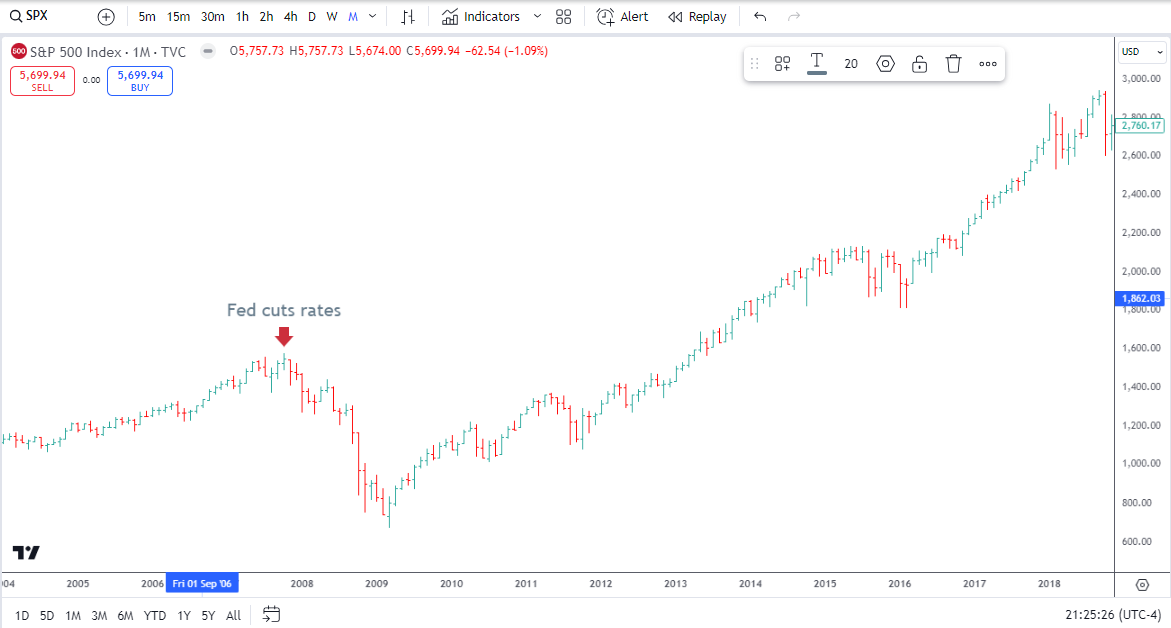
Below you will see a chart that I really hope is not an accurate predictor of future price action. Exactly seventeen years ago to the day, on the 18th of September, the Fed cut interest rates by 50 basis points. Interest rates in fact headed much lower over the following years, but so too did stocks. The Great Recession followed and the global financial system was really brought to its knees.
Knowing that I like to look at the value of different assets in terms of gold since fiat money clearly has lost a huge percentage of its original buying power over the years, I thought you might find the following chart to be very interesting. It shows the value of the S&P500 in terms of gold. Looking at the stock market in this way really puts things in a different perspective. The great bull market in stocks hasn’t really been so great after all when we consider the actual buying power of the stocks, adjusted for inflation.

Overall, I stick to my big picture view that the stock market is going to have a major sell-off once the euphoric buying of the market is exhausted. Because our bets were structured as zero cost trades, we remain quite relaxed about the idea. It remains to be seen whether today’s strong employment data will be revised lower, like essentially every prior month. For sure, the pace of hiring has slowed, but so too has the pace of firing. In other words, the unemployment rate of 4.1% or 4.2% is likely to stabilize for a while around the current level. The stock market is priced to perfection, and perfection is rarely achieved. There are many, many things which could get the market tumbling lower, but unfortunately my crystal ball is not telling me which one of them is going to be the trigger. Whether it be a surprising surge in bond yields, geopolitical developments, political developments, some shocking growth disappointments, a resurgence in inflation, or one of many other possibilities, the risk is real and not a low probability given the extreme overvaluation of the market.
With our trading, we are primarily focused on a variety of anomalies in the options markets, taking advantage of some technical inefficiencies in S&P500 index options, as well as the options of a number of individual stocks. There are more than enough opportunities for us to earn excellent risk-adjusted returns by focusing our trading on these shorter-term option plays, so we are able to put some of our longer-term, big picture views on the side and patiently wait for things to play out.
In the land of currencies, dollar yen is still in it is corrective mode, correcting the violent drop from 161.95 to 139.60. Once this correction is done, I will share with you a few simple trade ideas to benefit from an anticipated drop to the 127.50 level.
In the meanwhile, I wish you all the best of luck with your trading.
Andy Krieger