Surprising Correlations Show Speculative Forces Ruling the Markets
The price patterns are shockingly similar. Clearly, we have some massive speculative forces ruling the markets right now.
Last week was certainly an interesting one in the equity markets, but extremely boring in the currencies. We saw Nvidia rally $130 last week on the back of stronger than expected fourth quarter results, and in the process it has catapulted from a company worth $1 trillion nine months ago, to a company worth $2 trillion today. From a purely intellectual perspective, this is fascinating, but it is also very instructive as it reveals an awful lot about what is happening in the markets.
Nvidia’s revenues for the quarter were $2 billion higher than expected, so let’s put things in perspective. Their total revenues for the quarter were $22.10 billion, and their net income was $12.29 billion. Its cloud and AI service revenues were $18.40 billion, a five-fold increase from the year-ago period. These are absolutely solid numbers, and their margins are fantastic. I have to seriously question, however, whether a company that earned $12.29 billion in a quarter is truly worth $2 trillion. The assumptions that are layered into that valuation are astonishingly optimistic. Moreover, I have to seriously question why Nvidia’s earnings triggered an increase in capitalization in one day of just seven companies of nearly $550 billion (Nvidia, MSFT, AMZN, META, APPL, AMD, and Broadcom).
As I have pointed out several times, AI is definitely here to stay, and Nvidia’s technology is the clear market leader right now. Its GPUs are in high demand, and the orders will continue to increase and flow in over time. Please consider the following charts for a moment, however, as they will help you understand the points I am about to make regarding what is truly happening in the markets right now.
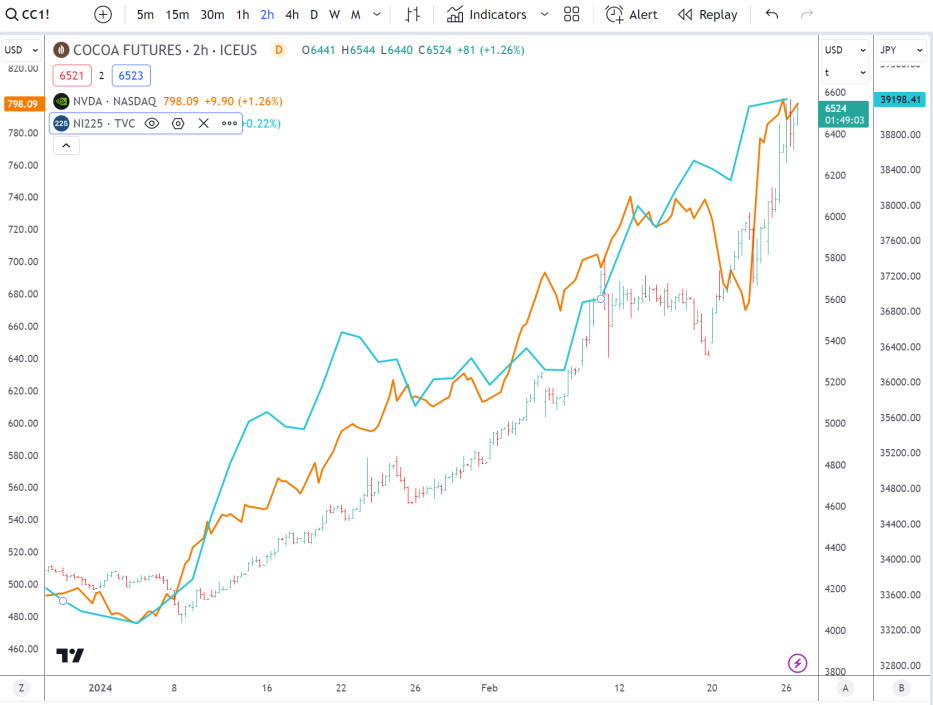
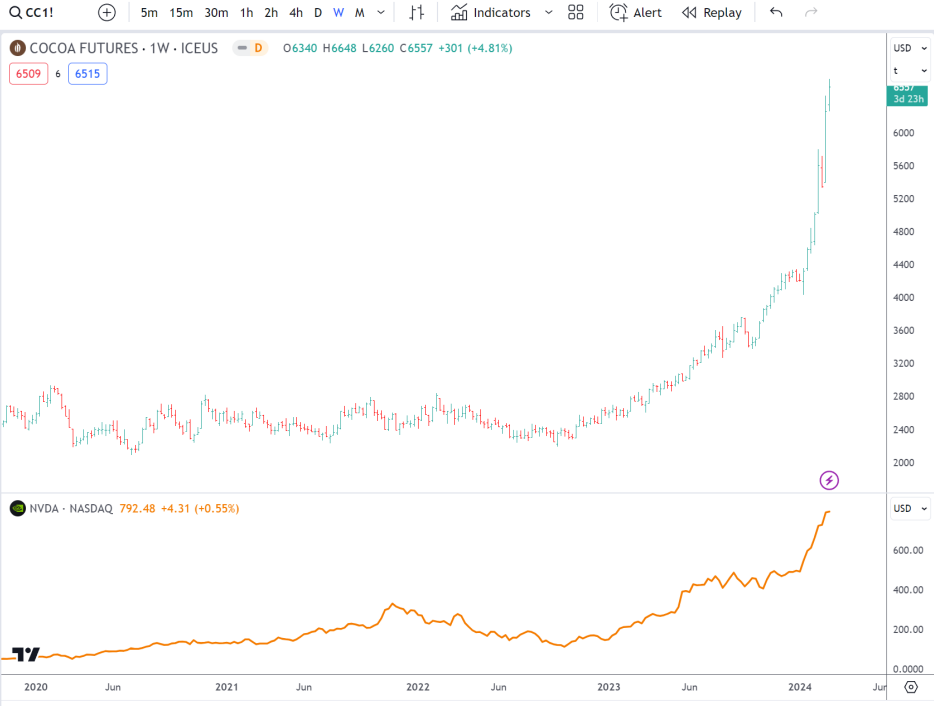
In the first chart, you will see the price histories of Nvidia, cocoa futures, and the Nikkei. As you can clearly see, the charts of each instrument are remarkably similar. You might ask me what Nvidia and cocoa futures have to do with one another, and I will tell you that they have essentially nothing to do with each other. I will say the same thing about the Nikkei and cocoa futures. They are traded on exchanges, and they are driven by market forces, but otherwise, there is no obvious connection. It is not as if cocoa supplies have anything to do with the gaming industry or AI except to the infinitesimally small extent that some gamers and users of AI might like chocolate.
Is there any obvious correlation between the Nikkei and Nvidia? Not really. Sure, some Japanese companies might be clients of Nvidia, but the price patterns suggest a very direct correlation exists.
So what is happening? It is simple. The markets right now are clearly being driven by liquidity and momentum. Fundamentals and market valuations are diverging more and more, and that is a very dangerous situation. In fact, what this simple chart illustrates is that the Fed’s notion that current monetary policy is somewhat restrictive is an utterly false narrative.
The next chart is further illustrative of this point. The chart shows the relationship between 2-year yields in the U.S. and the S&P 500. Normally, I might expect the price patterns to be inversely related, as they were in the late fall of 2023. Interest rates were declining, and the stock market started to rally. That seemed logical enough.
The Fed minutes and Powell’s comments in mid-December gave the market further ammunition to start betting on a series of interest rate cuts in 2024. Interest rates started to drop faster, and the rally in stocks accelerated. At one point the market was pricing in six or seven interest rate cuts in 2024, so some equity strength made sense to the extent that lower interest rates can be expected to fuel economic growth and higher stock prices. At the very least, lower interest rates can be expected to generate a higher expected price based on the discounting of expected future earnings with a lower interest rate factor. What we are seeing, however, is extraordinary. Market expectations about rate cuts in 2024 have been aggressively pared back, so even though expected rate cuts were the original catalyst for a stock market surge, the market has continued to explode higher. If you ever wanted to see a perfect illustration of a speculative market, here it is. One reason is as good as the next to keep chasing the prices higher and higher. It won’t really matter what the reason is – until it all ends in tears.
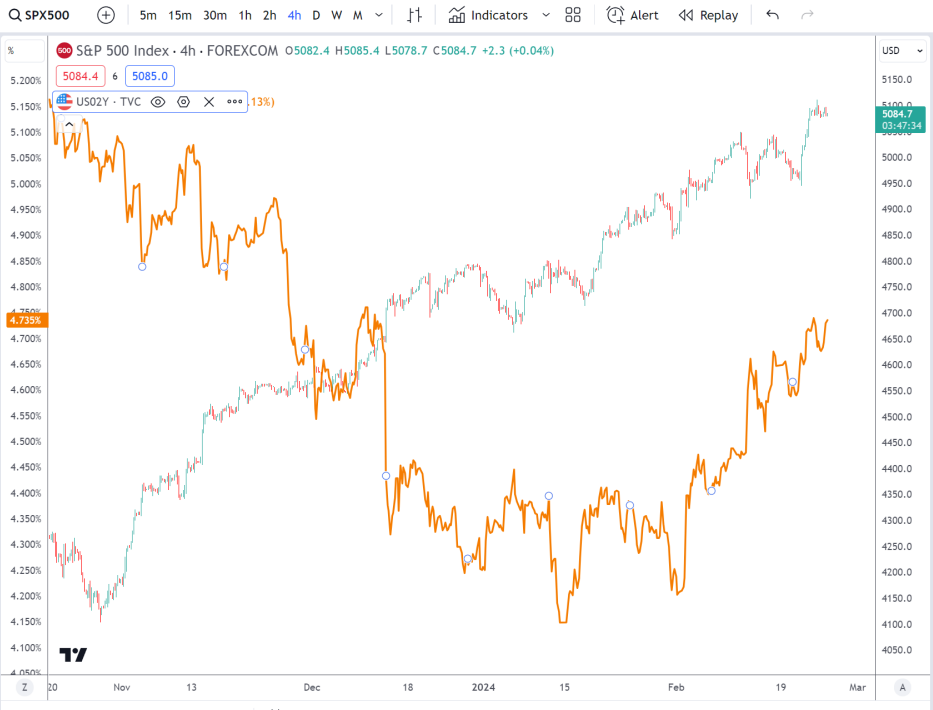
As you can see, in 2024, the correlation completely flipped. We have seen the two-year yield rise sharply, by roughly 60 basis points, as stocks have surged higher. This is not a normal phenomenon unless the economy is perhaps emerging from a very serious downturn, with rising rates marking the end of the deep recession. That is clearly not the current situation.
There is also something else going on. We currently have full employment, and the economy is chugging along at a fast clip. Clearly, monetary conditions are anything but restrictive right now. In fact, I would maintain that the booming equity markets are throwing the Fed’s equation about monetary conditions on its head. The markets are behaving as if we have loose monetary conditions – much looser in fact than a mere 60 basis point rise in two-year interest rates. This creates a conundrum for the Fed.
Not only do looser financial conditions in the current environment lead to sticky inflation – or perhaps even a reignition of inflation – but they also lead to dangerous market conditions in which market valuations are totally divorced from fundamentals. This in turn can lead to a financial collapse. We have watched this dynamic play out over and over in the markets as bubbles burst and the real economic fallout can be devastating.
The Nikkei collapse in 1989, for example, led to 34 years of economic stagnation and deflation in Japan despite nearly unimaginably vast monetary stimulus by the Bank of Japan. The dot-com crash in 2000 was another situation that led to serious economic fallout, and the Great Recession after the subprime debt crisis nearly crashed the entire global financial system. The Fed needs to address the current situation, and they need to address it quickly before it leads to something a whole lot worse than a correction in some overvalued tech stocks.
The current situation in the US with commercial real estate could easily escalate into a widespread banking crisis if the US economy were to suffer a sharp equity market “correction” that spills over into the banking sector. Private sector credit card debt has exploded higher, and delinquencies are surging. If things get ugly, then the Fed would almost certainly want to reactivate its Pavlovian response to economic problems and resort to Quantitative Easing.
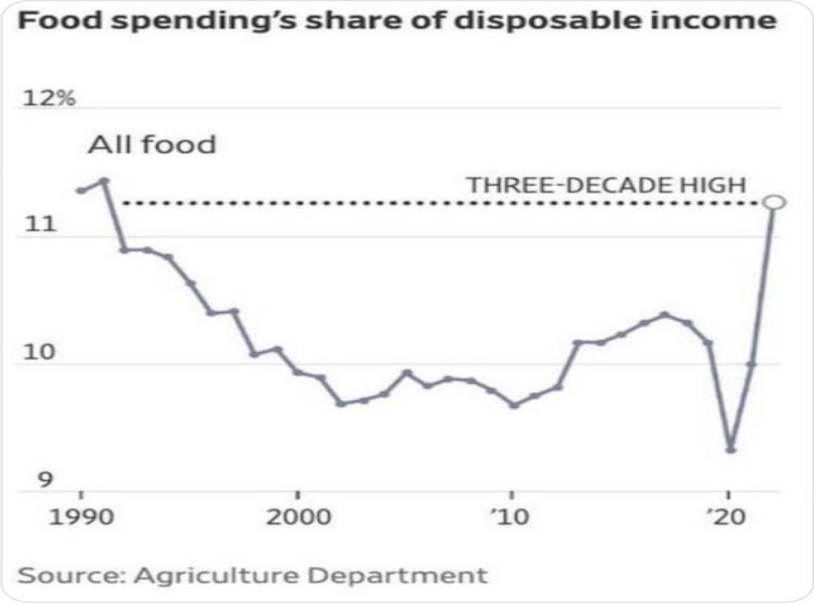
But can the Fed really afford to do this when inflation is far from tamed? Yes, inflation has been on a downward trajectory for the past year, but I have long maintained that the final push to the Fed’s arbitrary – and dubious -- 2% inflation target is the hardest part of the journey. Food costs are now at a three-decade high, and housing costs are still very high despite the Fed’s efforts to squash the inflationary pressures due to rising rents and house costs. In fact, the Fed is caught between a rock and hard place right now, and they need to walk a very delicate path. If they ease too soon, they will surely reignite inflationary pressures. If they wait too long, they might face a crash. All the talk about a soft landing is premature, and the wild rise in equity valuations is only complicating the situation.
I am not saying that Nvidia or the S&P 500 is about to crash. I am saying, however, that the enormous sums of money that are chasing the market higher are indicative of a growing problem that is exceedingly dangerous. There is clearly too much liquidity in the system right now.
As a speculator, I have started to lightly allocate some capital towards some limited-risk trades that will make excellent returns if we have even a modest correction in the high-flying stocks over the next six months. I am waiting for some fresh signals before I more aggressively play for this move. I don’t believe there is any rush.
Some famous investors like Buffett are sitting on record levels of cash right now. Clearly, they don’t see the value in chasing the market at current levels. They have done well with some global diversification towards Japan and elsewhere, but they are going to wait for new opportunities to emerge in the US.
The following chart is illustrative of the problem facing the middle class right now. Food and housing are expensive. This suggests that Wall Street and Main Street are becoming increasingly divorced from one another.
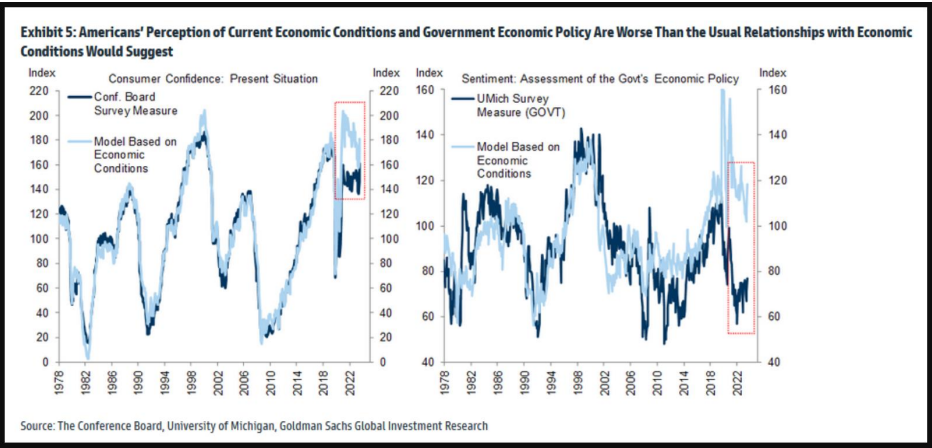
The following chart is also very interesting as it shows a surprising chasm between the perception of current economic conditions and the confidence levels that the economic models would expect. Put simply, people are not nearly as optimistic about economic conditions as we would normally expect given the economic data. This points to a deeper underlying issue, and it will likely play out with some very rancorous political elections.
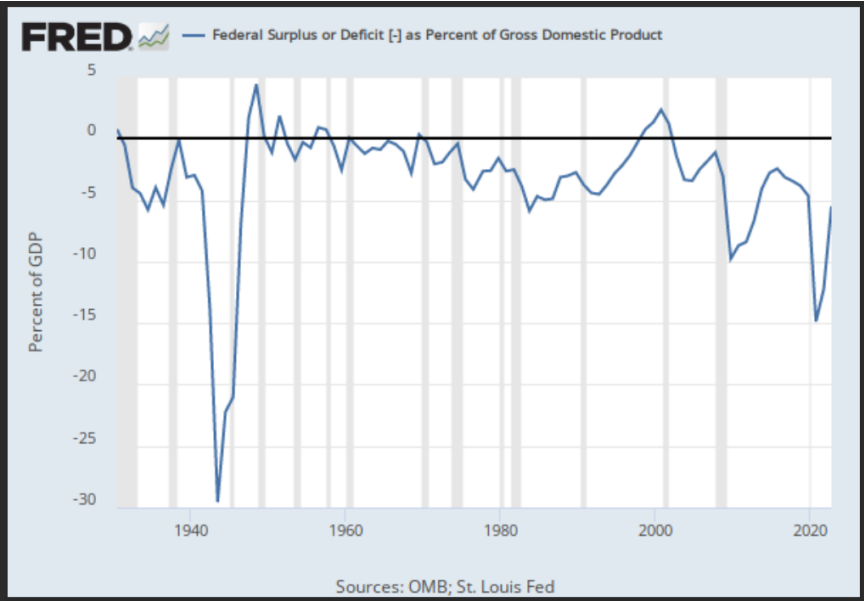
The next chart points out something that is perhaps the most interesting consideration of all. The Federal Government is borrowing money and spending at a rate that is wholly inconsistent with a growing economy that has a workforce at full employment. The current deficit level is dangerous and unsustainable. In fact, it is so extreme that it raises all sorts of unwanted questions about the potential underlying motivations of the people in power. Putting aside nefarious conspiracy theories, at a minimum we can conclude that we are witnessing an astonishing degree of fiscal irresponsibility.
If we do face a financial crisis at some point in the future, and that is nearly inevitable, we would all be much better off if our government had the firepower to step in with massive emergency assistance, rather than spending its fiscal bullets now when they aren’t needed. Unfortunately, the government’s current policies are reducing its flexibility to properly and comfortably address any serious crises that emerge in the coming years.
In terms of my market forecasts, I think my view on stocks is clear. We are in a bubble, but that doesn’t mean that a crash is imminent. The market is being driven by too much liquidity chasing after the momentum rallies.
This same observation holds for other markets right now as well. Speculators are going with momentum-based plays right now, and this will continue until the bubbles burst. What will cause the bubbles to burst? It isn’t clear. The most obvious reason would be some sort of draconian AI regulation, as there are many serious political and social risks associated with AI, but that isn’t necessary. The trigger could just as easily be something seemingly innocuous.
I stick to my longer-term bullish view on gold. It seems to be basing nicely, but for speculators looking to jump on an exciting train, there are plenty of better options right now. My trend-following strategies take care of those trades, so I am freed up to look for other sorts of opportunities.
In terms of currencies, dollar yen is grinding ever-higher in ultra-slow motion. It looks like it wants to try to take out the prior highs around 151.90. Perhaps it will have a bit of a spike higher if it can take out that level, but I am more interested in playing for the downside in dollar yen. It just feels a bit premature. Volatility is extremely low right now for good reason. The currencies are moving in slow motion. That, however, is nearly always a harbinger of hyper-volatility to follow. Once the eventual reversal comes in dollar yen, it will be violent. Volatility will scream higher, but for now, I will sit patiently and allow the trend following strategy to stay long dollar yen for its grind higher.
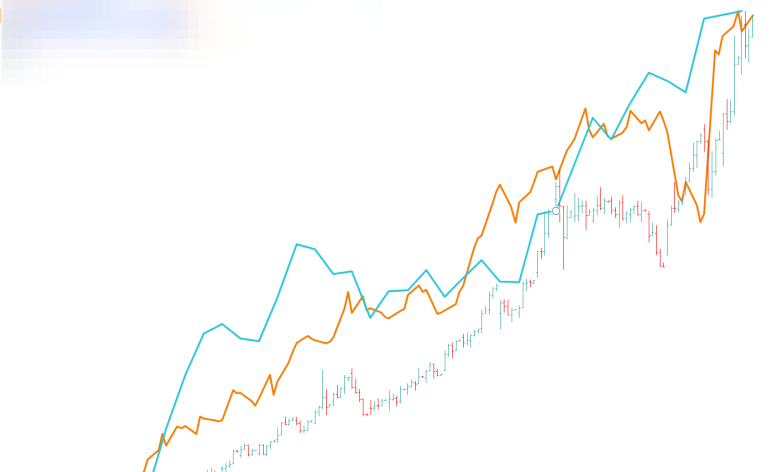
For your amusement, I have added multi-year charts of Nvidia and Cocoa futures. The price patterns are shockingly similar. Clearly, we have some massive speculative forces ruling the markets right now.
Until next week, I wish you all the best of luck with your trading.
Andy Krieger