Not So Merry Mayhem in the Markets

Thoughts on the Market
February 1, 2026
People often ask me what the secret is to making money in the markets. They want to know whether there is a secret formula. Is it a matter of intelligence? Does it require superior information? The questions go on and on. I find this topic fascinating, so it has captured a lot of my attention for the past forty years
This statement might either disappoint you or encourage you, but here’s the truth as I see it: making money in the market is a lot simpler than you might think. You don’t need to have an incredibly high IQ. Sure it helps to be bright, but It doesn’t require the astonishing intellect of a Jim Simons, the founder of Renaissance Technologies who personally earned tens of billions with his firm’s trading. (Simons was incredibly smart, having mastered advanced mathematics with pioneering work in geometry that earned him a place in the National Academy of Sciences.) You also don’t need to have the greatest technology and information flow, and you certainly don’t need to complicate things.
In fact, making money in the markets is more about having a disciplined approach and commonsense assumptions about market behavior and market price action. Successful trading also requires you to pay close attention to the market’s signals, so you can act on them when they line up. Another key characteristic of a successful trader is that they have a very healthy dosage of cynicism; this allows them to ignore the market views of the so-called pundits who go on TV and tout the wonders of various companies or markets. Profitable trading also requires an even healthier level of cynicism when it comes to listening to the words of market leaders -- the CEOs and CFOs of the major companies – because with this group, it’s their behavior that tells us everything, not their words.
To explore these basic rules a bit further, I’ve laid out a few simple observations that have allowed me to generate my trading profits over the years. I can assure you that if these observations are cleverly applied with the right risk management, you can make a lot of money without the fear of blowing up your accounts and losing your principal. Yes, you’ll have some losses and drawdowns along the way, but they won’t be catastrophic.
Key Rules
Rule Number 1: the only free lunch in trading is diversification.
Rule Number 2: during periods of panic, the correlation of nearly all assets will tend to converge. In other words, in a panic sell-off in stocks, stocks across every asset class will tend to go down in tandem.
Rule Number 3: Fighting momentum is a solvency risk, not an intellectual one.
Position sizing and risk limits matter more than conviction. In other words, even when a market is extremely overbought or oversold, we need to assume that the market can become even more overvalued or undervalued. We also need to assume that the market remain dramatically mispriced longer than we can remain solvent if we fight it incorrectly.
Rule Number 4: major market turns nearly always display shadows that warn us of reversals. With careful observation and analysis, we can nearly always identify a market that is dramatically oversold or overbought, but identifying the exact timing of the reversal is next to impossible. This means we need to be both alert and creative when we try to understand market risks, and we must be ready to act.
Rule Number 5: markets in motion tend to stay in motion for longer periods of time and for bigger moves than we might logically expect given their average underlying level of volatility. This is the key principle to successful trend-following.
Rule Number 6: markets tend to chop around In ranges for roughly two-thirds of the time. This is the key principle to successful mean reversion, counter-trend trading. It’s important to be able to identify when we’re shifting from range-trading to a trend, or vice versa. Recognizing regime shifts is the trader’s primary challenge.
Rule Number 7: don’t rely on the input of others – not even Imre or me! Develop your own rules and principles of trading. The fact is that nearly all day traders will lose the majority of their initial trading capital within one year of trading…so do you really want to follow the herd? (I have advised online brokerage companies who have verified this statistic!) Day traders lose because they trade noise, not structure.
Rule Number 8: we should assume that by the time we – the well-informed but still general public -- get information, it has likely been considered by the major market players. This means that most information we get has been largely discounted, so the savvy trader does not react to news unless it is exceptional.
Rule Number 9: markets have long memories. They will remember important levels from many, many years ago. Multi-year highs and lows, for example, are very important because they act as psychological and structural anchors. Multi-month highs and lows are also very important. Show these levels the respect they deserve.
Rule Number 10: you are never as bad as you think when you’re losing money, and you are never as good as you think when you’re making money. Emotional volatility is more dangerous than price volatility, which makes self-regulation a serious competitive advantage.
Rule Number 11: you can earn excellent returns over time by following simple rules and sticking to them. This is a prerequisite to consistent profit-making.
Rule Number 12: watch the actions of the insiders when you are trading stocks; for example, are the insiders net buyers or net sellers of their company stock? Ignore their words, watch their behavior. Top executives at public companies have to disclose when they have bought and sold stock, and they know the truth about their company’s prospects. Remember: words are noise, but actions are data.
Rule Number 13: See rule #1. And now see it again. It is very, very important.
If you think carefully about these twelve points, you can construct a very solid approach to trading that will survive in almost any market condition. Whether you want to use trend-following approaches or mean reversion strategies, or a combination of both, these rules give you enough guidance to help you figure out some basic trading strategies. And whether you want to trade with options or just futures, with spot or cash, the same rules apply. I’ll come back and revisit these rules over time, but I want to get you thinking about the markets in a different way.
Is Crypto-Credit Contagion Now in Force?
I want to bring your attention back to my write-ups from November 24, 2025 and December 1, 2025. In those Thoughts on the Market updates, I issued very strong warnings, and I believe it is critical that you pay particularly close attention to the markets right now. Bitcoin, which has been the bellwether of equity risk appetite for some time now, has now clearly broken below the critical support of $80,800 that I highlighted, and it is showing no signs of a meaningful recovery.
We are in the midst of the biggest “Everything Bubble” in history, and I maintain that the bubbles in stocks, Bitcoin, precious metals, real estate, and other markets are now at serious risk of bursting. The dramatic collapse in silver and gold last week certainly should give everyone pause and make them think about what might be coming next. Central banks and governments have fueled these bubbles with unprecedented levels of artificial stimulation in the form of monetary debasement and fiscal expansion; erratic government policies simply magnify the risk. For a variety of reasons, the major risk to our economy and financial system is a potential stock market crash, and we are now closer to that happening than most people can imagine.
I believe there are five basic conditions that are required for a stock market bubble to burst. These conditions were all in place in 1929, 2000, and 2007/2008, so we need to take them seriously. These conditions usually occur in stages that can take months, or even years, to unfold before the broader equity crash takes place. These stages involve credit conditions, market concentration, the behavior of major institutions, overall liquidity, and a final trigger – and every trader has the capacity to understand them. Let me explain.
I am suggesting that we can apply a systematic approach not just to trading, but to analyzing macro shifts in the economy and stock market. Anecdotally, we can look at the behavior of Bitcoin: it is a warning that is not just flashing bright red lights, it is blaring ear-splitting alarms. After dropping roughly 37% in just six weeks, Bitcoin staged a near-perfect 38% correction of the first leg down before topping out at $98,000. Now, in just two short weeks, Bitcoin has crashed over 20%, breaking below the critical support I identified at $80,800. This is a warning signal that you ignore at your own peril.
For those of you who somehow missed the insanity of the recent action in the silver market, please have a look at the daily chart. We have just witnessed the largest intra-day drop in silver EVER, when it lost 38.8% last Friday before bouncing back to $85.30.
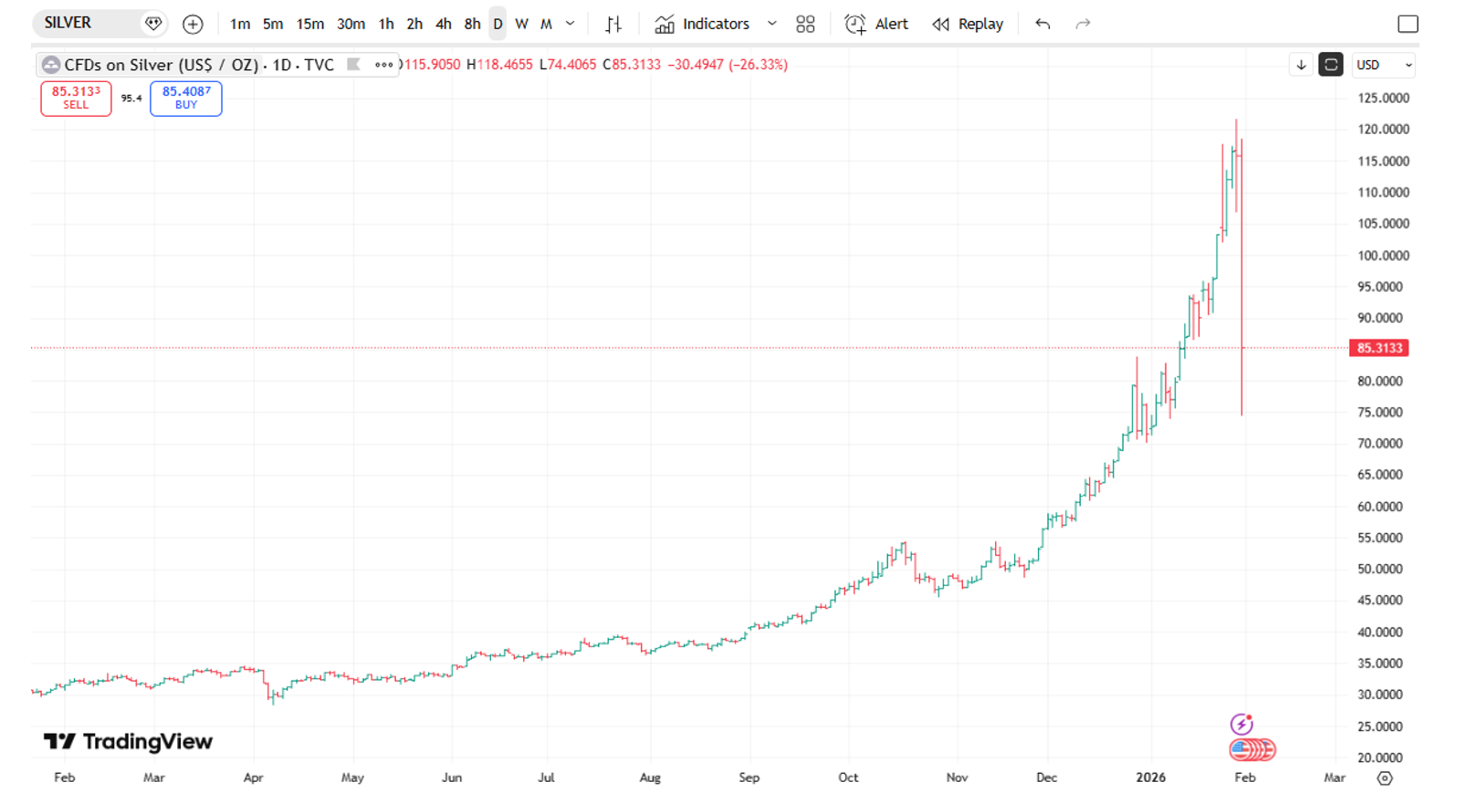
Gold had a parallel drop of 16.5% before staging a modest recovery. These extraordinary moves are further warning signals that the global economy is far less stable than the pundits want us to believe. Let’s have a look at the five factors that manifest in basically every major stock market crash.
Stage I: Excessive Credit Expansion
At $38.5 trillion and counting, it is obvious that the U.S. has gone wild with debt. Japan’s debt-to-GDP is even more leveraged, but the rest of their economy is far less leveraged than ours. Put simply, in Stage 1 governments, companies, and individuals borrow money faster than they can possibly repay except under perfect conditions that must be sustained for a long time. Excessive borrowed money has been used to leverage the asset markets, which has driven market prices to highly distorted levels of overvaluation.
The higher market prices lead to additional paper wealth, which in turn leads to additional borrowing – a very dangerous path can lead to widespread financial ruin at a whiplash pace when asset prices reverse sharply. While there were different underlying conditions leading to the credit expansion and subsequent stock market crash, this condition was a critical factor in 1929, 2000, and 2008. It makes no difference whether the borrowing was achieved via equity purchases on margin (1929 – when margin rules let people put down just 10% to buy stocks), corporate debt (2000 – when companies with insufficient profits borrowed huge amounts of money to fund corporate expansion), mortgage debt (2007 – when banks and investment banks created exotic structures that let people buy homes without making a deposit), or various forms of debt (today with the frightening amounts of collective debt in the form of equity margin, securities debt, leveraged exposure through the options markets, corporate debt – which has exploded --and government debt, which is wildly out of control). The bottom line is that Stage 1 is fully in force.
Stage 2: Concentration of Risk
It is blatantly obvious that the U.S. stock market is terrifyingly over-concentrated in just seven massive companies. The so-called Magnificent Seven carry a staggeringly disproportionate share of the market’s total value. A serious stumble by even just a few of these companies can easily drag the entire market lower. We had similar concentrations of risk in the three prior crashes I mentioned – 1929, 2000, and 2008 (when the concentration of risk was held by a handful of banking entities through their derivative exposures). Stage 2 is fully in force.
Stage 3: Quiet Liquidations of Holdings by Major Players
In this stage, the family offices, corporate insiders, top bankers, mega-wealthy investors, and others quietly reduce their exposures while often publicly touting the strength of the market and the very positions that they are selling. This has occurred in each of the prior crashes, and it is occurring now. If we just look at 2007, we know that hedge funds were shoring sub-prime mortgages a full year before the crash. In fact, Goldman was shorting the very structures that it was selling. With my own trading, we focused on heavily leveraged long option plays on dollar yen at that time as we knew very well what was happening. It allowed us to generate over 300% net profits that year and earn over 70% the following year when the entire financial system was cratering. We also did very well during 2000 as we had sufficient warnings from our network to be very careful.
Going back nearly a century, in 1929 many famous investors were largely or entirely in cash before the crash. For example, the Morgans, Rockefellers, Kennedys, and Bernard Baruch had liquidated most, if not all, of their stock positions before the October crash. (Joseph Kennedy famously liquidated all of his stocks when his shoeshine boy advised him to buy stocks – but he had already been selling his holdings.) In the current market, Board Members, CEO’s, CFO’s, and other insiders are selling their stock at record levels. At the same time, retail traders are pouring record amounts of money into the stock market When the actions of people on the “inside” warn us that things aren’t so rosy, we should listen.
Stage 4: Liquidity Conditions
With the stock market’s record volumes it appears that there is fantastic liquidity in the market today. I believe that is an illusion, and that the reality can become very harsh very quickly. Consider the following: investors were buying gold and silver in record quantities, presumably as a hedge against the stocks that they were buying. Likewise, they were long huge amounts of Bitcoin as a further hedge. How did that work out? (Remember, stocks can climb steadily up the stairs, but when they fall, they go down the elevator – or in a worst case, they go down the elevator shaft.)
My contention is that these hedges are not hedges at all. In fact, with further liquidations in gold, silver, and Bitcoin I would expect the forced sale of tremendous amounts of stock as the hedges become liabilities. Unless Bitcoin recovers quickly, I expect that market to slice through support around $74,500 and start to tumble aggressively towards $50,000. These are not fresh forecasts. I have written about this for months, but unfortunately, it looks like things are playing out now.
Stocks have made marginal new highs this year, but as I have noted, the upwards momentum is fully absent, and the downside market risk looks more and more ominous. I would have preferred a sharp rally towards 7300 or 7400 in the S&P500, but that seems less and less likely. Selfishly, I was hoping to put on a major, structural long-term short position at those levels. I have put on some short-dated tactical plays in the options, but I’m not ready to commit to a major short quite yet.
Stage 5: The Trigger
The only thing missing from the perfect set-up for a market crash in Stage 5 is the trigger. The trigger can be economic, political, geopolitical, or environmental. The actual trigger that gets us to this final stage is not important, and it is of course possible that the market will continue to muddle along for a long time without a trigger and subsequent crash – but we are frighteningly close to a major stock market crash, right now. Economic journalists like to refer to so-called Black Swan events that cause crashes, but crashes are not really so unpredictable. The only uncertainty is what the final trigger might be.
Going forward, I will selectively write a bit more about the Key Rules to trading profitably, and of course, there is room in their interpretation for personal preferences. Some traders are patient and are happy to run positions for days and weeks at a time. Others like to focus on just one market at a time. Some like to use options. Some traders are very flexible and can comfortably run a diversified basket of strategies and positions. Some traders want to be in and out of positions in hours or even minutes. Accordingly, it is hard to write one formula, because there are many paths to success. Honing a trading strategy is a personal endeavor that needs to be carefully crafted with full awareness of the individual’s strengths, weaknesses, goals, and tendencies.
As I mentioned last week, my partner Imre Gams is joining me in presenting Thoughts on the Market. Imre is a remarkably insightful trader, and I have long admired his ability to see powerful correlations among data that might otherwise seem disparate and disconnected.
Below, you will find Imre’s latest technical forecasts and associated analysis. His work is world class, so it is well worth your time to study it carefully.
In the meanwhile, I wish you all the best of luck as you navigate these very tricky waters.
Best regards,
Andy
Here are links to this week’s market analysis and technical charts from Imre:
USD/JPY: https://www.tradingview.com/x/OYQjplAJ/
https://www.tradingview.com/x/9bTibX3E/
Gold: https://www.tradingview.com/x/K0ZYC4oT/
S&P 500 Futures: https://www.tradingview.com/x/pTDHezyT/