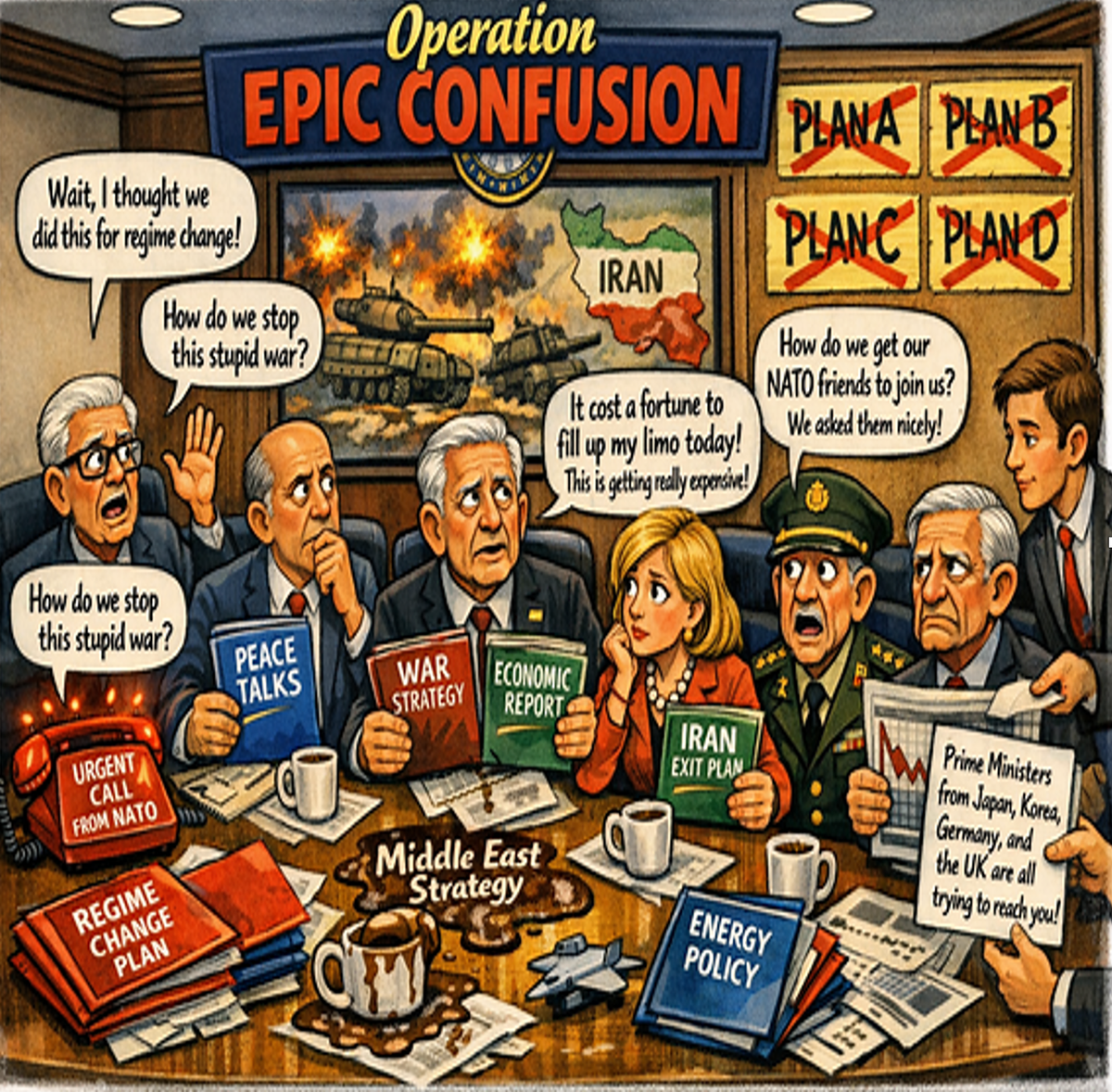
Operation Epic Confusion
Thoughts on the Market
March 24, 2026
On February 28, 2026, following orders from President Trump, the U.S. initiated attacks on Iran in a military operation labeled Epic Fury. The U.S., alongside Israeli partners, conducted massive airstrikes on various Iranian military and nuclear-related infrastructure. The stated objectives of the operation were unclear at the beginning and have shifted regularly, but the impact on the markets has been consistent. Simply put, the markets are very, very unhappy with the war, and it has become increasingly clear that a long-term extension of the hostilities will be economically catastrophic on a truly global scale.
Since the war started, oil prices have jumped by more than 50%, stock markets have come under heavy selling pressure, weakening by more than 6% prior to the short-squeeze yesterday. Gold – a traditional safe haven asset -- has weakened by more than 20%, and U.S. treasuries -- another traditional safe haven asset -- have likewise been crushed, with 10-year yields rallying by about 10%. Traditional hedges haven’t worked, and portfolio managers have become increasingly alarmed.
When the war started, the initial announcements coming out of Washington told us to expect fighting to last just a few weeks, with complete regime change in Iran all but certain. Clearly, the situation is far messier and far, far more complicated than U.S. leaders seemed to expect. It is obvious that the current administration was hoping for a quick win, expecting Iran to comply with U.S. demands for a near-immediate surrender and a complete change in leadership – to a secular, Western-favoring regime -- to quickly follow. By now, Washington is well aware that this capitulation is not happening, so the president has a problem: how to best extricate the U.S. from an ill-planned war.
Unlike prior situations (such as the cancellation or reduction of excessive tariffs), the decision is not entirely up to Trump. Even if he wants to chicken out, it isn’t quite so simple. Iran might want to extract a few pounds of flesh by continuing the blockade of the Strait of Hormuz, except for its allies. After all, Iran was attacked without provocation, so their trust level in the promises of the U.S. will be matched by their willingness to throw the U.S. and its allies a lifeline: exceedingly low.
Iran’s blocking of the Strait of Hormuz is immensely important due to its critical global role in the supply of oil, natural gas, and a host of by-products that are critical to keep a modern life moving, such as fertilizer and chemicals needed to produce microchips. With more than 20% of the world’s crude oil and natural gas flow through those waters, the long-term closing of the Strait to regular commercial traffic will have far-reaching, destructive effects on the global economy. Clearly, the U.S. did not anticipate Iran’s willingness to withstand a brutal military assault, although as you will see, I really don’t understand how the U.S. could have so catastrophically miscalculated Iran’s strategy vis-à-vis the Strait of Hormuz.
If you read this excerpt from my June 19, 2025 newsletter, you will see why I think Iran’s actions have been totally predictable:
“There remains a great deal of uncertainty as to how the situation with Iran plays out, but it is very easy to imagine a scenario in which a desperate Iranian regime tries to create global chaos by blocking the Strait of Hormuz, at which point we could even see oil prices over $100 per barrel.
If Iran were to block the Strait of Hormuz, the global markets would likely experience immediate and significant turbulence. Here's how the shockwaves would ripple:
1. Oil Prices Would Surge
Roughly 20% of the world’s oil and a substantial share of liquefied natural gas (LNG) pass through this narrow waterway daily. A blockade -- even a partial one -- would choke off supply, triggering a sharp spike in crude oil prices. This would hit energy-importing nations hardest, especially in Asia and Europe.
2. Energy Markets Would Scramble
Countries like China, Japan, India, and South Korea, which rely heavily on Gulf oil and LNG, would face immediate supply concerns. Strategic petroleum reserves might be tapped, and alternative shipping routes or suppliers would be sought -- though few can match the volume that flows through Hormuz.
3. Stock Markets Could Tumble
Global equities would likely react with volatility and sell-offs, especially in sectors sensitive to energy costs like transportation, manufacturing, and airlines. Safe-haven assets like gold and U.S. Treasuries would likely rally.
4. Shipping and Insurance Costs Would Rise
The risk of navigating the Gulf would skyrocket, leading to higher insurance premiums and rerouting of vessels. This would disrupt not just oil, but also global trade flows, adding to inflationary pressures.
5. Geopolitical Risk Premium Would Expand
Investors would price in the risk of broader conflict, especially if the U.S. or allies respond militarily.”
Surely, if a Sanskritist like me could forecast the recent developments over nine months ago, the United States, with its unparalleled military and intelligence capabilities, should have known what to expect when they attacked Iran. Other than a clumsy attempt to gain political momentum for the November midterm elections, I seriously can’t figure out what the U.S. administration was thinking when they launched Operation Epic Fury. Iran’s leadership is driven by a resolute ideology; they would rather die as martyrs than bow down to the U.S. and Israel, countries they view as evil manifestations of Satan. If the U.S. administration was assuming that most Iranians hold western values and think using western logic, they seriously missed the mark.
Since the war started, news has been flowing at a furious pace, with contradictory statements coming one after another. Trump has bounced us back-and-forth with declarations of total victory, followed just hours later by threats of massive escalations. Trump told us he has no interest in signing a truce since “the U.S. has crushed them in the war” right before issuing ultimatums. He has also launched into periodic attacks against our allies, calling them cowards for their resolute determination to not get militarily involved. The U.S. also telegraphed their real concerns with bizarre policy moves such as removing sanctions on Russian -- and most astonishingly, on Iranian oil -- while funding and operating military attacks against both nations. It is obvious to all that the U.S. is desperate to get the unencumbered flow of oil moving again. What is not so obvious is how so many (allegedly) smart people could have miscalculated so colossally.
Clearly, confusion and concern seem to abound in the administration, so the most recent developments were not totally unexpected. Three days ago the U.S. issued an ultimatum in which they threatened to decimate the Iranian gas fields and Iran’s domestic power infrastructure “within forty-eight hours” if the Iranians failed to open up the Strait of Hormuz. Then yesterday morning, hours before the ultimatum expired, the president announced that the U.S. and Iran have engaged in productive negotiations, so the massive attacks on Iranian energy and water infrastructure have been postponed for five days.
That announcement caused stocks to rocket higher and oil prices to quickly crash down from overnight highs, but Iran immediately denied that any such high-level negotiations ever took place, and categorized Trump’s flip-flopping and story-telling as an obvious ploy to try to soothe the deeply unsettled markets. (Taking a page from Trump’s own playbook, one of Iran’s most senior politicians said that “any talk of talks is fake news.”) In the meanwhile, fighting between Iran and the U.S.-Israeli alliance continues unabated: Iran launched missile and drone attacks on Israeli cities and U.S. bases across the Middle East, and Israel is attacking various Iranian locations with full intensity. This is not the behavior of parties who are anxious to work out a peace settlement! It is certainly possible that some discussions have taken place, but not with the relevant decision-makers in Iran.
The actual reason behind Trump’s decision to back down on his ultimatum has more to do with the ever-louder messages from U.S. allies, who have cautioned the administration that the war was quickly becoming a disaster. The pressure on Washington from multiple channels is extreme, and the administration knew that a shift was required, so just as we saw last April, when Trump chickened out on some of his Liberation Day threats, Trump abruptly announced the change of plans. What is clear from this latest development is that the administration cares -- a lot -- about the markets. The challenge going forward will be for the U.S. to find a way to extricate itself from a messy crisis of its own making because Iran doesn’t show the slightest interest in removing the blockade.
If Iran feels like they have the upper hand in this fight right now, they might be right. If the U.S. needs to station battle ships in the Strait of Hormuz to escort oil tankers through, the markets will react very poorly. Crude oil could easily trade above $150 per barrel, and in a way, Iran could bring the global economy to its knees. This is a very dangerous situation, with no apparent way to ease tensions. Shipping companies will clearly be loath to send their tankers through a chokepoint where they are essentially slow-moving targets for missile and drone attacks. The fact that the waters could be filled with mines just makes the situation worse. With such very real risks, Insurance premiums really won’t give the captains (and their crews) much comfort.
I am addressing this chaotic messaging to simply reinforce the point I made on March 3, 2026 when I wrote about adjustments I have made to my trading strategies due to the chaotic shifts in policy coming from the White House. It may be next to impossible to forecast the next policy reversal, but we can feel confident that more policy flip-flops over the coming years will follow. The consistent underlying message through it all is that extreme stock market weakness will be met will a fresh array of conflicting announcements to try to prop it up. I used to write about the Fed put option on the stock market, but we now have the Trump put option as well.
Going forward, how do I see things playing out? With all the conflicting messages and stories, my crystal ball is a little cloudy right now, but I persist with the warning I have provided over recent weeks: the U.S. stock market is dangerously overpriced. Can it trade higher? Sure, but it will likely struggle to do so. If we have a rally to new highs, it is unlikely to be sustained for a long time period.
Rather, I believe that the S&P500 is long overdue for a serious correction. I would expect the minimum magnitude of this correction to be 22% from the recent highs. I am playing the market in the same way I have been playing it for the past year and a half -- by using a variety of shorter-term limited-risk option strategies funded by a number of spread trades that generate a steady stream of monthly income. I use extremely conservative assumptions when I stress-test the portfolio, making sure that it will hold up under all but the rarest events -- events that have either never yet occurred, or have occurred only once or twice in the last hundred years. During recent weeks my bias has been slightly short, but I am largely indifferent as to the direction the market moves. If the market breaks down hard, then my positions become heavily short.
With all that said, I never say never when it comes to markets, so even if I assume that the markets have extremely fat tail statistical distributions, I know that unexpected events can take place that have never before occurred. Please note that I never sell options naked. Rather, I try to structure a portfolio that will generate huge returns if statistically unexpected events occur or otherwise earn steady returns if the markets trade within more typical broad ranges. My partner describes the strategy as a clever way to be paid to buy lottery tickets.
Longer-term, the developments in the Middle East, and the associated U.S. dealings with allies, are making me extremely uncomfortable about the prospects for the dollar. It seems that there is a growing likelihood that currency invoicing in oil trade will progressively shift towards non-dollar alternatives. If this happens on a large scale, the impact on the U.S. dollar could be quite devastating because petrodollars help create a steady demand for dollars and treasuries even as the U.S. fiscal situation continues to spin further and further out of control. I have put on long-dated, tiny dollar bearish option structures, but depending on how things play out, I will increase those bets.
One more point to bear in mind is the current reading of the Michigan Consumer Confidence Index. In November 2025 the index posted its second lowest reading since 1978. The Michigan ICS is one of the longest‑running and most closely watched sentiment indicators in the U.S. It captures:
- Current household financial conditions
- Expectations for the next 12 months
- Longer‑term economic outlook
When it collapses to levels seen only during the massive stagflation of the 1970s, the Great Financial Crisis, and the 2022 inflation shock, then we can safely conclude that American consumers are feeling significant stress. The Index has bounced a bit since the November reading, but it is still frighteningly low. It also happens to be nearly a full 30% below the levels posted during Biden’s presidency. Trump is well aware of this, so he is feeling tremendous pressure to give the economy a big boost. Perhaps that helped inspire the Iran war, but the last thing the U.S. needs now is a sustained inflationary shock due to skyrocketing oil prices because deep consumer stress often precedes economic slowdowns. The last thing any of us want is a period of stagflation with surging oil prices and a slowing economy.
We should have a lot more clarity by next weekend. Until then, I wish you all the best of luck as you navigate these tricky markets.
Andy Krieger
*******************************************
Imre’s Views
My Framework
I treat markets as auctions, not prediction machines.
Most sessions on a day-to-day basis are balanced.
Edges form at the extremes of value.
I trade acceptance and rejection at those edges.
If value migrates, I align with it.
If it fails, I trade the rotation.
I am not in the business of forecasting.
I am in the business of validating participation.6584
_________________________________________________________
Before diving in, a quick housekeeping note. Last week we rolled from the ESH contracts to the ESM contracts. The current chart is back-adjusted to keep price levels consistent. But because the M contracts were trading at a premium to the H contracts, last week's key level of 6584 has shifted roughly 50 points lower on the adjusted chart. Keep that in mind as you read the levels below.
Now, to the action.
Buyers showed up in force at the start of the week. The response to the prior week's selling was impressive. The market rallied straight into the cited upside target at 6769.50.
That's where sellers were waiting. And they didn't waste any time.
Price got driven back down through the prior key level of 6584 and continued lower, printing a weekly low of 6523.75. The week closed at 6588.50 — just a few points above that 6584 level.
That zone deserves your full attention again this week.
The 6584 to 6600 zone is the line in the sand. If sellers build acceptance below it, the next destination is the previously cited target zone between 6483 and 6460. That's where the next meaningful cluster of buyers is likely to show up.
Below there, 6404 stands out as an absolutely critical level. A failure to hold there opens the door to further acceleration lower. If we get a test of that level, we'll address it in detail at that time.
For now, watch 6584 to 6600. That's the number that matters.
Sellers stayed in control all week. No debate, no hesitation. Price moved lower with conviction and hit the cited downside target zone between 4626 and 4582.
To put that in perspective, the invalidation level for the short side was 5110. The target was 4626 to 4582. For those who followed the analysis, that setup returned over 550% in terms of reward relative to risk.
That's what happens when you trade with the money flow rather than against it.
Heading into next week, the 4582 to 4626 zone now becomes the battleground.
Sellers will look to defend it. If they succeed, the next target sits around 4400. Below that, the 200-day moving average comes into play, currently sitting near 4045. That's a long way down from here — but markets in free fall don't tend to ask for permission.
Buyers need to reclaim 4582 to 4626 first. If they can build acceptance back inside that zone, the next upside targets come in at 4828 to 4902. That would represent a meaningful stabilization.
Last week the question was simple. Can the market build acceptance above $75?
This week we have an answer. Yes.
Price has spent time above that level. Buyers and sellers are negotiating. A range is forming. Right now, the market is bracketing between $93 and $100. That is where fair value is being established.
This is what acceptance looks like. It's not exciting. It's not a straight line higher. It's the market doing the quiet work of finding equilibrium.
But balance never lasts forever. Eventually one side wins.
If value migrates below $93, sellers take control. The likely destination is the $82.80 to $85.50 zone. That's a significant drop from current levels.
If value migrates above $100, buyers press the advantage. The next target zone sits between $110 and $113.55.
The geopolitical backdrop remains the wildcard. Equity markets don't like this war. Neither does the bond market. There is real pressure on President Trump to find a resolution — and find it quickly.
But how that resolution looks, and how fast it comes, remains unclear. Until it does, crude oil will remain hostage to headlines.