Revisiting My Recent Market Forecasts
Let's go through an update of some of my recent forecasts and how my views have changed

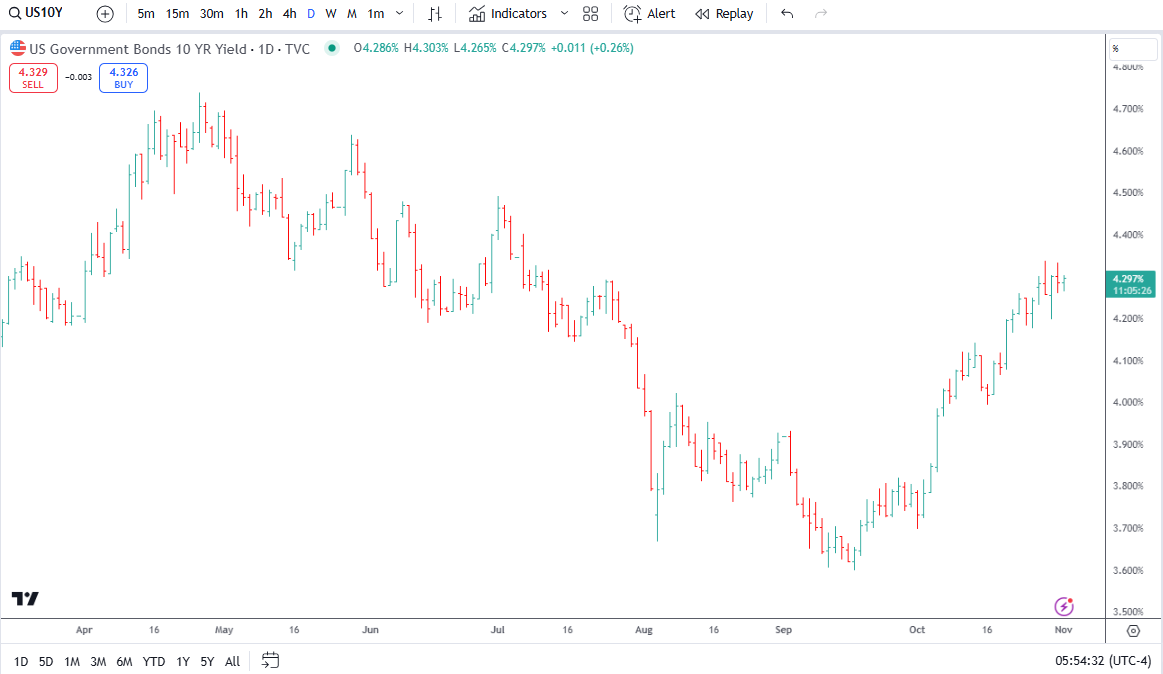
As you know, I have been complaining every week about the bond market’s terrible reaction to the Fed’s outsized rate cut in September. Since my write-up last week, bonds have continued to get hammered. The high in the 10-year treasury yields reached 4.33%, more than 20% higher than their yield on September 17, when the Fed over-reacted to a softening labor market and some modestly moderating inflation data.
The UK, however, in its effort not to be outdone by the US, has seen an even more remarkable sell-off in its government bonds as investors have reacted very poorly to the Labour Government’s first budget. Investors are not happy with the inflationary pressures and increased government borrowing. The Debt Management Office outlined plans for roughly £300 billion in gilt issuance for 2024-25, which has put further pressure on gilt prices, which have now dropped by 21% in the past six weeks. The bottom line is that the UK is planning a classic “tax and spend” budget, with tax hikes and increased fiscal spending.

The pound has not reacted well, although it was clearly overbought, so perhaps the recent currency move was more of a classic example of “one excuse is as good as another” when a market is ready to move.

I will have more to say about the British pound in coming write-ups, but today I want to address a few of my recent forecasts. First, I want to visit the wild, whacky world of crypto. In July I recommended that my readers buy Bitcoin as I anticipated the start of Bitcoin’s next surge higher. On July 9, 2024 I wrote, “Just as I expect gold and silver to shine, I also expect Bitcoin to shine for quite a while. I have a variety of potential targets for Bitcoin, but I think that a price around 90,000 should finish this part of the move.”

Bitcoin was gyrating between $54,000 and $57,000 at the time, and it just felt like the market had spent enough time consolidating its prior gains. I hardly profess to be an expert in Bitcoin, but I felt that it was a clear buy at the time. I still like it much higher, but this week Bitcoin tried to make a new all-time and just missed punching through $73,666. It has subsequently started to correct a bit, and I am recommending that you now take profits on one half of your position. I like using this strategy of taking partial profits as it gives me a very strong hand going forward. In this case, our profits of roughly $15,000 take our average entry price down to around $40,000, a level which should be quite safe while we wait for the anticipated eventual surge higher towards the $90,000 level.
The election next week will undoubtedly bring lots of fireworks to the markets. Both candidates will likely bring plenty of borrowing and spending, so we don’t need to worry about any sudden major fiscal reform and disciplined fiscal constraint by our elected officials. Yes, I am sure you can detect my cynicism here, as I am not a big fan of our ever-growing mountain of debt. Gold, silver, and yes, to some extent, Bitcoin, are likely to benefit over the long haul, but we need to be patient as markets typically get too excited and carried away once a trend is underway.
We saw that enthusiasm play out in silver, for example, over the past seven weeks, as silver surged from $26.54 all the way to last week’s high of $34.86. As I wrote last week, it was time to take some profits on our long silver positions and give the market some time to digest its rise of 31% since early August. Eventually, silver should break higher and continue its ascent, but it is prudent risk management to periodically take some profits to improve one’s average entry price.

Three weeks ago I advised my readers to re-establish their long positions in the euro versus the Canadian dollar (eur/cad). I warned you that the move will be slow moving, and true to form the cross is grinding higher, ever so slowly.

We need to work through lots of sell orders in front of the year’s high at 1.5228, but eventually we should see the Canadian dollar weaken significantly.
Over the past week, my team and I have been slowly increasing our long yen exposure. We are focused on a basket of currencies to sell against the yen as we expect the yen to eventually resume its rally. Yen sellers are heavily focused on the yield differentials – that is right, the carry play is hardly dead – which have swung sharply in favor of the dollar recently. After the dollar’s recent rise of fourteen yen, it feels like a very sound move to at least play for a sizable recovery in the yen. As you know, my bias is for the yen to eventually have a cycle of tremendous appreciation, but I want to take this move one step at a time. In the short term, we think that the recent move higher in rates is getting overdone, and any softening in rates will help add support to the yen.
We have been selling the Australian dollar, New Zealand dollar, Canadian dollar, and Swiss franc against the yen, but it is still early in these plays. Is this going to be the start of the next major swing in these currency crosses? Maybe. We don’t have the full confirmation yet that the moves are really underway, but current levels are attractive as initial entries. We have plenty of room to add to the exposures and improve our average prices in case we are too early. As I have explained, this is a classic example of why we like to use options to express our more structural views. Although we are sure that the market will eventually go our way, we aren’t as sure about the timing. Limited risk option strategies allow us to hold onto our positions when we are forecasting turns in a market that might be premature. Yes, it is true that we give up some profit potential by using this strategy, but we can still structure excellent risk-rewards that allow us to be too early, or even wrong, more than half the time and still earn good profits.
In the stock market, we have seen some amazing volatility in a variety of stocks. Coinbase is one of our favorites to trade. As you can see in the chart, this is not a stock for the faint-of-heart.

These moves are wild. The stock regularly moves 30%, or more, and the options are quite liquid. Frankly, after focusing on currency options for many years, playing in a market that has implied volatility levels of 80% or higher is quite exhilarating. Currency options in most major currency pairs tend to trade at volatility levels between 6% and 11%, with periodic, short-lived spikes into the low teens. (Dollar Canada options tend to trade around the 4% volatility level, but that is exceptionally low.) I have never before been able to trade options at volatility levels in the 80% plus range, and that opens up an entire universe of different strategies to earn some good trading profits.
I also find the options in the S&P500 market very amusing. The skew between the volatility of calls and puts is astonishing, and that opens up some fascinating trading opportunities. This skew is based on the overwhelming long bias of investors in the underlying stocks and stock indices, as this creates an outsized demand for put options to hedge their underlying exposures. This also reflects the fact that the market tends to rise slowly over time, with periodic vicious declines during its corrections. Thus, we like to use the phrase “up the stairs and down the elevator” when we describe overall stock market price action.
What am I expecting in equity indices going forward? It is a very tricky time as the election will likely be a time of great uncertainty. Lawsuits are already being filed and both sides are gearing up for a big fight. My best guess is that the final results of the election won’t be decided for quite a while, and this period of uncertainty will create a short-term period of tremendous volatility. Markets typically abhor uncertainty, and there is a good chance that uncertainty is exactly what we are going to have for a while. Depending on the results, we could easily see a short-term surge in stocks which is followed by a nasty sell-off. In the big picture, I like the idea of one final push to new all-time highs followed by a sustained correction that will be surprising in its depth and duration. Frankly, this is long overdue as the market has discounted an awful lot potentially good news while ignoring the rest.
In terms of my trading approach in stock indices, I tend to focus more on relative value option plays rather than making heavy directional calls in the underlying index. My team and I find it far easier to take advantage of a wide range of option pricing inefficiencies than to fine-tune my directional forecasts on the broader index. We like to stick to the basic adage, “If it ain’t broke, don’t fix it.” We have a way to make money trading index options without needing to be great forecasters of the next big market move, so we stick to that. Yes, periodically, my team and I see a tremendous technical set-up in the market that we want to play, but that is not a requirement for us to make money with our trading.
Next week, I will dig into the election results and try to share some insights about what this means for the markets. In the meanwhile, I wish you all the very best of luck with your trading.