Shifting Tides in the Markets – Time to Head for Cover

Thoughts on the Market
November 24, 2025
Last week I warned my readers that Bitcoin was ready to crash another 20% once it broke through some residual support levels. In fact, it collapsed by 15% over the next couple of days, but it still looks extremely vulnerable overall. In stocks, the price action this past week was no less troubling. In particular, the market action this past Thursday was much more than an eccentric trading session. It carried the unmistakable signature of a stress signal – the kind markets flash when fragility is building beneath the surface. The reversal was unsettling not merely because of its magnitude, but because of what it reveals about investor psychology at this stage of the cycle.
The Rejection of “Good News”
Nvidia delivered extraordinary earnings, the kind of results that should have fueled a broad and sustained rally. Instead, the market surged at the open and then collapsed into a rapid, disorderly selloff. When strong fundamentals no longer translate into upward price momentum, the message is clear:
Macro forces now outweigh micro strength.
That is a classic hallmark of a late-cycle environment.
Violent Reversal and Rising Volatility
The S&P 500’s 3.75% intraday swing -- erasing more than $2 trillion in market value -- was exceptional. Events of this nature tend to cluster at turning points in market regimes. Volatility confirmed the seriousness of the move: the VIX jumped above 26, signaling a surge in hedging demand even as ostensibly positive news was released. Optimism is being overwhelmed by fear.
Liquidity Is Thinning to Dangerous Levels
Perhaps most concerning is the collapse in order-book depth. At several major market-making firms, liquidity fell to less than half of normal levels. Thin liquidity exacerbates every move; when combined with heavy ETF and futures shorting for hedging purposes, it exposes systemic vulnerability.
Historical Parallels
This pattern -- strong earnings followed by sudden weakness -- appears in many pre-crisis environments:
- Dot-Com Peak (2000): Excellent tech earnings were dismissed as valuations became untenable and liquidity evaporated.
- 2007 Financial Crisis: Banks posted solid results, but underlying credit stress dominated.
- 2022 Tech Selloff: Mega-cap earnings could not offset the weight of Fed tightening.
In each instance, markets were signaling that the narrative had shifted.
Implications Going Forward
1. Macro Now Dominates Micro
Traders are signaling that inflation, Fed policy, and stretched valuations matter far more than individual corporate performance. If expectations for rate cuts continue to fade, even exceptional earnings may fail to stabilize the market.
2. Crowding Risk in AI and Tech
Positioning in Nvidia and AI-linked trades is extreme. When positioning becomes one-sided, good news often triggers selling rather than buying. Profit-taking becomes hedging; hedging becomes forced de-risking.
3. A Fragile Liquidity Regime
With shallow order books, even modest flows can produce outsized price swings. In stressed markets, this dynamic becomes self-reinforcing.
4. A Warning of Regime Change
When markets reject bullish news, history shows that a correction -- or a full bear market -- often follows. The fact that aggressive hedging is occurring despite the market sitting only ~5% below all-time highs reinforces the anxiety.
The “Everything Bubble” and Bitcoin’s Warning
Last week’s break in Bitcoin was an important signal. After slicing through the 95k–97K support band, it fell more than 15% in days. While a short-term bounce or a period of corrective consolidation is possible, the structure remains weak.
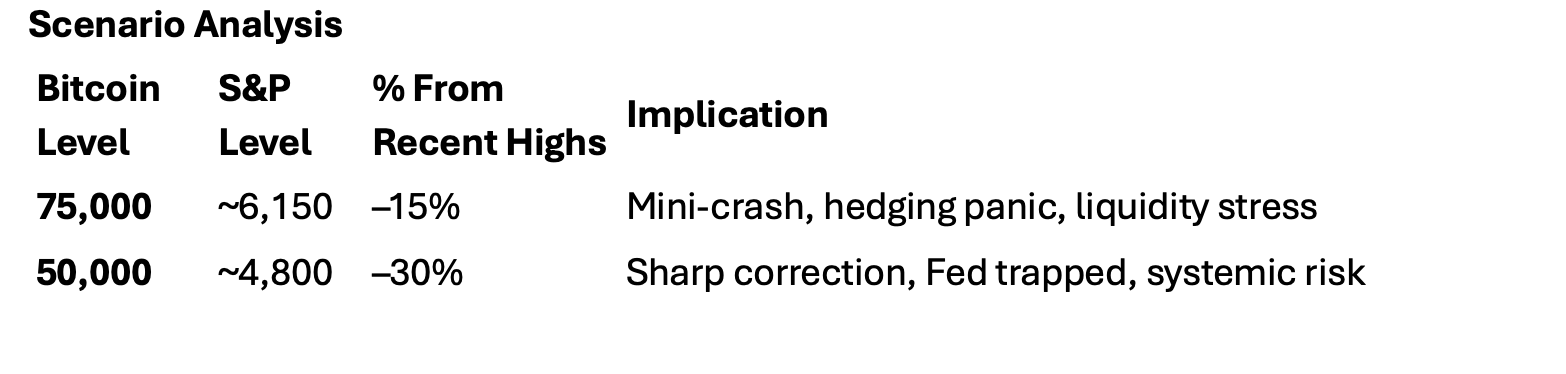
A slide toward 75,000 appears likely; a deeper move toward 50,000 -- or even 29,000 --cannot be dismissed. I have written previously how in exceptional circumstances markets can correct and lose roughly 77% of their total value, and a move to 29,000 would equate to such a move from the recent high
Because Bitcoin has been the bellwether of risk appetite, such a decline would amplify equity fragility. A move toward 50,000 in Bitcoin would be consistent with an S&P 500 decline of 25%–27%. A drop to 29,000 would imply a much broader capitulation.
Critical Equity Levels
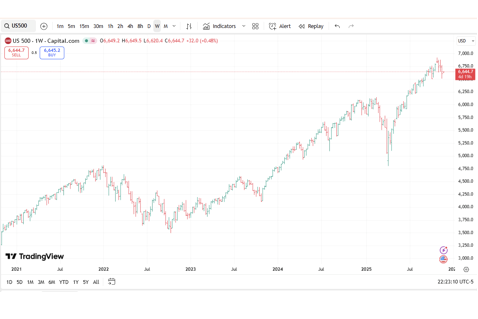
If the S&P breaks the 6150 support zone, systematic selling will intensify.
A failure of the 5610 Fibonacci support level would shift attention to the April lows near 4800. Should those give way, the next significant target is 4105 -- a level that represents a true capitulation zone.
At 4105, liquidity would likely evaporate, volatility would surge into the 40–50+ range, and forced selling across funds would become unavoidable.
Macro Traps Intensifying the Risk
- The Fed is boxed in: inflation remains roughly 50% above the target, leaving little room for easing without triggering credibility concerns.
- Political uncertainty is rising: a potential Supreme Court ruling against the administration’s tariff policies could undermine the government’s core economic narrative.
- Fiscal strain is mounting: federal debt-service costs are soaring; within a decade, tax revenues may barely cover interest payments. Markets will not ignore this once selling accelerates.
How a Selloff Could Unfold
- Bitcoin breaches 75,000 → panic hedging surges.
- S&P breaks 6150 → systematic strategies begin de-risking.
- Breach of 5610 → increasingly nervous market gravitates toward 4800.
- Below 4800 → panic liquidation ensues.
- Fed action is interpreted as political capitulation or panic. If the Trump administration really wants the Fed to lower interest rates, then they should make their wishes known more privately. Pounding on the Fed for rate cuts undermines the perception of Fed independence.
- Tariff-related legal rulings inject policy instability.
- Debt-service pressures raise sovereign risk premiums.
- Massive bond issuance by the giant AI companies simply adds to the worries that a massive “Everything Bubble” is going to burst.
This is a classic setup where crowded positioning, macro stress, and poor liquidity can combine into crash conditions.
Below 4800 Panic Ensues and Mass Liquidations Occur
It represents the threshold at which:
- hedged positions become forced liquidations,
- volatility enters panic territory,
- liquidity providers withdraw,
- and the market transitions from orderly correction to disorderly unwind.
At that level, the “Everything Bubble” would truly burst. The next target would be 4105, the corrective level in October 2023 from which a tremendous acceleration higher launched. A move below that level would target the lows of October 2022 at 3500.
Bottom Line
The market is flashing all the signals of a system approaching instability:
over-crowded trades, thin liquidity, macro uncertainty, rejecting good news, and a vulnerable risk-on bellwether in Bitcoin. In such an environment, markets no longer need a catastrophic shock; a small disappointment can ignite a large fire. Is the market absolutely ready to break down? Not necessarily, but the risks are mounting fast. It is definitely time to buckle up. We are heading for wild times in the market. If these risk-off moves accelerate, then we will see major moves in other markets as well.
I will address the yen in my next write-up. It has reached a fascinating crossroad, and it is now time to focus on whether the period of speculative Yen weakness is nearly done. I will also address CAD/CHF which looks to be completing a healthy, corrective pullback. In the meanwhile, I want to wish you all the best of luck with your trading.
Andy Krieger