The Administration Wants Lower Bond Yields – Will They Get Them?
Thoughts On The Market
December 8, 2025
By Andy Krieger
Topline Summary
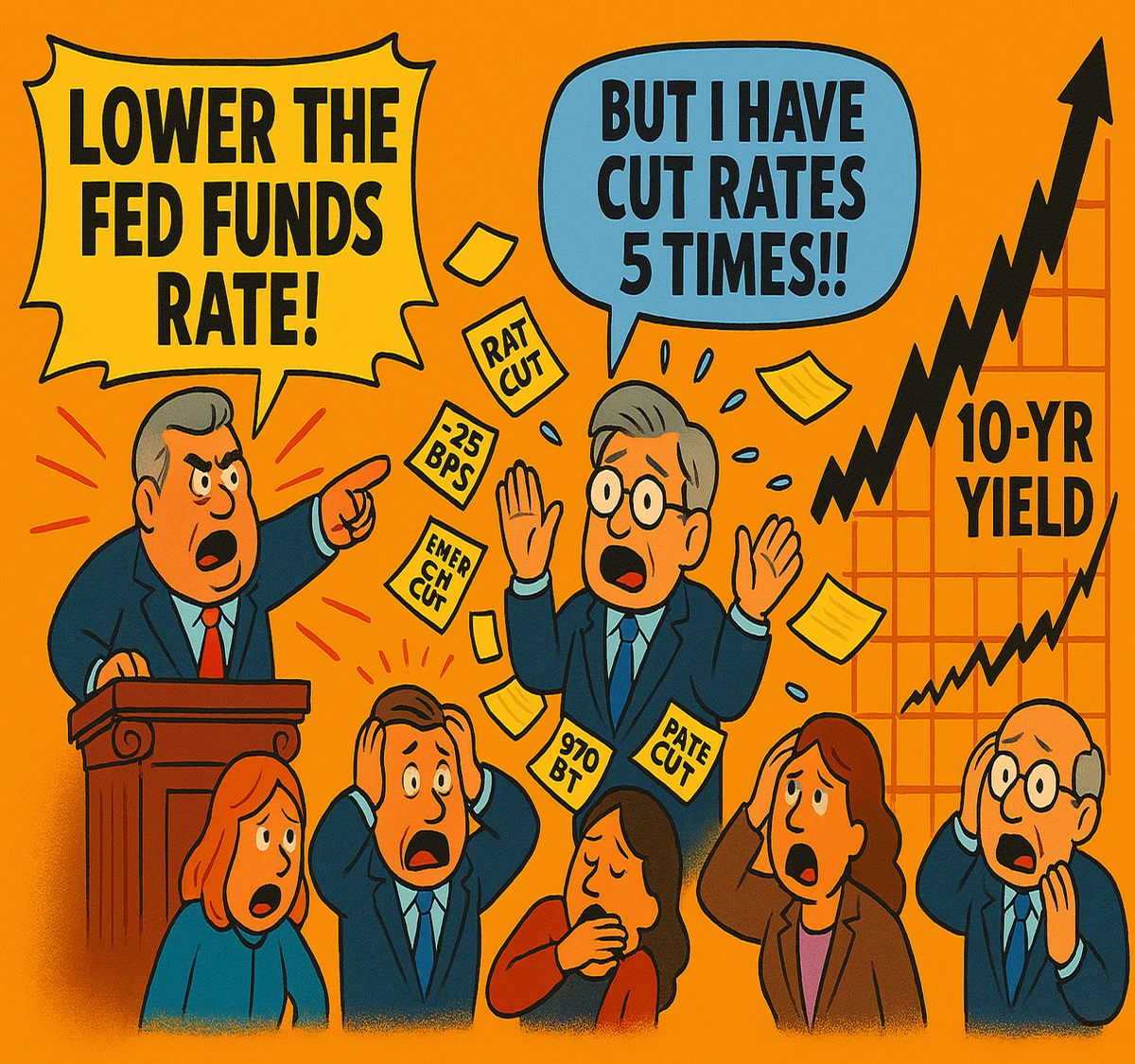
The U.S. enters late 2025 amid a confluence of rising long-term yields, a weakening dollar, deteriorating labor conditions, and aggressive political pressure on the Federal Reserve. Despite five rate cuts since September 2024, 10-year Treasury yields have risen from 3.6% to roughly 4.2%. This rise represents a highly unusual divergence in historical context.
Today’s Thoughts On The Market examines:
- The growing vulnerability of the U.S. dollar and the global capital flows that could accelerate its decline.
- Structural risks embedded in U.S. fiscal and monetary policies.
- The administration’s push for lower yields, and why the market may not cooperate.
- A thought experiment illustrating how fragile U.S. growth would be without the massive post-2008 debt accumulation.
Evidence suggests the U.S. is entering a critical period in which political pressures, unsustainable fiscal practices, and lingering inflation collide with skeptical bond markets. The risks of a sharp repricing in both the dollar and U.S. assets are rising – not falling.
1. The Dollar Outlook
Current Market Posture
- The U.S. dollar has been under sustained pressure throughout 2025.
- Short USD positions versus the CAD and AUD have performed exceptionally well; additional weakness has appeared versus the EUR and GBP.
- The dollar index is poised to retest the July/September lows (~3% below current levels), with deeper declines possible.
The recovery from July appears corrective, suggesting the dollar is preparing for another move lower toward the 96.30 area. Under several macro scenarios, a much deeper decline toward 90–92 becomes plausible.
Long-Term Perspective
A multi-decade view of the Dollar Index highlights:
- A corrective rally from 2008.
- A dominant long-term downtrend since the mid-1980s.
- Increasing vulnerability to a structural turn in global capital flows.
Major currency pairs function like massive oil tankers: they require enormous capital flows to change direction. With global FX turnover near $10 trillion per day -- most of it short-term noise -- sustained “real money” flows define the big trends. That is why trends last far longer and travel far further than standard statistics predict.
Why Currencies Matter Right Now
The dollar’s position as the world’s reserve currency hinges not only on economic size but also on trust, credibility, and global demand for USD assets. The U.S. has run large trade deficits for decades, leaving foreign investors with trillions of surplus dollars – many recycled into U.S. stocks and bonds.
This recycling is the backbone of American financial dominance. If confidence erodes, the unwind could be violent.
2. The Unmatched Size of U.S. Financial Markets
U.S. Treasury and Equity Market Scale
- The U.S. represents 40–45% of the global sovereign debt market.
- The U.S. economy is ~26% of global GDP, yet the U.S. stock market is ~50% of global equity capitalization.
- Total U.S. market cap (2025): $68–71 trillion.
Foreign Ownership of U.S. Equities (~20%)
Major holders include:
- Japan: ~$1.6T
- UK: ~$1.4T
- EU (ex-UK): ~$4.5T
- Canada: ~$1.2T
- China/HK: ~$900B
- Middle East SWFs: ~$600B
Implication: Even modest reallocations by foreign investors could trigger significant pressure on both U.S. equities and the dollar.
Why This Matters: The sheer size of U.S. markets has long provided stability. But concentration cuts both ways: A sudden reversal of global capital flows would amplify volatility and threaten the dollar’s reserve status.
3. The Dollar in a Thought Experiment
By visualizing the Dollar Index’s multi-decade structure, one can infer that the rally since 2008 looks corrective within a much larger bear market. A deeper decline -- or even a structural dollar crisis -- is therefore not only possible, but plausible.
A similar long-term study of USD/JPY shows:
- Massive secular decline since 1974.
- Multi-decade consolidation since 1995.
- Severe distortions created by Japan’s near-zero rates and speculative carry trades (including USD, MXN, and even Bitcoin purchases funded by selling yen).
A synchronized unwind of Yen carry trades could be one of several catalysts for a sharp dollar decline.
4. Fiscal Policy, Monetary Policy, and Investor Confidence
Fed Policy Since 2021
The Fed shifted from emergency COVID-era easing to rapid tightening (5.25–5.50%) by July 2023. By September 2024 it began cutting:
Rate Cuts Since Sept 2024
- Sep 2024 → 5.00–5.25%
- Dec 2024 → 4.75–5.00%
- Sept 2025 → 4.50–4.75%
- Oct 2025 → 4.25–4.50%
- Nov 2025 → 4.00–4.25%
- Expected Dec 2025 → 3.75–4.00%
Labor Market Weakness
- Unemployment peaked at 14.8% during COVID, then bottomed at 3.4% (2023).
- By September 2025: unemployment rose to 4.4%, the highest since 2021.
Inflation, unfortunately, is still running ~3%, not the targeted 2%.
The Fiscal Situation
- National debt: $38.4 trillion
- Debt/GDP: ~120%
- Government spending continues at extreme levels.
- Investor tolerance is not unlimited.
The dollar is backed not by gold or commodities but by confidence. Once that confidence erodes, investors may reduce exposure cautiously at first, then aggressively.
5. Counterfactual Analysis: What If the U.S. Had Not Borrowed?
A macro simulation shows:
- Debt in 2007: ~$9T
- Debt in 2025: ~$38.4T
- Increase: ~$29.4T
If the U.S. had maintained a balanced budget since 2008:
|
Scenario |
Estimated 2025 GDP |
|
Low fiscal multiplier (0.4) |
$18–20T |
|
Medium multiplier (0.7) |
$14–16T |
|
High multiplier (1.0) |
$12–14T |
Central Estimate: ~$15T GDP—about half of today’s actual $30T output.
Key takeaway:
Massive deficits prevented deeper recessions but also created the foundation for today’s instability and overvaluation. We can easily conclude that at least half of our annual GDP is built on “funny money,” – artificially inflated currency. This doesn’t even take into account the massive quantitative easing of the Fed to further support this bubble-like growth.
6. The Administration’s Push for Lower Yields
Why Lower Yields Matter
- Reduce borrowing costs on $38T of U.S. debt.
- Lower mortgage and corporate borrowing costs.
- Improve fiscal sustainability -- at least superficially.
Policy Actions and Strategy
- Treasury Secretary Scott Bessent emphasizes suppressing long-term yields.
- Administration claims energy dominance + fiscal reform will curb inflation.
- Open criticism of the Fed raises concerns about its independence.
The Market Disconnect
Despite 125 bps of rate cuts, the 10-year yield rose from 3.6% to ~4.2%.
Historically, long-term yields almost always fall when rates are cut. This divergence is a warning signal.
Ask ten people where they think the 10-year yield was before the first cut in September 2024 – they won’t guess the correct answer. (Hint: it was 3.6%).
Why Are Yields Rising?
- Economic optimism (soft-landing expectations).
- Reversion to pre-2008 norms (4.5–5% was once “normal”).
- Bond vigilantes returning:
- Fear of fiscal unsustainability
- Concern the Fed will not defend its inflation target
- Deep skepticism about long-term U.S. policy credibility
This third explanation is the most troubling.
7. Key Takeaways
- Dollar: In early stages of a potentially major decline.
- Fed: Clear pivot to easing, but not trusted by markets. Inflation is way too high to justify rate cuts.
- Labor: Weakening, unemployment up to 4.4% -- still historically low overall.
- Bond Yields: Rising despite aggressive cuts -- a rare but ominous signal.
- Politics: Administration pressing for lower yields risks undermining Fed credibility.
- Systemic Risk: Dollar flight + foreign equity outflows + stagflation could trigger a global crisis.
Conclusion
The U.S. is entering a complicated and potentially dangerous phase. Persistent inflation, fiscal excess, political interference, and eroding global confidence form a combustible mix. Throw in the fact that stocks are ridiculously overpriced and you have a near-perfect recipe for disaster. The unusual rise in long-term yields -- despite significant Fed easing -- reveals deep structural concerns about debt sustainability and policy credibility.
If policymakers fail to course-correct, the dollar’s decline could accelerate sharply. In a worst-case scenario, a stagflationary environment combined with a loss of investor confidence could ignite a disorderly exit from dollar-denominated assets and trigger a global financial crisis.
For now, we must remain vigilant, consider a wide range of scenarios, and navigate the markets with caution.
As always, I wish you the best of luck with your trading.
Andy Krieger