The Triumph of Narrative Over Reality
Thoughts On The Market
April 19, 2026 — For Qualified Subscribers
I. Our Current Positioning
In the two weeks prior to the U.S. military strike on Iran, we warned subscribers that the bull market was in serious jeopardy. The technical deterioration was evident, the macro headwinds were intensifying, and the geopolitical kindling was unmistakably dry. When the strike came and the resulting sell-off accelerated through March, we covered our short positions into the volatility, locking in gains as the market priced in the immediate shock.
We have since been methodically reestablishing short exposure. The reasoning is straightforward:
the market, rather than recalibrating to a structurally more challenging reality, has done the opposite. Driven by a speculative wave of FOMO — Fear Of Missing Out — it has rallied back to and through prior all-time highs. The S&P 500 is now trading above 7,100.
That gift — a market that has returned to stratospheric valuations in the face of deteriorating fundamentals — is precisely the kind of environment where structured downside exposure makes the most sense. We continue to use defined-risk options strategies throughout, where maximum loss is known and bounded before any position is initiated. This discipline is non-negotiable given the potential for violent overnight gap moves in a market trading on narrative rather than data.

II. Anatomy of a Speculative Surge
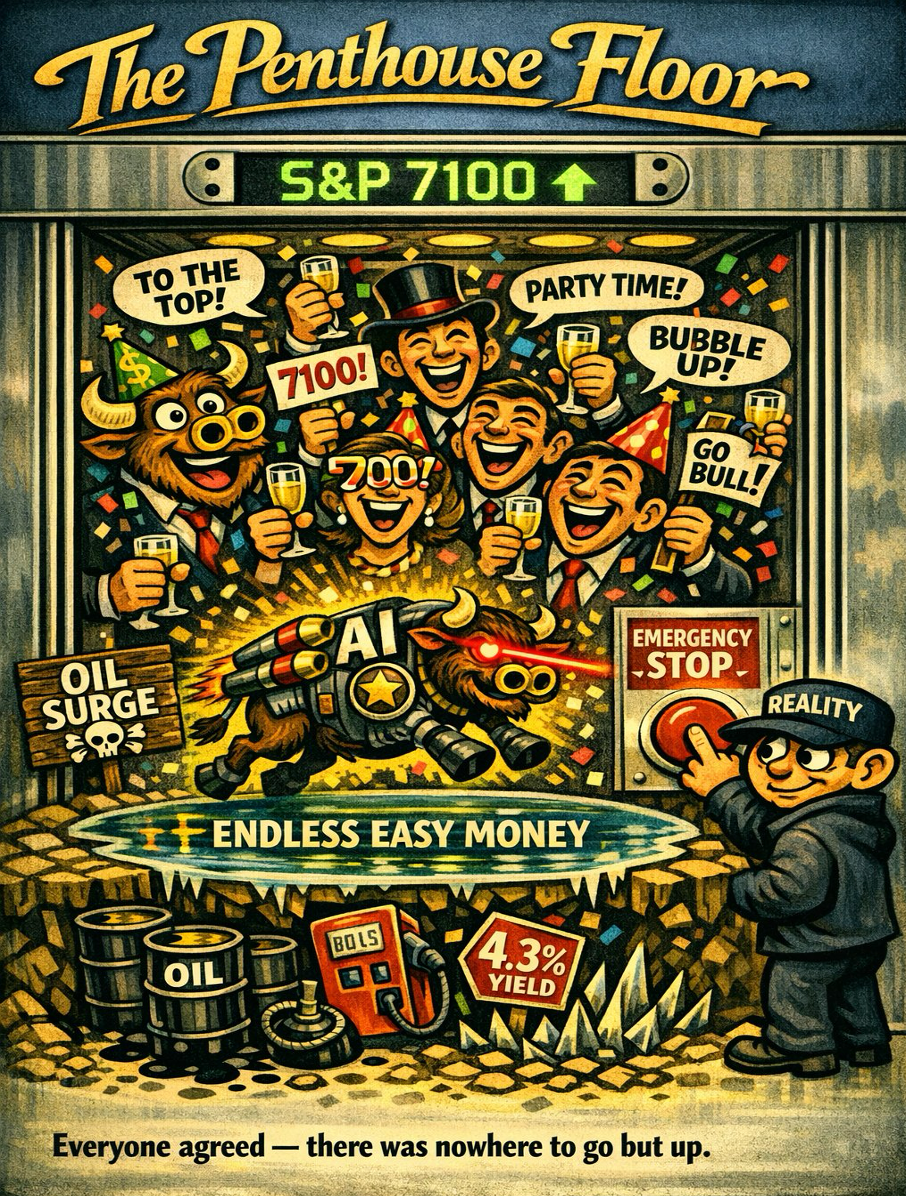
The cartoon below, which has been circulating widely, captures the current market psychology with uncomfortable accuracy. The “priced in” reflex — the instinctive dismissal of any adverse development as already reflected in asset prices — has become the defining feature of the 2028 bull market. It is a posture that conveniently absolves investors of the need to think too carefully about what they are actually buying, at what price, and against what macro backdrop.

The reality that the market is so studiously ignoring is one of the most pronounced disconnects between price and fundamentals that we have observed in four decades of trading.
Narrative Dominance Over Data
The single most important feature of the current market psychology is the displacement of valuation discipline by story-driven conviction. Earnings quality, balance sheet stress, and real return thresholds have been subordinated to the AI narrative — a belief that technological transformation will permanently expand productive capacity and earnings power, rendering traditional valuation anchors obsolete.
This is not without historical precedent. The late 1990s saw identical reasoning applied to the internet revolution. The productivity miracle was real, but the valuation extrapolation was catastrophically wrong. Investors who paid 80× earnings for the story, not the business, were eventually destroyed by the gap between narrative and reality. We are in a structurally similar moment today, compounded by a macro environment that is meaningfully more hostile.
The Liquidity Illusion
Despite 10-year Treasury yields approaching 4.3% — levels ominously reminiscent of 2007, the year before the Great Financial Crisis — traders have maintained an almost religious conviction that the Federal Reserve will resume easing at the first sign of economic softness. Every dip is treated as a liquidity-backed buying opportunity. This misreads both the Fed’s reaction function and the structural nature of current inflation.
The historical parallel to 2007 deserves to be stated plainly. In the months before the GFC, 10-year yields were trading at similar levels while equity markets were registering new highs, credit spreads were narrow, and the consensus was broadly constructive. The yield signal was there. The market chose not to hear it. We are in an analogous configuration today, with the added complication of a genuine commodity shock layered on top.
Energy-driven inflation is not transitory in a context where the Strait of Hormuz remains operationally constrained. Fertilizer, food, fuel, and freight costs are embedding into the broader price level. A Fed that cuts into this environment risks repeating the errors of the 1970s, and the current leadership has been explicit about its reluctance to repeat those mistakes.
The market’s assumption of imminent easing is, in our view, deeply mistaken.

Momentum Feedback and Algorithmic Amplification
With the VIX hovering in the 16–17 range, volatility is priced at near-complacency levels. This suppressed vol environment creates a dangerous feedback loop: low realized volatility encourages greater risk-taking, algorithmic trend-following models add to positions, which further compresses vol, which encourages still more risk-taking. The cycle is self-reinforcing until it is not. And when it breaks, the reversal is typically vicious and rapid.
Having run momentum-based models, we understand their dynamics intimately. They function beautifully in trending, low-vol regimes. But they have an Achilles heel: they are structurally short convexity. When the trend reverses sharply, they do not reduce exposure gradually — they exit simultaneously. The resulting air pocket can be both fast and deep.
Social Contagion and Institutional FOMO
What began as retail-driven speculation has become systematized across the institutional landscape. Hedge funds, risk parity strategies, and even some traditionally conservative asset managers are chasing performance. The fear of client redemption for underperformance has become a more immediate threat than the risk of capital loss, a dangerous inversion that invariably marks late-cycle behavior.
The concentration risk embedded in this dynamic should not be understated. Mega-cap technology and AI-adjacent names now represent over half of S&P 500 total returns. What looks like broad market participation is, in reality, an extraordinarily narrow leadership. When that leadership cracks — as it did briefly during the March sell-off — the index is far more vulnerable than a diversified composition would imply.
III. The Contradictions Beneath the Euphoria
The divergence between market pricing and macroeconomic reality is, in our experience of roughly four decades in this business, among the most extreme we have observed outside of a genuine bubble. We document the key contradictions below.
A. The Commodity Price Shock — An Economy-Wide Tax
Since the onset of the Iran conflict, commodity markets have registered dislocations that would, in any historically normal market environment, have forced a fundamental equity repricing. The following table summarizes the scale of the energy and commodity shock:
|
Commodity |
Change |
Market
Significance |
|
Sulfur |
+57% |
Input cost for fertilizers; cascading inflation across
agriculture |
|
Jet Fuel |
+52% |
Aviation sector margin collapse; travel inflation surge |
|
Urea / Fertilizer |
+51% |
Food cost spiral accelerating across emerging markets |
|
Diesel |
+48% |
Core logistics & transport cost — embedded in all CPI
categories |
|
Gasoline |
+36% |
Direct household tax; consumer spending headwind |
|
Heating Oil |
+32% |
Residential energy burden rising heading into autumn |
|
WTI Crude Oil |
+28% |
Benchmark global energy cost; margin pressure across industry |
|
Brent Crude Oil |
+26% |
Global pricing reference; refining crack spreads widening |
|
European Nat. Gas |
+21% |
European industrial competitiveness further undermined |
|
Coal |
+12% |
Power generation backup cost rising |
|
Palm Oil / Rice |
+7–10% |
Soft commodity inflation embedding in food supply chains |
The critical point is not merely that individual commodity prices have risen, but that their interconnections create a compounding transmission mechanism through the real economy. Higher diesel costs raise the price of every good that is transported. Higher urea and fertilizer costs raise the price of every foodstuff that is grown. Higher jet fuel costs raise the effective cost of every flight and compress the margins of every airline. Higher gasoline costs directly reduce consumer discretionary spending power.
Collectively, this constellation of commodity shocks functions as a broad-based tax on activity — both consumer and corporate — that is not yet fully reflected in corporate earnings forecasts or equity multiples. The lag is real, but it is not infinite.

B. Valuation vs. Rate Reality — The 2007 Echo
The S&P 500 is currently trading at approximately 22 times forward earnings. This is a multiple that matched the euphoric peak of 2021, when the 10-year Treasury yield was near zero. Today, that same yield is approaching 4.3%, testing the same levels we had on the eve of the Great Financial Crisis.
That 2007 parallel is not merely a data point — it is a warning. In mid-2007, with the 10-year yield similarly elevated and equity markets trading near all-time highs, the consensus was constructive, leverage was abundant, and risk was perceived to be well-distributed. Credit problems were ignored, the housing bubble was catastrophically overdone, and twelve months later the financial system had come within hours of a complete seizure. We are not predicting an equivalent systemic event. What we are saying is that history has a habit of rhyming at precisely the moments when markets are most confident that it will not.
The mathematical implication is stark in any case. Equity valuation is fundamentally a present-value exercise. When the risk-free rate rises from near-zero to 4.3%, the discount rate applied to all future cash flows rises commensurately. A 22× forward P/E at these yield levels implies a degree of earnings growth and duration that is, historically speaking, extraordinary. To justify current multiples, the market must believe that AI-driven productivity will generate sustained double-digit earnings compounding while simultaneously absorbing a commodity shock, rising debt service costs, margin compression from input inflation, and a consumer increasingly squeezed by energy and food costs. This is not analysis. It is faith. This is also ignoring the incredible U.S. debt levels which are accelerating not moderating.
C. The Macro Divergence Scorecard
The following table captures the breadth of the disconnect between market pricing and macroeconomic fundamentals:

D. Margin Compression — The Unreported Story
While top-line revenue projections remain elevated on the strength of AI capex demand, the margin story is quietly deteriorating. Higher energy and raw material input costs, rising freight rates, increasing debt service burdens on variable-rate corporate debt, and a labor market that has not fully absorbed the post-pandemic wage reset are all compressing operating margins across large swaths of the economy.
These pressures are particularly acute in industrials, consumer staples, transportation, and mid-market retail — sectors that lack the pricing power of the mega-cap technology names and whose earnings are far more directly exposed to input cost inflation. The consensus earnings model, which extrapolates AI-driven productivity as an economy-wide offset, misses the fundamental point: AI efficiency gains accrue primarily to a handful of capital-intensive technology businesses, not to the aggregate corporate sector.
IV. The Bull Trap — A Classic Formation
The term “bull trap” describes a market configuration in which price action convincingly resolves to new highs, drawing in momentum buyers and forcing out remaining shorts, only to reverse sharply, leaving late buyers trapped at peak prices. The pattern is among the most reliably destructive in markets, precisely because it exploits the two most powerful human emotions in trading: greed and the fear of being left behind.
The conditions for a bull trap are typically: (1) a prior significant decline that instilled fear; (2) a sharp recovery driven by a plausible catalyst, real or imagined; (3) a breakout to new highs accompanied by strong momentum and retail/institutional capitulation to the upside; and (4) a fundamental environment that is inconsistent with the implied valuation at those highs.
The current configuration satisfies all four criteria with unusual precision. The March decline instilled genuine fear. The catalyst for recovery — optimism about a rapid conclusion to the Iran conflict — was superficially plausible. The breakout above prior all-time highs triggered systematic buying from momentum strategies and forced short-covering. And the fundamental environment, as documented above, is deeply inconsistent with 22× forward earnings at 4.3% Treasury yields.
Fig. 2 The Penthouse Floor Edenridge Trading LLC, 2028.

V. Strategy Framework — Defined Risk, Asymmetric Return
Our approach to expressing this macro view is grounded in the structure of the options market itself, which currently offers a number of inefficiencies that favor disciplined bearish positioning.
Why Options, Not Outright Shorts?
Outright short positions in equities carry theoretically unlimited loss in a market driven by momentum and narrative. The risk of a continued, irrational rally — particularly in a context where central banks retain residual easing capacity — is real. We have no interest in being right about the fundamental thesis and being forced to cover at a loss before the trade pays off. Options solve this problem. Maximum loss is fixed, known, and bounded before any position is initiated.
Additionally, with VIX in the 16–17 range, implied volatility is near multi-year lows. Purchasing put options or various types of limited-risk spread trades at depressed implied volatility levels has asymmetric appeal: the premium paid is relatively modest, the vega position profits if the vol regime normalizes toward something more consistent with the underlying macro uncertainty, and the gamma will kick in and increase our bearish market exposure if the market starts a significant decline over coming months.
The Structural Skew Opportunity
A significant feature of the current options market is the relationship between implied volatility on puts versus calls across different tenors and strikes. The near-term speculative euphoria has compressed put skew in short-dated options — creating a window in which longer-dated downside protection is attractively priced relative to historical norms and relative to the macro risk being undertaken.
We are committing additional premium at current levels to extend the duration of our downside exposure. The logic: the triggers for the reversal we anticipate — commodity inflation transmission, earnings disappointments, a Fed that resists the market’s easing expectations, or renewed geopolitical escalation — are unlikely to resolve on a two-to-three week horizon. Structural portfolio hedges require structural positioning.
Institutional Demand for Hedges
At S&P 500 levels above 7,100, we expect that a meaningful shift in institutional behavior is quietly underway. Large family offices, sophisticated hedge funds, and risk-aware asset managers will begin to structure downside protection regardless of their public positioning or the dominant narrative. This institutional demand for tail hedges can itself create floor-level support for put options, and, when realized volatility begins to rise, can accelerate the repricing of implied vol across the surface.
We are comfortable being early to this trade. The asymmetry of the return profile — defined loss, substantial upside if our thesis is correct — means that time decay is the principal cost, and that cost is manageable given the level at which we are entering. Moreover, I have typically been a bit early on all of my major plays for the past four decades, so I am comfortable in that regard. If I were to wait for confirmation, then my option strategies would be far more expensive. Plus, we have many strategies that earn plenty of time decay over shorter time periods, so we are not bothered by some modest time decay over a long time period.
VI. Conclusions
The market is presenting us with a rare combination: all-time high prices, depressed volatility, a clear fundamental disconnect, and the structural conditions of a classic late-cycle bull trap. We have been building toward this moment through a series of shorter-term bearish trades that have performed well through the March volatility and the subsequent recovery.
We are now prepared to commit more capital to a structural short thesis — one that is not dependent on a precise timing catalyst, but rather on the inevitable mean reversion between narrative-driven valuations and fundamental economic reality. The commodity shock is real and compounding. The yield environment — at levels not seen since the eve of the Great Financial Crisis — is fundamentally incompatible with current equity multiples. The earnings revisions that will reflect input cost inflation have not yet begun. And the momentum-driven buyers now dominating price discovery are structurally fragile.
We continue to welcome the market’s generosity. Every day above 7,100 is an opportunity to build more defined-risk downside exposure at levels that history will almost certainly recognize as extreme. We are doing exactly that.
In the meanwhile, I wish you all the very best of luck with your trading as you try to navigate these markets.
Andrew J. Krieger , Edenridge Trading LLC — April 19, 2026
IMPORTANT DISCLAIMER
This commentary is produced by Edenridge Trading LLC for informational purposes only and is intended solely for qualified institutional and professional subscribers. Nothing herein constitutes investment advice, a solicitation, or an offer to buy or sell any security. Past performance is not indicative of future results. Options trading involves substantial risk of loss and is not suitable for all investors. The views expressed represent the author’s personal market analysis and are subject to change without notice. This document is confidential and may not be reproduced or distributed without prior written consent.
From Imre Gams:
My Framework
I treat markets as auctions, not prediction machines.
Most sessions on a day-to-day basis are balanced.
Edges form at the extremes of value.
I trade acceptance and rejection at those edges.
If value migrates, I align with it.
If it fails, I trade the rotation.
I am not in the business of forecasting.
I am in the business of validating participation.
_________________________________________________________
The week opened with a sharp gap down of over 1%. News that the U.S. and Iran had failed to reach a negotiated resolution sent the market lower at the open.
Buyers didn't flinch.
The gap was filled quickly. From there, buyers pressed the auction higher with conviction — hitting every upside target in sequence, including the final target of 7013.50. In the process, the index printed new all-time highs.
Remarkable, given where this market was trading just weeks ago.
Now comes the harder part. New all-time highs mean nothing if sellers reclaim them immediately.
The first critical defence zone for buyers spans 7124.25 to 7135.75. Below that, 7077.50 is a key level buyers cannot afford to surrender. A failure there opens the door to a test of the next defence zone spanning 6985.25 to 7005. That zone will need to hold if the bull case is to remain intact.
If buyers can maintain control, the next upside targets come in at 7229 to 7258, followed by 7328.
The bulls have made a significant structural statement. The question now is whether they can defend it.
Gold posted a gain of 1.64% on the week. On the surface, encouraging. But the nature of that advance tells a more complicated story.
The overlapping price bars are the key clue. When a market grinds higher through a series of overlapping candles rather than auctioning cleanly in one direction, it signals that neither side has firmly seized control. Buyers are making progress — but sellers are not giving ground easily.
This week a new zone enters the picture. The 4820 to 4882.7 area sits at the boundary between the current choppy price action below and the cleaner air above. Whoever wins that zone sets the tone for what comes next.
If value migrates above 4882.7, the upper target zone of 5085 to 5207 remains in play. That's where this story has been pointing since the breakdown began.
A failure to hold 4820 brings the familiar 4611 to 4661 zone back into focus as the first high-confidence downside target. Below 4611, sellers will look to press toward 4411.
The advance is encouraging. The conviction behind it is not yet there.
A quick housekeeping note. Last week saw the crude oil contract roll over. The current chart is back-adjusted to keep price levels consistent.
Now to the action.
Sellers delivered. Value migrated forcefully below the key $93 support level, with the market printing a weekly low of $78.97 — within striking distance of the first cited downside target at $75.44 to $79.01.
Buyers responded at those lows. That response matters.
Based on that buying activity, the support zone for this week is being adjusted slightly higher. The zone to watch now spans $75.44 to $79. As long as buyers defend it, the downside case is contained. A break below opens the door to $71.27.
For buyers to reassert control, the first order of business is reclaiming $85.16 and building acceptance above it. That's not a minor ask from current levels. But if they can do it, the upside targets come back into play — first $93, then $101.50.
The market has given buyers a level to lean against. What they do with it this week will tell us a great deal.