What's Next for Gold and Silver Prices?
I will provide some updated forecasts for gold, as well as some thoughts about silver, another of my favorite markets to trade right now.

Readers of my newsletters know well that I have been very bullish on gold for a long time. On April 27, 2023, I wrote, “I am now expecting a corrective cycle in gold that should result in either a sharp price correction back to $1800 per ounce, or a protracted period of choppy consolidation as the market digests the recent sharp rally from $1615 to $2048 that began last fall. I will be looking to buy the next corrective sell-off and play for an even larger rally that will take us well above $2,000 per ounce.”
Then, on October 11, 2023, I wrote, “We finally hit my buying zone last Friday, the 6th of October, when it reached $1810. I have covered my shorts, and I am now expecting the anticipated rally to develop. Overall, I think that the mid-$1800’s are a great buying zone for a move that will likely surprise many people with its eventual force.” Well, the anticipated move higher is well underway. We have touched $2354 today, having rallied 30% since that buy recommendation. Later in today’s write-up, I will provide some updated forecasts for gold, as well as some thoughts about silver, another of my favorite markets to trade right now.
On March 3rd of 2024, I pointed out the fact that “gold is the ultimate currency, so it is almost inevitable that it will rise against currencies that are following irresponsible policies. That includes the dollar and most other currencies as well.” I then went on to lay the groundwork for also being long silver. I was anticipating silver would “do a big catch-up and break through some strong, long-term resistance…and break above $25.50 en route to $30.00.”
Four and a half weeks later, silver has complied and exploded higher from $23.00 an ounce to a high today of $28.14 an ounce. This move of 22.3% has been fierce, but it is hardly surprising considering the extraordinarily easy financial conditions in the US and the Federal Reserve’s apparent tolerance for ever-higher inflation targets. As I have written in some detail, the level of Fed Funds is only a small part of the picture, and financial conditions are very loose right now.
I imagine that many of you were somewhat bothered by my recent write-ups, which focused very heavily on in-depth macroeconomic analysis, but I am hoping that you will realize now that this analysis is exactly what enabled me to identify the trading opportunities in gold and silver. I was 100% sure that the question would only be when these moves developed, not if.
Trading is a strange business. In a way, it is very complex and requires a tremendous amount of time, energy, and focus. For example, I follow a refined risk management strategy and a very disciplined methodology in order to make money consistently over time. I spend thousands of hours every year reading research reports, studying technical formations, analyzing momentum signals, breaking down Elliott Wave counts, and digging deep into some long-term cycle analytics.
On the other hand, however, trading can really be reduced to one simple rule: figure out what other people are going to do and then position yourself accordingly. Ultimately, the best trades are the simplest ones.
I have a basic rule that I tell all my traders: if you can’t explain the reasoning behind your trade idea in simple terms to a taxi driver or a typical high school student, then you probably have the wrong trade.
Consider the analysis behind the gold and silver trades. From 2008 until today, the Federal Reserve ran the easiest monetary policy in its history.
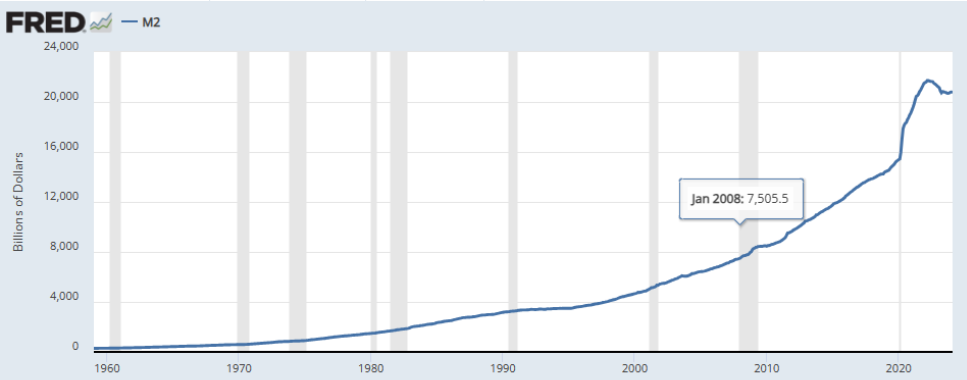
The Fed expanded the M2 Money Supply from $7.5 trillion to $20.8 trillion. The financial system was on the verge of collapsing in 2008, and the Fed embarked on a massive monetization plan to try to float the economy to safety.
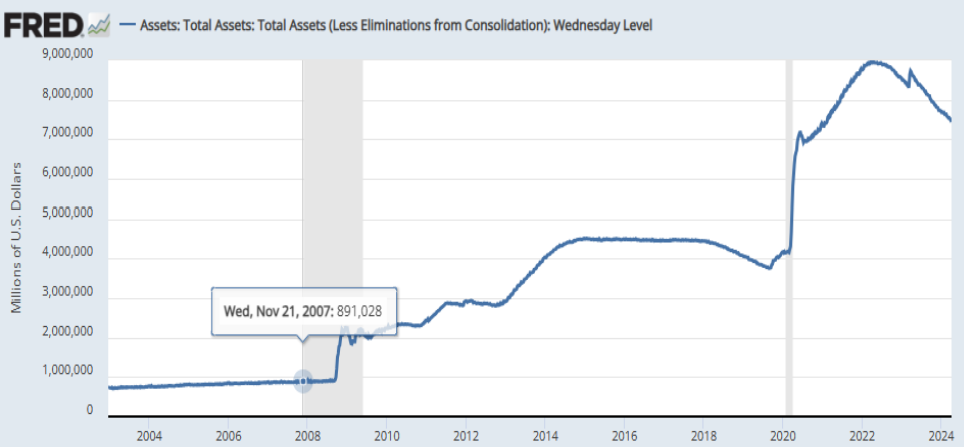
At the same time, the Fed’s balance sheet ballooned out from $900 billion to its grotesquely bloated current level of $7.5 trillion as the Fed purchased trillions of dollars of paper in order to bail out the economy. Eventually, the amount of money circulating in the economy would overwhelm the amount of goods that the money could buy – thus driving up the prices of goods.
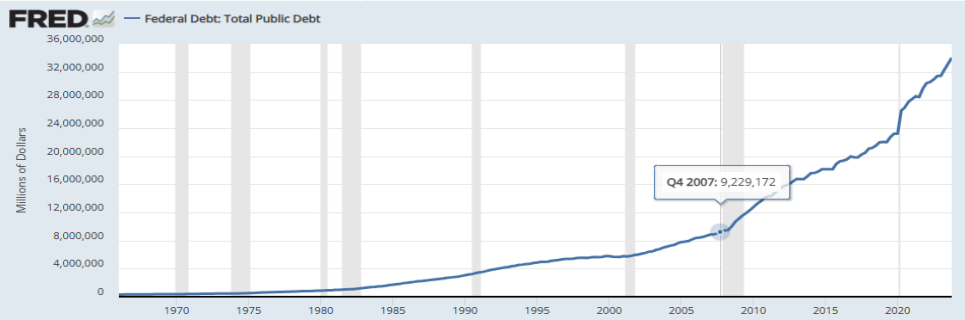
The US Treasury was a willing participant in this grand experiment by borrowing and spending money at unprecedented levels. Congress has managed to increase our nation’s debt load from $9.2 trillion at the end of 2007 to current levels in excess of $34 trillion! Wow! That is really a serious amount of borrowing and spending!! The end result was bound to be inflation, and the prior disinflationary cycle ended in grand style.
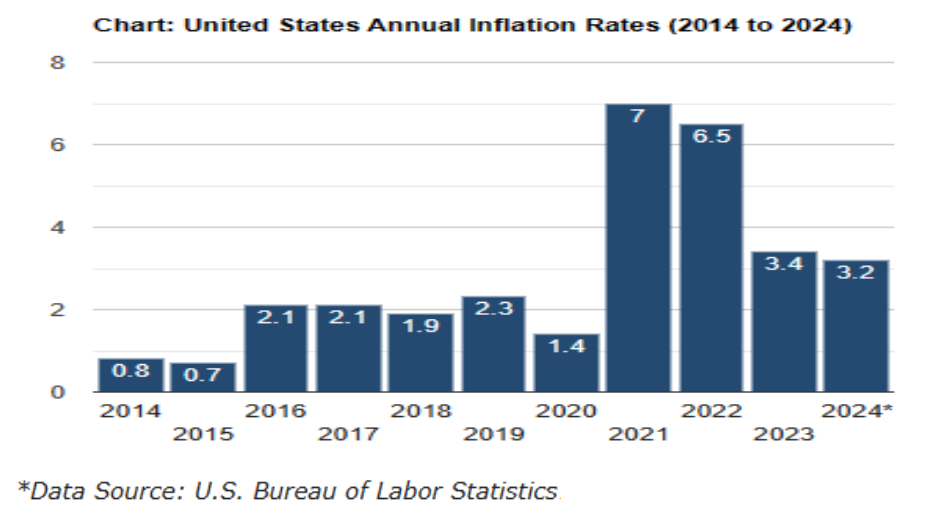
We are on track now for a total devaluation of the US dollar’s buying power that exceeds 20% since the beginning of 2021!! We have already taken a big hit on our spending power, so it is quite astonishing to listen to analysts praise the Fed for doing such a great job of bringing down the inflation rate without creating a recession. This is seriously misguided thinking. People have essentially received pay cuts of 20% during this period, so a good portion of our economic gains have been truly illusory.
Once we consider gold – and to a lesser extent, silver – to be the true global currencies (they have held this role for thousands of years!!), the recent moves in gold and silver make perfect sense. Put differently, it wouldn’t make sense if they didn’t rally sharply. These are trades that we should be able to explain in very basic terms to a high school student. Our dollars are worth much less, so the prices of gold and silver should be marked higher to adjust for the loss of the dollar’s buying power.
It was clear that investors would come to the same conclusion once they took a step back and thought through the situation more thoroughly. How far are these rallies going to go? It is a little hard to fine-tune my precise targets since the inflationary data for this year is still to be seen. I had mentioned $30.00 as a somewhat near-term, obvious target for silver as silver traded up to $30.09 in the beginning of February 2021 before crashing off to $17.56 in 2022 after the Fed started hiking rates. That would be approximately an 8% rally from the current price of $27.80, a very sensible sort of shorter-term target before we begin a more complex correction. Eventually, silver could trade MUCH higher than $30.00 - $32.00, but we should take this one step at a time.
If we assign a similar percentage move to gold from its current level of $2344.00 then we will reach $2532, which happens to be $13 short of one of my possible swing targets – $2545. Will we get to $2545? At some point, I think it is very likely. I don’t believe it will go there in a straight line, but I think the chances of reaching that level are very high. I also don’t think that this will be the highest price we will ever see. We should, however, take this one step at a time. My forecast might change depending on the inflation data over the coming months as well as the Fed’s policy response, but for now these forecasts are consistent with the current data.
Gold and silver haven’t been outliers. Other commodities have also been on a tear, further reinforcing the fact that inflation is going to be much stickier and harder to tame than the market has anticipated. We have also written about this likelihood in prior newsletters, but this wasn’t a very difficult conclusion to draw. Given the government’s massive debt load and the Fed’s huge balance sheet, it was easy to conclude that the Fed would almost certainly tolerate a higher level of inflation than they wanted to publicly admit. It is much easier for the authorities to try to inflate their way out of a problem whenever possible, as this path is less painful than crushing deflation that would emerge from squeezing an economy with dramatically higher interest rates. Besides, inflation effectively reduces the total amount of debt in the system in real terms, so the Fed will always want to talk tough and then err on the side of easing. Moreover, we learned in the 1970’s that inflationary pressures in the economy can be very hard to vanquish once they get a strong toehold, so I figured things wouldn’t be any different now.
Gold and silver haven’t been the only commodities surging this year. Since early October, cocoa has exploded from $3469 per metric ton to its current price of $9900 per metric ton. That is an increase of 285%. Crude oil has rallied from $69.70 per barrel in December to its current level of $86.60 per barrel, an increase of 24.2%. Coffee prices have jumped over 44% since October. Copper has rallied by about 20% during the same period. The message is clear – the dollar fetches a lot less now than it did even a few months ago.
Many retail companies are being very clever about these price rises. Rather than ramping up the prices of their packages of goods, they resort to a devious “shrinkage” strategy, just offering smaller quantities of goods in packages for the same cost. Somehow, this strategy doesn’t evince the same howls of protest, so it will likely continue for some time. It doesn’t make life any more affordable. It just makes it seem to be a bit less unaffordable.
In prior write-ups, I have already discussed how we have the least affordable homes ever, and it is not going to get better soon with the underlying inflationary pressures still going strong. Consider the following thought before I end this write-up. The real risk in the economy now is a growing risk of stagflation. Yes, I know that the consensus view is for a soft landing, but there are some signs of weakness that are showing up in the economy for the first time in a very long time. They are not obvious, but I find them very alarming. They may be well-concealed, but they are very real. I will write about this very real and very scary risk in my next newsletter. It is a very important topic, and it deserves some serious consideration.
In the meanwhile, I want to wish you all the best of luck with your trading.
Andy Krieger