Where Are the Markets Heading Long-Term?
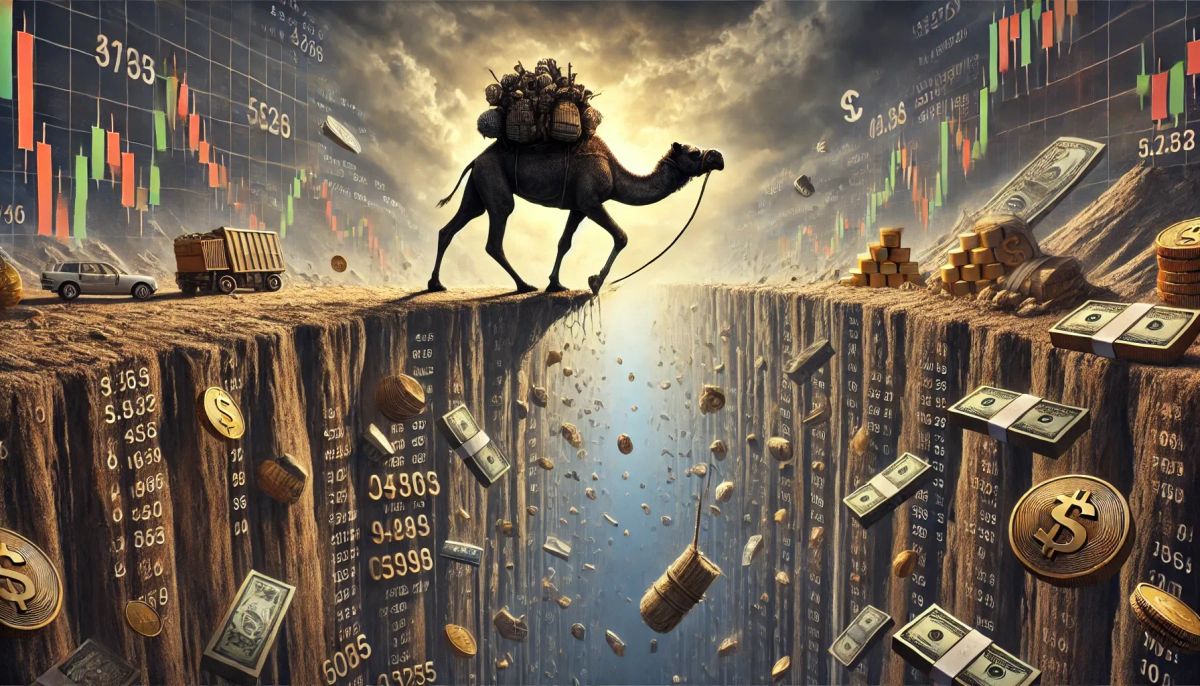
We are dangerously close to a tipping point. We don’t need a specific catalyst, just the straw that breaks the camel's back.
As we leave the summer months and move towards the US election, I decided to take a deeper dive into the economy to see how things are shaping up. I was hoping this would give me some additional insights into where the markets are heading, and indeed, the results of this exploration have been both clear and surprising. Although much of the data points to long-term trends rather than immediate shifts, the long-term ramifications have to be noted.
First of all, I have to admit that I was quite surprised when I started my digging. Actually, I was taken aback by how dramatic some of the findings proved to be. Upon deeper analysis of the data, the first thing that jumped out at me is how uneven the economic performance of the US has been for different segments of our population. In case you read some headlines or hear some news reports about how terrific our economy is, please consider the following chart. The real story is clearly a matter of perspective.

It doesn’t take an advanced degree in economics, or any other field for that matter, to see that since The Great Recession, things have indeed been very good for the top 1% of the country. Their total net worth has exploded higher, increasing by nearly $30 trillion since 2009 to a current total net worth of approximately $46 trillion. In fact, their net worth has increased by $16 trillion in the past four years alone! Remember, we are talking about the net worth of just a few million people! During this same period, the bottom 50% of the nation – over 165 million people -- has seen their total net worth increase by several trillion US dollars, barely reaching $3 trillion. Wow!! Talk about being left behind!!! What you should also find interesting about this chart is that our nation’s debt has increased by about $25 trillion during this same period. If I wanted to be even marginally cynical, I would point out the fact that the nation’s huge debt issuance has essentially resulted in a massive wealth transfer to the uber wealthy, as both the national debt levels and the wealth of the top 1% are increasing at almost an identical pace. I would suggest that this is not a coincidence.
This is not a healthy situation, and the overall debt situation is outright scary for many reasons. I could lay out many scenarios about how this plays out, but none of them are good. The system is out of balance, and the imbalance is accelerating. The great divide in America is stark, and it is getting worse. The media covers aspects of the divide, with the country heavily divided on many “hot” topics, including such things as women’s reproductive rights, gun control, immigration, the handling of illegal immigrants, taxes, how to define and manage “free speech,” and many other things. Putting aside the many turbulent waves of social discord, however, there are several common economic issues that scream out loudly and clearly: housing affordability is at an all-time low, and the sharp price rises in nearly every aspect of our lives have dug deeply and painfully into the pockets of nearly everyone except for the wealthiest Americans. Remember, the recent slowdown in the pace of growth of inflation does absolutely nothing to alleviate the accumulated price increases that are already in force. The pace of the rise in the consumer price index has clearly accelerated sharply over the past three and a half years since covid.
The huge savings that consumers accumulated during the covid period are largely depleted. The enormous price increases are taking their toll, and the damage shows up in a variety of studies. For example, credit card debt and associated interest payments are skyrocketing. The savings rate is dropping sharply, and the economy is definitely slowing. Job openings are trending lower. Manufacturing surveys look very weak, and the softness in this sector is likely to keep a lid on payrolls and growth. In fact, 3rd quarter GDP may surprise with a growth rate of only 1.5%. The following chart shows quite clearly how people are handling the price rises – and it is not well. Cost increases are stretching consumers, and that strain shows up in tremendously higher personal interest payments. Perversely, for the wealthiest people, the rise in interests has led to more spending as their holdings in fixed income assets have led to increased income and discretionary spending. The Fed and many government officials like to tout the “soft landing” of our economy, but this soft landing feels more like a crash landing for hundreds of millions of Americans
Consumer prices have sharply accelerated over recent years, although they essentially always rise. I suppose this is the Fed’s vision of price stability. The acceleration in the CPI coincides precisely with the US shift from a gold-backed currency to a fiat currency.

The following chart depicts perfectly how savings rates have crashed as interest payments have zoomed higher.

Going forward, the Fed now has plenty of supporting data to finally cut rates, but aside from a short-lived relief rally in a few markets, the long-range benefits of the Fed’s move are likely to be modest. The following chart shows explicitly how the rise in stocks sharply contrasts with consumer sentiment. This is extremely unusual, and it is likely a portent of bad things to come. Yes, the move to record highs in stocks has been great for some, but huge swaths of the population are not enjoying the ride.

I am including for your review charts showing the price rises of a variety of categories, ranging from health care costs to food and energy. The reality is that whether we look at food costs, medical costs, housing costs, or pretty much anything else, the price rises have seriously hurt a lot of people – and the pain continues.

The following chart showing the overall price rise in housing costs tells a very clear story. There is no disputing the reality that housing costs are at an all-time high. In fact, housing is now largely unaffordable for a record fifty percent of US renters. In fact, tens of millions of households now struggle to pay rent, according to a report from the Joint Center for Housing Studies of Harvard University. A record half of U.S. renters paid more than 30% of their income for rent and utilities. Nearly half of those people were severely cost-burdened, paying more than 50% of their income.
Owning a home, the longstanding dream of America’s middle class, is now more of a distant hope than an expectation. People have been forced to delay for many years the purchase of their first home. The average age of a first-home buyer is now much older than ever before, and there appears to be little relief on the horizon. Mortgage rates are very high, and inventory is not moving. People who have locked in attractive mortgage rates are loathe to sell their homes, and new buyers are largely priced out of the market due to the record high prices and expensive borrowing costs. At the very high end, cash buyers are still purchasing homes, but that is a very small slice of the American housing market.

What is gong to happen to this home price index when the Fed starts cutting rates? Do they think prices will come down? We are already at record highs!!

Energy costs have been one of the outliers since 2020 as the price rises in this sector have been quite uneven and choppy overall. Nevertheless, energy costs have risen despite their choppy performance. Price rises in the medical sector have been crushing, and there is little relief in sight.

Childcare and school costs are likewise crushing. The challenge for many families is whether the second job is sufficient to offset the cost of childcare.

It is very clear from these charts that the price increases in a broad array of categories has been rising sharply for many years. Unfortunately, these price increases are outpacing the income of the bottom 50%. Actually, the price increases are now outpacing much more than the bottom 50%. The bottom sector of the United States is struggling, but the middle class is hardly doing much better.
Bull markets in stocks typically have corresponding rises in consumer sentiment. The divergence in today’s economy is stark. In fact, many of the divergences are stark. The divergences in wealth and general affordability are glaring and dangerous. This sort of two-tiered society has led to the downfall of many nations over the centuries. The problems in the economy are structural and not the result of price-gouging by one greedy group or another. The problems are far more systemic, and they point to almost certain problems over time. Yes, the national debt situation frightens me, but the magnitude of the wealth disparity in our nation is even more unsettling. The fact that our nation’s social security system will run out of money while our country borrows tens of trillions of dollars is astonishing. Don’t our leaders care enough about our citizens to prioritize their long-term well-being? Something has to change, and the changes need to start soon.
The problems are not just national, however, as state pensions and retirement plans are likewise underfunded. People work for dozens of years, and chunks of their income are dedicated to retirement plans, but many of those retirement plans have been grossly mismanaged. This is not a long-term recipe for happy citizenry. To the contrary, in a nation with roughly 500 million guns in the hands of civilians, this is a truly scary trend. Unfortunately, because these problems are slowly building up over time, they don’t get the heightened focus and attention that they deserve and require. It is unfortunately only when issues reach a fever pitch during a crisis that they get the necessary attention. At that point, however, it is often too late. We have seen this same process play out over and over again, whether it be with polluting our rivers or building up our nation’s debt to unsustainable levels, or even with our nation’s obesity issues. These issues all have slow debilitating negative ramifications that cost us all dearly in different ways.
Unfortunately, one economic issue that we will almost certainly face is a potential dollar crisis due to a loss of confidence among global investors in the financial stability of the US. It is still avoidable, but only if we start an honest self-appraisal process as a nation and take stock of where we really stand economically. We simply can’t afford to keep borrowing and spending at the current pace, and either the markets will force us to stop our profligate ways through an almost unimaginable collapse in our markets, or we need to get control of our spending and our budgets NOW. We can’t simply keep spending as if we have a bottomless pit of borrowed funds that we can keep dipping into to satisfy every whim and fancy that our leaders in Washington can conjure up. We don’t have such a bottomless pit, and we need to start acting responsibly or face ugly consequences that could test the very fabric of American society.
Because of the dollar’s supremacy as the global reserve currency, we currently have many trillions of dollars of capital from foreign investors stored in our various markets: equities, fixed income, real estate, and private equity. In fact, people are probably unaware that Japanese owned companies now employ roughly one million Americans. These companies contribute over $75 billion to our nation’s merchandise exports. Japanese insurance companies and pensions are extremely well funded, and they hold trillions of dollars of US assets.
Japanese investors are not alone, however, as our nation holds huge savings and investments from individuals, pensions, companies, and nations from all over the world. The Japanese, however, have outsized financial holdings. Therefore, I tend to focus on Japanese portfolio decisions. In the current environment, with Japanese rates set to continue inching higher and US rates set to drop quite sharply, the conclusion about the yen is quite straightforward. The yen is going to surge. Whether it be simply a partial hedging operations against trillions of dollars of exposures or outright liquidations and repatriation is undecided, but in either case, the yen is going to launch. Accompanying the yen’s surge, could very easily be a general dollar sell-off of historic proportions. I am undecided about the overall magnitude of the dollar’s overall decline, but I am quite clear about the yen. Just as I warned repeatedly about the yen’s imminent rise when dollar yen was trading up to 160.00, I am now telling you that the yen has much, much further to go. We have only seen the first leg of a much, much bigger move to follow. The pace and ultimate target of this move, and associated dollar weakness, will depend on how the US manages its finances.
My hope is that the US manages to muddle along without a major financial crisis, thus forestalling for quite a while a vicious dollar sell-off, but the odds are shifting towards an uglier scenario. I maintain that we are dangerously close to a tipping point, and that a major dollar collapse could start at any time. We don’t need a specific catalyst. It is better to use the analogy of the straw that breaks the camel's back. There is a point at which the strain just becomes too much, and things start to unravel. As noted, we are not there yet, but we are surely on that path. With record high levels of household allocations to equity markets, it would be naïve to think that our powerful equity markets will be immune to a potential major shock or disruption. In fact, there is no segment of our economy that would be immune.
The record high levels of household allocations to stocks actually increases the risk of a major stock market retreat. Warren Buffett has been unloading enormous amounts of stock holdings, and I doubt he has taken any stupid pills lately. The chart below illustrates clearly what has happened in the past when household allocations to the equity markets has reached the current levels of participation.

In sum, the underlying risks and dangers in multiple markets are at all-time highs, and these dangers are not just in foreign exchange and equities. Therein lie the profit-making opportunities that I foresee. I believe that we are poised for the best trading markets in many decades, and I will spell out in greater detail in my coming newsletters some of my targets for specific markets. I will also share a few of the specific trades that I have put on to benefit from these anticipated moves.
In the meanwhile, I wish you all the best of luck with your trading.
Andy Krieger