Where Is the US Heading and How Will This Impact Markets?
What are some of the options going forward? None of the options are particularly pleasant, although some are less lethal than others.

We are entering the summer months with a wide array of conflicting and confusing data. I have touched on many of these things previously, but we need to dig into them a bit deeper to get a better understanding of where the economy is heading and how the markets are likely to react. Consider the following chart: Job Openings in the U.S.
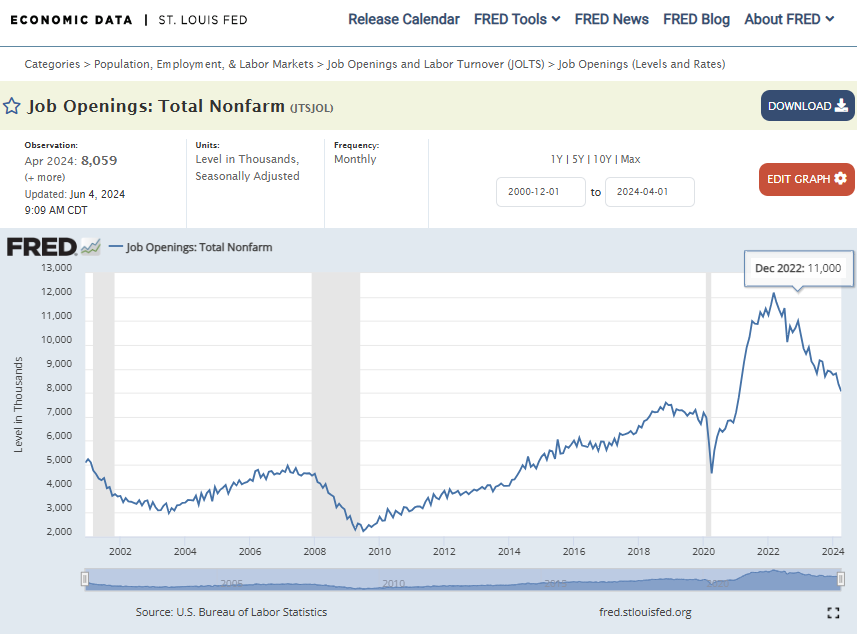
Job openings in the US are effectively falling off of a cliff. Prior sharp declines in job openings over the past twenty-five years have coincided with severe economic downturns – the Dot-com bubble of 2000, the Great Recession that began in late 2007, and the Covid recession of 2020. The current collapse in job openings, however, is an anomaly as the economy seems to be chugging along, albeit at a modest growth rate. This is just one of many anomalies in the current economic environment. Several obvious questions are why things are different this time and how things will play out from here. Hopefully, we will get a better understanding of these things in this week’s write-up.
Last week I touched on the clear disconnect between the non-farm employment data and the household survey, which tell dramatically different stories about the strength in the labor market, or lack thereof. The reality is that there has been effectively no job growth at all except in the part-time sector. There we have seen tremendous job growth, another indicator that usually coincides with an economic slowdown. The Labor Department addressed some of my issues by revising downwards job growth over the past year by more than 700,000 jobs, but the discrepancies are far larger than that. I expect additional revisions and clarifications over time, but the sad fact is that we need to be extra-cautious when we look at economic data when we are approaching a presidential election.
For many years, many economists and forecasters have missed the mark repeatedly with their loud, warning cries about an imminent recession. They have cited the inverted yield curve and a host of other factors as tried and true indicators. Nevertheless, despite their warnings, the economy has continued to post positive numbers. There are a variety of reasons for this continued growth, not least of which has been the rare combination of easy financial conditions and massive fiscal spending during a time of economic expansion.
Sure, the Fed has hiked rates from zero up to 5 1/4% in response to the worst inflation in over fifty years, but there have been many mitigating circumstances which have offset the impact of this monetary tightening. First of all, the Fed’s balance sheet is now more than $3 trillion larger than it was pre-Covid. This has had many knock-on effects that are highly supportive of economic growth. Second, the stock market is making repeated all-time highs. (The S&P 500 has made dozens of new all-time highs in 2024.) This has a very positive wealth effect, supporting further spending and investment. Third, the higher money market rates have a somewhat perverse positive wealth effect as well, as the increased interest earnings also support further consumption and investment. The higher rates simultaneously have a dampening effect on the real estate market, in particular slowing down the velocity of home sales, but the net effect is strangely supportive of growth. Fourth, the Fed has been holding a huge amount of money from money market funds which has been dumped into the banks, helping support their liquidity. Fifth, the Treasury Department is literally pumping trillions of dollars into the economy at a mind-boggling rate. It used to be that our federal government used dramatic fiscal expansion to offset short-term economic weakness during economic contractions. This new policy of fiscal expansion during a period of economic expansion is actually a somewhat twisted form of preventive medicine which is being used to try to address the terrible, long-term fiscal mess our government has created. It is also remarkedly short-sighted and long-term irresponsible as it puts an ever-growing economic burden on future generations, while severely restricting the flexibility of future administrations to handle future crises – which will inevitably come. The following charts illustrate the magnitude of these factors very clearly.
First, you can see from the Fed’s own financial condition index that financial conditions in the U.S. are extremely loose – among the loosest for many, many years. The next time you hear the Fed talking about their restrictive monetary policy, you should know that they are making up stories to suit a particular agenda.

The next two charts show you quite clearly the extent to which our federal government has resorted to dramatic deficit spending while proclaiming that the U.S. economy is remarkably strong. Is it really so strong? I don’t think so. Where would the economy be without the trillions and trillions of dollars of artificial government support. Deficit spending is a useful tool when employed wisely. In the hands of short-sided, self-interested leaders, it can be a devastating weapon that will eventually backfire on the very people it is supposed to serve.


I have written previously about the corner into which the Fed and the Treasury have painted themselves, and I have very serious concerns about the damage these policy decisions will have on our society over time. Frankly, we should be ashamed of the legacy we are leaving our children and grandchildren. With wiser leaders, we would have done much better. In fact, it is fair to say that we should have done much better.
At the current pace of debt growth, we will hit about $100 trillion in total government debt before 2040. ONE HUNDRED TRILLION US DOLLARS!! Think about the number for a moment, and then think about how we will pay back that debt, let alone cover all of the interest payments. Our debt is already growing at $1 trillion every hundred days. Have a look at this next chart, which shows a consolidated picture of all debt securities and loans for governments, households, and businesses.

This is really quite a shocking picture considering how quickly things can turn sour in the event of a sharp economic downturn. Servicing this debt could become nigh on impossible if we face another severe economic downturn, or alternatively, another spike in inflation that jacks up interest rates even further. Janet Yellen ran the Fed, and now she runs the Treasury Department. She is a brilliant woman, and she is clearly well aware of the data and the trends. When one looks at these charts, it becomes very clear why the government is using such drastic measures to keep alive the image of economic growth and strength. These charts display graphically why the authorities insist on kicking the proverbial can down the road indefinitely while leaving the mess to the next group of leaders to try to muddle through without causing a full-blown, widespread, financial collapse.
Every central bank governor and regional president at the Fed is undoubtedly instructed to put on a brave face when they make their regular speeches and conduct their periodic interviews. They are clearly told to talk about the progress they are making in whatever challenges we are particularly focused on at that time. Sometimes the challenge may be fighting inflation, other times it may be stimulating economic growth. Addressing head on the hard truth about the unsustainability of our debt situation must be avoided at all costs. As long as the dollar reigns supreme and our printing presses are functional, we can keep printing more and more dollars and growing our debt almost indefinitely – until the market screams, “NO MORE! We don’t trust you as a borrower any longer!”
Where is all of this heading? What are some of the options going forward? None of the options are particularly pleasant, although some are less lethal than others. Clearly, the interest payments on an ever-growing mountain of debt become more and more unmanageable if the economy and tax base aren’t growing in a commensurate fashion. In no particular order, some of the obvious alternatives are as follows:
- The most unpalatable and least attractive solution would be to sharply raise taxes for corporations and individuals – a LOT. That would be highly unpopular, and it would have nearly catastrophic consequences for economic growth. This is also the least likely as it would effectively guarantee that the political party that implements this policy would be voted out of office for a very, very long time. Would it eventually bring about a long-term solution? Maybe – but only after a long period of widespread economic hardship.
- A more palatable variation of this option would be to adjust the tax code to prevent the massive sheltering of income by US corporations in off-shore and overseas locations. These numbers are large, but due to intensive lobbying efforts, this will be a brutal battle. This would help address the problem somewhat, but it would not fix the problem in the long term.
- Impose a huge wealth tax on people with more than $X. What is X? That is unclear, and it would lead to a long, complicated, drawn-out fight due to the power of lobbying by the wealthiest people. This would actually be a popular initiative for the middle class and poorer segments of society. This is tricky, though, and clearly “undemocratic,” and it is rife with many challenges.
- Another variation of number 3 would be to more aggressively tax inheritances. This would be very hard to implement because of the obvious negative impact this would have on many voters.
- Sharply reduce government spending. An obvious target would be to cut back on military spending. Talk about a brutal battle! Trying to sharply reduce military spending would be a battle royale! Social Security and Medicare are underfunded in any event, but it is difficult to tell retirees that they need to go into poverty without adequate medical coverage because the government grotesquely mismanaged its finances and burned through their retirement funds. Cutting back on postal service would be another highly unpopular option – and frankly, a foolish place to seek drastic budgetary reductions.
- Privatization of government services – including the military – is a slippery slope that is potentially very dangerous. I can think of many reasons why I wouldn’t want to do this.
- Inflate our debt away. This is clearly the most palatable option as long as the rate of inflation is not too noticeable. In fact, we are already doing this. Put more crudely, using the metaphor of the boiled frog syndrome, as long as people don’t realize the value of their money is being destroyed systematically over time by a steady annual rate of 2% inflation (this rate of economic destruction has already been effectively accepted by nearly everyone), then this is the path of least resistance. Every 35 years, the value of our country’s debt is effectively halved by the dollar losing half of its buying power -- assuming a 2% annual rate of inflation. This solution makes the debt less expensive, although it also decimates people’s savings. For net savers who own real assets, this strategy works pretty well.
An important fact to consider here is a rather ugly alternative that a future government might choose. I can easily imagine a future government that is choking on debt service and struggling with the painful choice of which critical government services to cut, to take the scary, but plausible, decision to restructure its debt. It will never renege on the obligation to pay back the principal, but it could take the incredibly painful decision to arbitrarily decide to only pay an annual coupon of 1% or 2% until the bond’s maturity. Therefore, it wouldn’t be an outright default. It would be a sort of hybrid default that damages the government and the country’s credit standing, but not destroy them.
This would be devastating to people who are relying on government coupons for their survival, but their principal would be safe. Would this be legal? Of course not. Could it ever happen. Absolutely. Is there a way to hedge against this? Yes – buy zero-coupon bonds.
Bottom line, our government is desperate to continue maintaining the mirage of economic stability and strength. Our debt levels are too high, and they are going to grow and increase further – but each administration realizes that for the most part, this will be the problem of future administrations. Does this mean that we can continue to avoid recessions indefinitely? No. Rather, it means that when the next recession hits, it will be a doozy, as it means that the authorities’ fierce efforts to kick the problems down the road ran out of short-term ammunition.
There are currently many areas of concern in our economy. The S&P 500’s 34% rally since the lows of last October has been largely driven by a small segment of the stocks. This is not a healthy market, but it will likely become a bit more unbalanced before it finally reverses. I am expecting a blow-off top which could be triggered by a variety of things. In fact, this blow-off top doesn’t need a trigger, but I wouldn’t be surprised if it were to perhaps follow on the heels of the Fed’s long-awaited interest rate cut in the next few months. This isn’t needed, but it would be convenient since markets like to make important highs on good news.
Last fall, the stock market exploded higher on the promise of six Fed interest rate cuts this year. It was as good an excuse as any to buy stocks. The rate cuts never came, but market euphoria simply latched onto the next big theme – Artificial Intelligence. The AI euphoria then swept over the market, driving the tech sector valuations to astonishing levels. Again, this was as good an excuse as any to push the market higher. Nvidia’s PE ratio of nearly 77 is certainly pricing in an awful lot of good news. Nvidia, however, is hardly alone with its exceedingly optimistic valuation. Whether I look at the Shiller PE ratio, the Buffett Indicator, differentials between current levels and long-term moving averages, or pretty much anything else, the risks in the equity market are very extreme. My own proprietary models are flashing bright red WARNING signals right now.
The commercial real estate market is a mess. The chart below shows how drastic the drop has been in price per square foot. It is actually quite frightening. The last time we saw this sort of crash in the price for US office space was during the Great Recession. The nationwide price per square foot is now down 43% from the peak.

In a way, we are facing unprecedented market conditions. We simultaneously have sharp drops in the volume of home sales, sharp drops in the number of full-time workers, severe problems in commercial real estate with more to follow due to the challenge of major refinancings, equity market valuations are severely stretched, and we have a brutal presidential election over the next four and a half months. I could go on and on about potential risks, but for the time being, downside risks in equity market valuations are irrelevant. Good news is accepted as good, and bad news is interpreted as good because it means the Fed will be more likely to respond in kind with rate cuts.
Realistically, this sort of bubble-like environment won’t end unless it bursts. That is the way bubbles always end. The weird thing is the extent to which these bubble conditions are spread across so many markets. As a momentum trader, I simply maintain my trend-following exposures with trailing stops. As a discretionary trader, I have started to lightly position myself for some major reversals using limited-risk option strategies.
In the currencies, as I have noted previously, I think that the yen will have a major reversal over the next nine months to one year. The mere flattening of positions could easily lead to a 10% - 12% price change in the various yen crosses. Additional capital flows could easily lead to an additional 5% move. The Japanese authorities are increasingly alarmed by the yen’s weakness, and they absolutely have the power to force market players to unwind their positions. They also have the power to strong-arm Japanese companies to start repatriating some of their overseas investments.
I remain overall bullish on gold and silver. These have been relatively obvious and easy trades this year. I generally like real assets in the current environment. Oil looks like it might have finally put in a major low, but it is a little early for me confirm this. Fixed income is a bit tricky. I see some residual inflationary pressures coupled with some serious economic headwinds. Therefore, I am going to hold off on specific forecasts there except to say that the Fed will cut rates as soon as possible.
The problems in Europe are real, and they could worsen significantly. I have been playing that primarily by buying Swiss francs against the British pound and Euro. These crosses have been very nice plays, and they should have further to fall -- but from current levels I would wait for a bounce before entering if I didn’t already have positions. I also like the Australian dollar versus the Canadian dollar. It is a slow-moving cross, but it has quite a lot of upside from current levels. In my next write-up I will focus on several specific trade ideas that I particularly like now.
In the interim, wishing you all the best of luck with your trading.
Andy Krieger