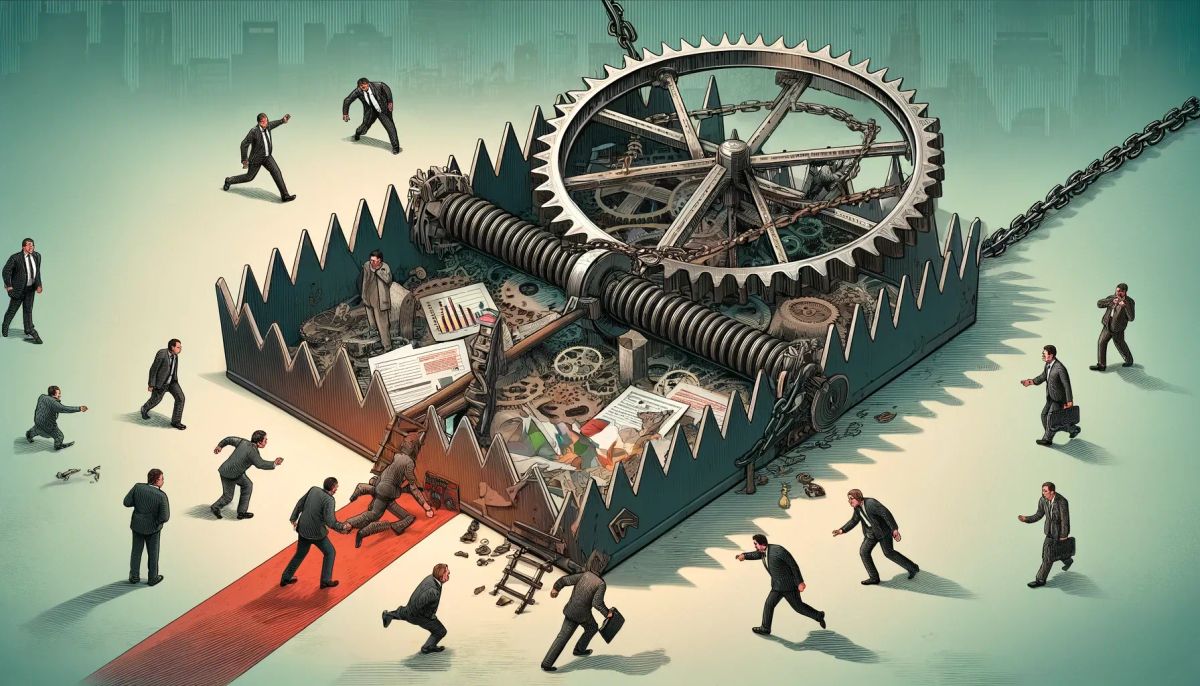
Policymakers Are Stuck in a Trap of Their Creation
They have been kicking the can down the road for a very long time, careening from one crisis to another always trying to make things look a lot better than they were.
Last week was a strange week in the markets. The jobs data that was released on Friday for the month of May presented a message of two inherently contradictory stories. The household survey showed a shocking drop of 408,000 jobs, while the BLS nonfarm payroll report showed a stunning 272,000 new jobs, far more than expected. Either the job market is much stronger than expected – or much weaker – but both can’t be true. The Fed and the investment community chose to embrace the nonfarm payroll numbers, so treasuries got slammed, with yields climbing by nearly 3½ percent across most maturities.

At the same time, however, the unemployment rate rose from 3.9% to 4.0%, providing a hint about the real state of affairs. Moreover, downward revisions by the Bureau of Labor Statistics told us that payrolls over the last year were overstated by about 60,000 per month on average. That was a significant reduction that is actually quite worrisome. So, which is the real story? Is the jobs market really much softer than first thought, or is the market still extraordinarily tight?
As you can likely tell from my prior write-ups, I am leaning strongly towards the former. I believe that there are underlying weaknesses in the economy and jobs market that haven’t yet fully manifested in the rest of the data. Regardless of whether the data is being massaged to appear better than it really is, or whether we have some strange statistical anomalies that somehow permit both stories to simultaneously coexist, I expect that over the coming six to nine months some major cracks in the economy will appear. Based on prior experience, I would expect the authorities in power to do everything possible to delay the cracks until after the November election.
The reality is that in the past two years jobs growth has dramatically overstated the strength of the jobs market. In fact, the difference between the headline employment number and the household survey is now more than 4 million. There are millions of people who are working multiple jobs, so this discrepancy appears because workers in the household survey are only counted once.

The Bureau of Labor Statistics may try to smooth over the data and present a rosier picture as we head into the elections, but the divergences are becoming too large to just smooth over. Purchasing manager surveys are soft, pending home sales are way down, credit card delinquencies are way up, and commercial real estate is suffering, and likely to get even worse. The Fed is itching to cut rates because they know the truth, but the inflation data is simply too high – unless the Fed can sell its story that the 2% inflation target needs to be put on hold for the time being.
I have now seen multiple articles promoting the idea that a 3%, or even a 4%, inflation target is fine for the time being. Yellen and Powell are paying very close attention to the reception of this idea, as they are increasingly desperate to get interest rates lower. The US government needs to refinance over $9 trillion over the next twelve months!! In fact, over the past four years the US government’s accumulated deficit has exploded by more than $11 trillion. There is no doubt that the authorities are well aware of this requirement, and they are very anxious to get their borrowing costs down as much as possible.
Yellen has been issuing bonds at an increasing pace with shorter maturities in hopes of having lower funding costs over time. The timing for Yellen is getting tricky as the already frightening, longer-term projections of the Congressional Budget Office assume much lower interest rates than the rates currently available in the market. Sticky inflation is complicating her strategy, and it is further complicated by the fact that foreign government demand for US treasuries has weakened over the past several years. Plus, we are moving into increasingly dangerous territory now as our borrowing requirements have surged as the cost of borrowing has shot higher. This is an ugly combination.
The CBO’s own forecasts are clear, but to potentially realize them, inflation and interest rates must come down. To the extent the government’s funding costs exceed the targeted rates, the government’s finances will be notably worse. We can scarcely afford this, as the current debt to GDP ratio is already extremely high at roughly 125%, and it could potentially double over the next thirty years. That would make our financial position very tenuous. This is not a sustainable path, and we must make some changes in order to avert a catastrophe.

The current debt levels are now worse, on a percentage basis, than the levels we had during World War II. The problem, as noted, is that they look set to get much worse over the coming years. In fact, if you look at these projections, you will find a number of highly questionable assumptions. Frankly, they are way too optimistic, and the interest expense that is baked into these numbers seems way understated. Is it even remotely accurate to assume that interest rates will remain at 3%, or between 3% and 4%, for the next thirty years. We aren’t even close to that now! Also, is it realistic to assume that inflation-adjusted GDP will continue to grow at a steady rate, with no significant bumps along the way? There are also problems with the assumptions that they make regarding the size of the government deficits, which are very much understated.
Our government is already leveraged, and our central bank’s balance sheet has ballooned out. When the US debt situation was less frightening, it was more sensible to think that government spending could pick up some of the slack when the economy hits rough patches. That ability to borrow and spend, however, has limits, and we will hit those limits much sooner unless rates come down a lot – and soon. Somehow that is supposed to happen in a relatively non-inflationary cycle. This sort of thing was far more plausible when we entered a long-term disinflationary cycle nearly forty years ago, but projecting this out into the future seems more like wishful thinking than serious forecasting.

Last week we saw several G7 central banks take action by lowering interest rates. As expected, the Bank of Canada lowered its overnight interest rate from 5% to 4.75%, its first rate cut in over four years. The Canadian central bank governor, Tiff Macklem, noted that further rate cuts would follow if inflation continues to slow towards their 2% target. This move was particularly important to the Canadian authorities considering the extremely elevated household and corporate debt levels in Canada.
Canada’s economy is heavily reliant on real estate, with the housing market contributing more than 20% of the nation’s total Gross Domestic Product (GDP). This is by far the heaviest weighting of any G7 nation, so the central bank is particularly focused on doing whatever it can to try to keep a cap on the cost of mortgages.
Housing is also critical to the Canadian economy as a store of wealth. There is currently an enormous wealth gap between renters and owners, as the cost of housing in Canada has risen dramatically since 2000. In 2000, the average price of a residential property was about $225,000. Today, the national average home price is about $655,000, an increase of nearly 200%.
One of the most important points that we need to bear in mind is that central banks typically lower rates to address a problem. It is easy to forget this very basic, but very forgettable fact. The Bank of Canada lowered interest rates because the housing sector is struggling with higher interest rates and economic growth has slowed in Canada. Clearly, lower interest rates will have positive ripple effects in the economy as the cost of mortgages can start to ease.
I am not going to start my regular diatribe about the not-so-innocent 2% inflation target. Suffice it to say, that when inflation in Canada was north of 8% in 2022, there were loud and piercing screams of pain across the country. The screams when inflation is 2% are more muffled and less insistent, but nevertheless, they are still there. Canada has now joined the ranks of other countries which have already cut rates this year – Sweden and Switzerland. For sure, more will follow regardless of the level of inflation at the time of cutting. Remember, when it comes to monetary policy, one excuse is as good as another, even if the excuse makes no sense.
The ECB demonstrated this cynical view perfectly when they took the decision last week to lower rates from 4% to 3.75%. In fact, the ECB’s decision really pre-empts the drop in inflation, as the ECB’s own forecasts don’t show inflation coming down to the central bank’s 2% target for a very long time. Christine Lagarde, the president of the ECB, said that they had made tremendous progress in their fight against inflation, and that over time the inflation rate would continue to come down. In fact, the ECB’s suggestion that great progress had been made was largely refuted by voters in the eurozone over the weekend as gains by the far-right in voting for the European Parliament on Sunday prompted a bruised French President Emmanuel Macron to call a snap national election, adding uncertainty to Europe's future political direction.
The outcome in the elections clearly reflected people’s discontent with the severe cost-of-living pressures over the past few years. A recent survey by the Wall Street Journal was telling. Bottom line – people HATE inflation. In fact, below is a copy of the headline from the Wall Street Journal. I think that this headline summarizes the attitude of people very well. Trying to raise the inflation target will be a very dangerous and very unpopular move. Don’t expect people to accept it calmly.

A big part of this issue is that people may not feel the squeeze of higher prices on a monthly basis, but collectively, over time, inflation hurts. Consider the chart below. It shows very clearly the cumulative impact of inflation only since the end of 2020. This is a serious problem, and the leaders in government should not delude themselves into thinking that people don’t notice price increases. On a month-to-month basis, .3% or .4% increases might not be so painful, but over time, price increases are absolutely noticed and absolutely detested by the majority of consumers. The cumulative impact of price increases has been very big, and people definitely notice.

So, the authorities are stuck in a trap of their creation. They have been kicking the can down the road for a very long time, careening from one crisis to another, applying patches, bandages, and even tourniquets when necessary; always trying to make things look a lot better than they were. This has been standard practice for decades, but particularly since the Great Recession, when the system really was on the brink of a major meltdown. This is the basic practice of people who are in power. The US situation is hardly unique in this regard. Bottom line – people in power like to stay in power, and they sometimes go to extreme lengths to try to maintain the status quo. At some point, though, the authorities will need to come clean about our fiscal and monetary mess, and the repercussions will not be pleasant. I could speculate at length about what those repercussions might look like, but the recent reaction of voters in Europe to the establishment is just a small taste of what we might expect here.
Consider the following basic facts. In 1971, at the advent of the dirty float of the US dollar, gold was trading at $40.80 per ounce. That same ounce today is trading at $2310. This means that the value of gold in 1971 was less than 1.8% of its current value. This is effectively the cost of inflation. For wealthy people who own real assets, inflation over time gives them a feeling of greater wealth. For the supermajority of people, however, the cost of inflation in housing, education, and general living expenses has far exceeded their increases in wages. If the authorities think they can keep masking underlying problems indefinitely, without ramifications, then they need to rethink their strategy. The fact is that economies go through cycles, and it is not natural to try to offset every downturn with excessive monetary and fiscal stimulus. Slowdowns occur for a variety of reasons, and micromanaging every little economic softening is unnatural. It is exactly what leads, over time, to the mess we are in now.
We are at an important juncture in the markets. The stock market keeps making new highs as a very small percentage of stocks distorts the overall performance of the market. There are enough warning signals out there that this rally in equities is getting very, very extended. It would only be natural at some point for a corrective cycle to happen. Trying to delay its onset can work for a while, but not forever. It is the fantasy of many central bankers that they can forestall permanently any major stock market corrections or economic recessions, but the cost of that process can far exceed the short-term benefits.
In the currencies, the dollar is strong against most major currencies, with the yen showing particular weakness for the year. Now that other central banks are starting to cut rates, their currencies will likely weaken further in the short term, but over time that weakness tends to normalize. We saw this play out with the Swiss franc when the Swiss National Bank cut rates in March. The currency sold off sharply for a few weeks before the prices normalized and started to revert back towards prior levels.
Am I still expecting the yen to put in a major recovery? Yes, but not immediately. I will trade in the spot market in the short-term, playing for swings periodically of one or two percent, but the big picture price adjustments take a long time. This shorter-term play is exactly the sort of trade I put on when dollar yen traded up toward 157.50 on the 3rd of June. I was happy to take an aggressive short-term position, looking for a play that lasted several days. The trade worked out fine, and I run those sorts of plays independently of the longer-term plays where I use limited-risk option strategies. It takes a massive amount of flows to create a 10%, or larger, price shift in the currency market, and it takes a lot of patience to capture such a move. A market which trades over $6 trillion a day is very deep, and it takes big shifts to move the market on a sustained trend. The volumes that drove the yen to 160.00 from 140.00 were gigantic. It will take time for those positions to get unwound and for the major, underlying trend to reverse.
The Japanese authorities are very concerned about the yen’s weakness, and they are going to start applying increasing pressure on Japan Inc. to start repatriating some of their overseas funds. For quite some time, Japanese companies have been leaving their profits overseas. They will therefore have several massive buckets to bring home: a portion of the accumulated assets that are invested overseas and a portion of their ongoing overseas cash flows from operations.
In a major risk-off scenario, the dollar will typically benefit against nearly all currencies. The yen is the second most popular beneficiary when the markets go into a risk-off mode. In the current situation, it is not hard to imagine a number of problems emerging over the coming months which would ultimately lead to a major reversal in the yen’s fortunes – if not against the dollar initially, at least against most other currencies. Therefore, my longer-term plays consist of a basket of currencies against the yen, not just the US dollar. Over the very long term, I would expect the US dollar to have a major decline against nearly all the other currencies, but that is a topic for a different day.
In the precious metals, I remain very constructive long-term on gold and silver. The recent sell-offs still look corrective, which is natural after such huge rallies. Silver has surged from $22.00 an ounce up to $32.50 an ounce in just four months, a gain of nearly 48%. A correction of 10%, or even much bigger, is natural and healthy. Markets need to correct in order to establish new equilibrium levels and clear out the weak speculators. It will take a much deeper sell-off to get me to reconsider my long-term bullish view on silver. The US, along with most of its major trading counterparties, are doing enough irresponsible things that it should be safe for quite a long time to hold onto some real assets as a portion of our portfolio.
In the meanwhile, wishing you all the best of luck with your trading.
Andy Krieger