A Very Worrying Story for the US Economy
The overall macroeconomic scene is, frankly, a big mess right now. One might say that if things start to unravel, then the scene would quickly devolve from being a mess to being outright terrifying.

In my last write-up, I focused heavily on the bull markets in gold and silver. I have been touting these trades for many, many months, and the markets have cooperated nicely with sharp rallies. Given the underlying fundamentals in the global economy, these rallies have been among the easiest markets to forecast in a very long time. Silver continued its surge and nearly touched my intermediate target of $30.00, while gold got within shouting distance of $2500.00 per ounce. Both gold and silver corrected sharply late on Friday when heavy selling caught some short-term players long. The authorities are deathly afraid of market moves which suggest that inflationary pressures are spinning out of control again, so they welcomed the selloff. Both gold and silver should resume their rallies after a period of consolidation and choppy trading.
A number of major banks have finally noticed that gold and silver were in the midst of major rallies, and they put out revised forecasts this week, sharply raising their year-end targets.
Goldman is now expecting gold to reach $2700.00 per ounce, while Bank of America is expecting gold to reach $3,000.00 Their revised forecasts coincided almost perfectly with the sharp selloffs on Friday, but overall, their forecasts will be fine once the markets consolidate some of their recent gains.
This past week was notable for many reasons, not least of which because it seems that economists and analysts are finally waking up to the reality that financial conditions in the U.S. are way too loose. Consumer Price reports have become the most widely watched economic indicator over the past three years, and Wednesday’s report sent shock waves through the system. Federal officials tried to ignore the hotter-than expected readings from January and February, but the March numbers forced the Fed to take note and admit that there is still a serious inflation problem in the US.
Consumer Price Inflation figures hit their highest levels in seven months, reinforcing the fact that there is absolutely no justification right now for the Fed to cut rates. Inflation is running hot, and the sharp rally in many commodities is worsening the situation. Consumers are still spending – albeit with ever-increasing levels of credit card debt – and the government is still borrowing and spending at an insane pace, so rising price pressures will persist. The Fed is stuck between a rock and hard place because there are growing signs of economic weakness that make the task of taming inflation progressively more complicated. Plus, it is an election year, so the Fed will bend over backwards to try to forestall a possible recession.
I have written for a long time that inflation would be sticky, and there is no way that we will get to the Fed’s 2% arbitrary inflation target by cutting interest rates in the current environment. In fact, I would argue that the Fed really should hike rates and engineer a recession in order to get inflation under control, but the chances of that happening in an election year is essentially 0%. In fact, even a recession won’t assure us that inflation will drop sharply any time soon, as stagflation would be the likely short-term outcome.
As you can see in the Fed’s Financial Conditions Index below, conditions are now the easiest they have been since early 2022, BEFORE the Fed started hiking rates.
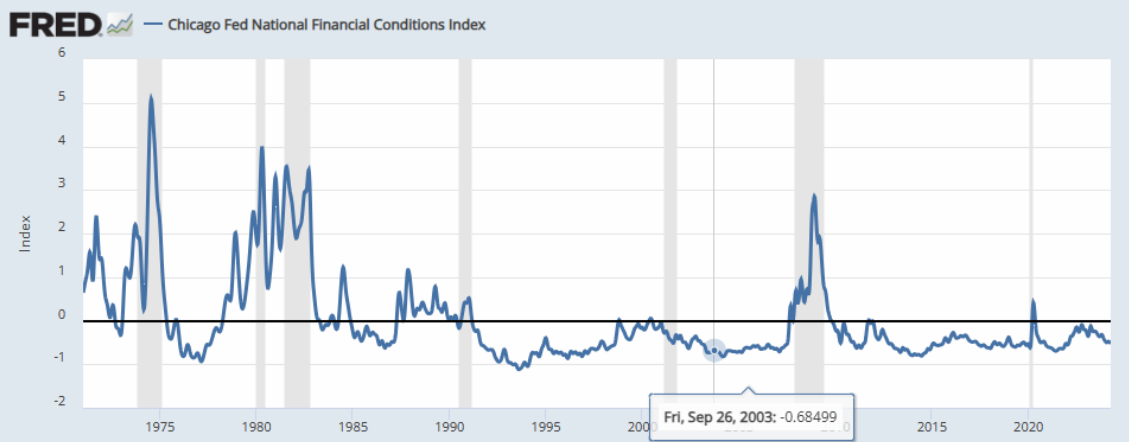
In prior newsletters I wrote extensively about the loose financial conditions in the U.S., and I am quite sure that the Fed officials, with more than 400 full-time PhDs on staff and access to the best economists on the planet, were well aware of their disingenuous double-speak when they talked about soft landings and said that conditions were ripe for lowering rates due to the “tremendous progress” they had made in quelling inflation. Clearly, the Fed and Treasury have been trying to cover up a very serious problem, but there is a limit to how far they can kick the proverbial can down the road before that problem manifests.
Credit card delinquencies are hitting all-time highs and commercial real estate is under unprecedented pressure. By way of example, the 44-story One AT&T Center in St. Louis, the third-tallest building in the city, just sold for $3.5 million – after trading for $205 million in 2006!!! The Dallas News just noted that if a premiere building in St. Louis can trade at a 98% discount, what does this portend for Dallas Fort Worth?
Tomasz Piskorski, the Edward S. Gordon Professor of Real Estate in the Finance Division at Columbia Business School has pointed out that Commercial Real Estate (CRE) faces a number of massive headwinds:
- Office loan delinquencies are increasing and the vacancy rate in CRE is hitting all-time highs.
- Covid-era work habits have permanently altered office space utilization, and the banking sector could easily face a devastating credit crunch after accumulating approximately $2.2 trillion in unrealized losses over the past several years. (The total market capitalization of US banks is about $2.2 trillion. *See the data below.)
- There have been massive layoffs in the technology sector, exacerbating the CRE problem. In 2023, according to Statista, more than 262,000 employees in tech companies worldwide had been laid off during the year. More than two-thirds of these layoffs occurred in the United States. The combination of high inflation, rising interest rates, softening economic growth, and smaller profits margins took a heavy toll.
- Regional lenders could easily face a wave of defaults as commercial property owners struggle with higher interest rates.
- Small US banks originate roughly 80% of CRE bank loans, and in addition to their huge mark-to-market losses on securities holdings, they could get overwhelmed by a wave of CRE defaults.
*As you will see in this list of the thirty-two largest banks in the U.S., the net capitalization on a marked-to-market basis, after adjusting for the unrealized losses, is shocking.
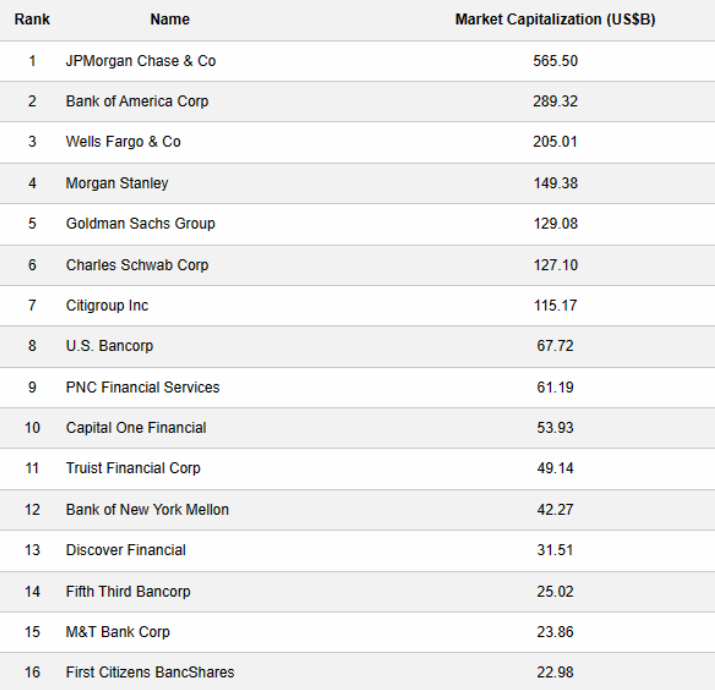
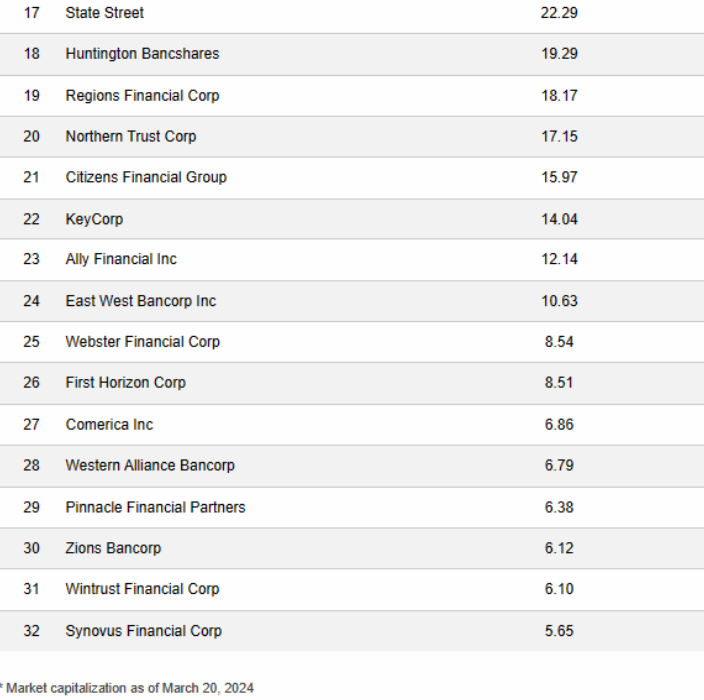
The total market capitalization of these banks is $2.148 trillion.
The overall macroeconomic scene is, frankly, a big mess right now. One might say that if things start to unravel, then the scene would quickly devolve from being a mess to being outright terrifying. The unraveling could come in any one of multiple forms, with many possible catalysts. Stagflation is real estate’s worst-case scenario, and it is a growing possibility. As noted, I don’t expect the Fed to intentionally engineer a downturn, but the likelihood of a serious downturn is increasing. Stagflation is probably a worst-case scenario for equities as well, as they are priced for perfection right now.
Once we consider the growing geopolitical unrest in the Middle East (with Iran and Israel tensions at an all-time high, Hezbollah and the Houthis shooting drones, rockets, and missiles, fighting in Gaza, etc.), the worsening situation in Ukraine, the price surges in various commodities, US political uncertainty in an election year, and the huge unrealized losses being carried by the banks, then we are looking at a potential perfect storm. No wonder the authorities are trying to deflect all tough questions and present a rosy picture to the unsuspecting public.
The layoffs in the technology sector bring me to another fascinating topic – the US labor market. The jobs reports in the U.S. have been a wonderful example of how statistics can present a very different picture from reality. I believe that the picture below gives us a far more accurate understanding of the “robust” US employment market than the commentaries from Fed officials and mainstream media reporters.
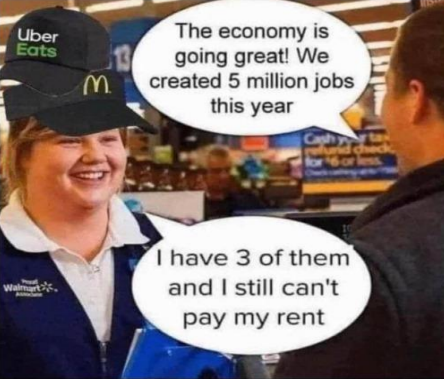
The Bureau of Labor Statistics reported this week that the US economy added 303,000 jobs for the month of March, while the unemployment rate fell to 3.8%. In typical fashion, the financial news media reported this information as further evidence of a powerful labor market with robust underlying strength. Fed officials chimed in and said the report provided evidence of a strong jobs market, and Biden touted the report as marking a “milestone in America’s comeback.” Unfortunately, the reality is quite different.
In fact, full-time jobs in the US have been disappearing, and the job growth reported is comprised of virtually all part-time jobs. In the past four months, for example, the total number of employed people has fallen by nearly four hundred thousand jobs, and 1.8 million full-time jobs have disappeared over the same period. At the same time, the official jobs data shows a sharp increase in new jobs.
The real data portrays a very worrying story for the US economy. This sort of loss in full-time jobs is normally a harbinger of a recession. Employers typically shift to part-time employment strategies in response to weakening economic conditions. Moreover, temporary jobs are often the first jobs to be eliminated once the economies weaken sufficiently. Another concerning aspect of this report is that nearly 25% of the new jobs were government jobs. When government jobs comprise more than 20% of the new jobs, it is another strong indicator of underlying economic weakness.
This employment situation is just one of the many indicators that point to a growing chance of a recession. I have mentioned some of the others. We also have an inverted yield curve, diminished net savings, record credit card delinquencies to add to our long list of potential problems. If you will pardon my cynicism, please consider the following quote from the Dallas Fed – from September 26, 2007, right before the Great Financial Crisis.
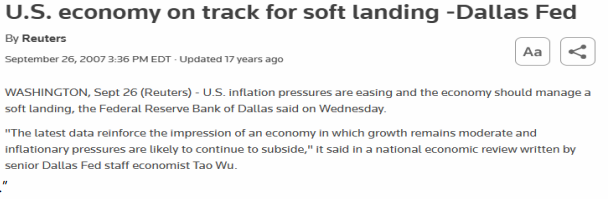
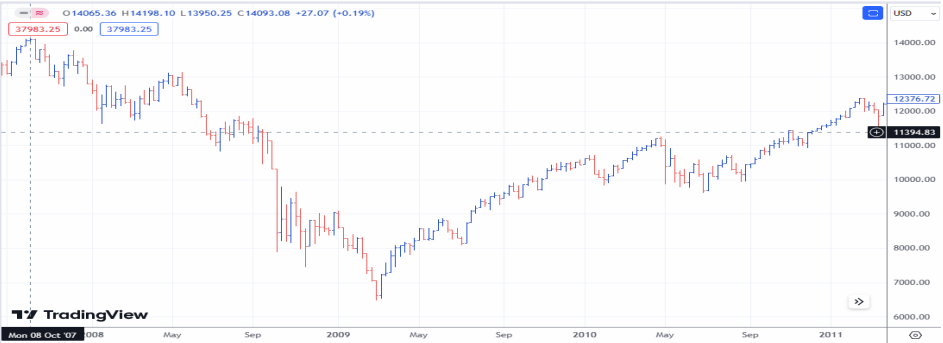
Now look at the chart of the Dow from October 8, 2007, less than two weeks later!! It was certainly unfortunate timing on the part of the Fed. One could say that the analysis of the Dallas Fed couldn’t have been more prescient – as a counter-indicator.
Looking ahead, I think that over the coming weeks and months, there is a growing likelihood that the markets will shift progressively towards a risk-off scenario. There are so many things that could go wrong that the odds are becoming heavily skewed that way. This would include downward pressure on stocks, and an eventual sharp appreciation by the yen on the crosses. I have been patiently waiting for yen strength to appear, and this past week we finally saw some early signals that the move will start soon.
I wish you all the best of luck with your trading. The markets should be very active.
Andy Krieger