Long-Term Impact of the Bank of Japan's Important Decision
As this move by the BOJ will be the first such move in seventeen years, we really must not underestimate the importance of this decision.

This week should have lots of fireworks as the Federal Reserve Open Market Committee (FOMC) and the Bank of Japan (BOJ) meet to decide the future course of interest rates in their respective economies. In a way, the BOJ meeting is more interesting as Bank of Japan Governor Kazuo Ueda and his board have decided today to proceed with the first rate hike in Japan in seventeen years.
Suggesting that the BOJ is cautious is an enormous understatement. The BOJ has been saddled with a brutal job for the past thirty-four years as the bursting of Japan’s real estate and stock market bubbles led to a multi-decade, crushing deflation. Yes, the BOJ’s policies in the 1980s contributed to the bubble, but dealing with the aftermath has been a very rough task.
The BOJ has been on a strange experimental path, intervening constantly in multiple markets, with massive purchases of stocks and bonds while using negative interest rate strategies to try to induce spending. Clearly, offering depositors negative interest rates provides a strong disincentive for the investors to hold their savings in cash deposits at banks, but this hardly gives consumers the confidence to go out and spend their money when the economy is clearly not on very solid footing. Quite frankly, the psychology of the BOJ’s strategy has been a mixed bag with questionable results. I would think that typical investors would prefer to invest and spend money when they feel that prospects look promising and that the future does not look bleak. Nevertheless, despite a plethora of mistakes by the Japanese authorities, it looks like Japan is finally on the mend.
The psychological impact of Japan finally abandoning its negative interest rate policy will be fascinating to observe. The Japanese economy is still massive, and Japanese investors hold trillions of dollars in overseas markets. I don’t expect a move of ten basis points in and of itself to be a massive catalyst for investors to immediately repatriate hundreds of billions of dollars of their overseas holdings. Rather, I think the psychological impact of the move could finally give Japanese investors the confidence that their economy has turned the corner and that the future prospects indeed are looking better. This should lead to the continued repatriation of capital from Japanese investors that could easily accelerate under certain conditions.
With over three decades of deflation coming to an end, we can now expect companies and consumers to finally resume their investments and purchases. The mere expectation that prices will rise moderately over time will impel consumers to spend and companies to invest in the future. As noted, I don’t expect a massive immediate reaction when the BOJ makes this long hoped-for announcement, but I do believe that this announcement will further support two underlying trends, namely the continued allocation of global funds to a sensibly priced Japanese stock market and the further repatriation of overseas holdings to capture the higher yield now offered on thirty-year Japanese bonds. The repatriation of overseas funds by Japanese investors is a recent phenomenon, but I do expect it to continue.
In addition to ending their negative interest rate regime, the BOJ is going to terminate their purchases of real estate investment funds and exchange-traded funds. As these markets have finally stabilized, the authorities in Japan will finally leave these markets to grow unassisted. The central bank, however, will continue to lend support to the Japanese bond market in order to keep things calm on that front. The central bank will try to keep bond yields under 2% for the time being in order to keep the cost of long-term capital attractive for Japanese corporates. The BOJ’s priority is two-fold: to support economic growth and further reinforce the modest level of inflation that has only recently revived after a very long and painful deflationary cycle.
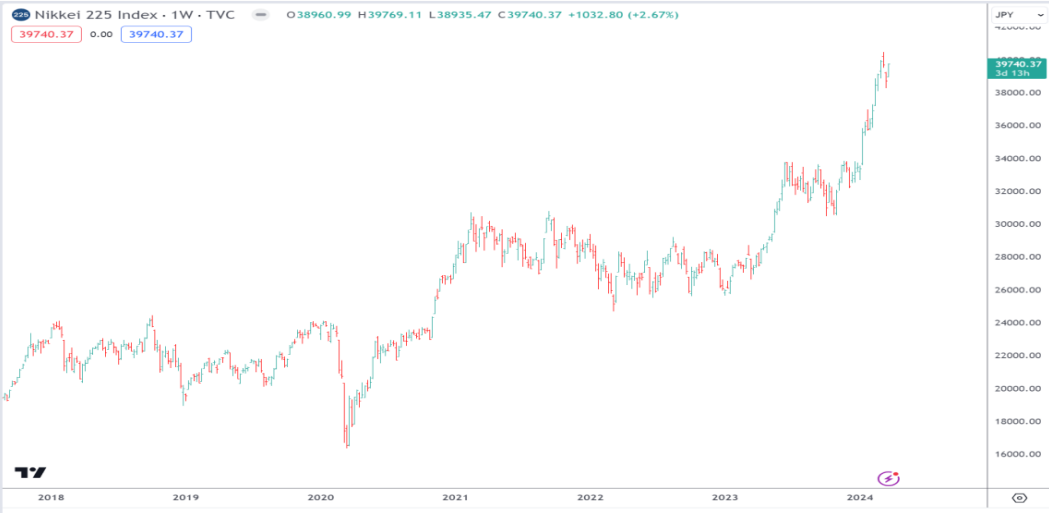
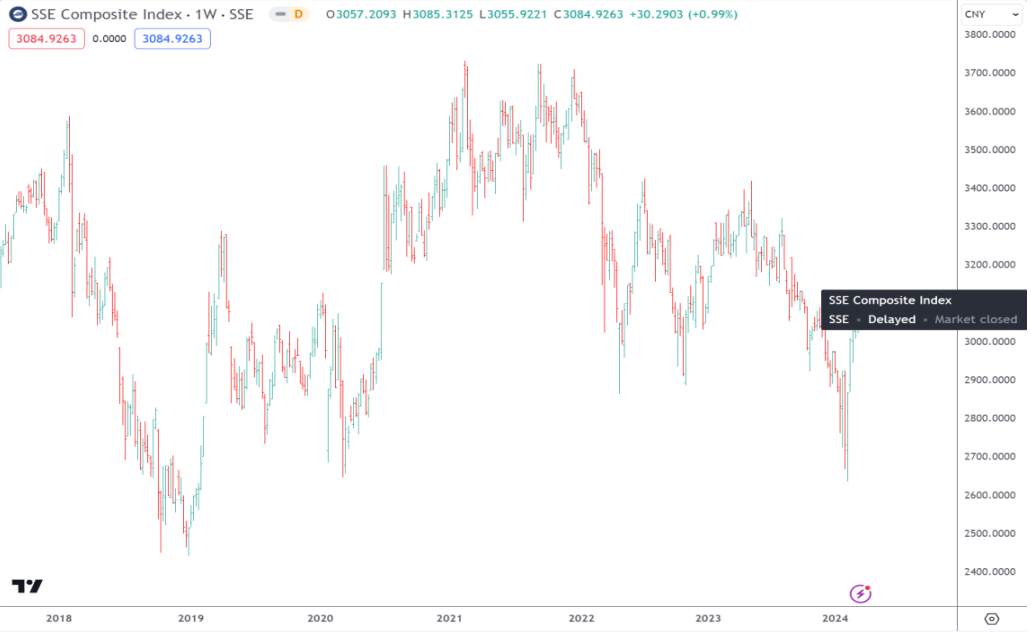
While economic growth in Japan has been modest, the mere fact that consumption and investment have returned has helped fuel a very strong equity market. In fact, the stock market in Japan has been anticipating this sustained shift for some time. As you can easily see below, the Japanese stock market has been a stellar performer for a few years now while the Chinese equity market has languished. The Chinese economy has run into a variety of problems, and at the same time, there is growing geopolitical pressure on China. The Chinese real estate market is in crisis, and government support is doing very little to stop the pain. The Chinese stock market was recently dramatically oversold, so recent government intervention has led to a bounce, but it is not clear that the bleeding in China has stopped. This overall relative outperformance looks likely to continue.
Will this move by the BOJ lend short-term support for the yen? Not really, as many speculators will want to “sell the news” and try to press the yen’s value lower. The reality is that the yen is still an attractive funding currency as long as it remains stable to weak. Interest rate differentials are still weighted heavily in favor of other currencies. The challenge with using this strategy is that the yen is also the ultimate safe haven currency, so when there is perceived danger in the global markets, the yen can strengthen very dramatically.
Rather than expecting this move by the BOJ to lead to short-term, dramatic yen strengthening, I rather see the yen’s longer-term strengthening resulting from a variety of influences. The primary influences will be such things as continued steady capital inflows from both domestic and global investors to benefit from relative stock market outperformance, higher Japanese domestic bond yields, the eventual unwinding of monstrously large, short yen carry plays, and a more significant narrowing of interest rate differentials between the yen and a variety of other currencies once the other central banks start to cut their rates. In fact, the mere expectation of lower rates from other central banks will be sufficient, as the market will discount the expected effect.
The European Central Bank is almost certainly going to start cutting rates within a few months, and the pronounced economic weakness in Europe will likely lead to multiple interest rate cuts. The European authorities are very concerned about a recession, and they hope that lower interest rates will forestall a further economic slowdown. The same goes for the UK and Canada.
As these interest rate differentials narrow, I expect the yen to start outperforming on a relative basis on most major cross currency plays.
The situation with the US is not as clear. Inflationary pressures in the US remain very sticky, and the recent inflation data has been very concerning. This means that the Fed will almost certainly need to delay its interest rate cuts a bit longer than it would otherwise prefer. The political pressure on the Fed to cut sooner is extreme, but unless we see some much better inflation data coming in over the next month or two, even an interest rate cut in June is doubtful.
Things can change quickly, however, and nothing could impel the US central bank to cut rates sooner than a good, old-fashioned market crisis. Given the extreme equity valuations and the fact that the stock market is priced to near-perfection, a sharp sell-off/correction could quickly trigger a knee-jerk response from the Fed to cut rates. This has become a Pavlovian-type response that is quite predictable, however misguided it might be. Despite the current optimism in the US markets, it is not hard to imagine things turning ugly. The presidential election is likely to be a very nasty political battle that could prove very divisive, and there are some underlying signs of economic vulnerability in the economy. Moreover, certain sectors, such as commercial real estate, are performing very poorly, and huge refinancings might prove tricky.
As this move by the BOJ will be the first such move in seventeen years, we really must not underestimate the importance of this decision. The market reactions over the coming days and weeks will be important. Although Ueda will only offer very careful and measured optimism, it is very significant that Japan seems to be breaking out of its long-term deflationary cycle. The recent wage negotiations in Japan were critical, and they really cemented what I have been writing about for many weeks, i.e. that the end of negative interest rates in Japan was a near certainty.
The Japanese hold well over $1 trillion of US government debt, and they also own significant amounts of US stocks. They also hold hundreds of billions of dollars’ worth of European bonds This anticipated move by the Japanese central bank could set in motion forces that will take years to play out, but the impact of these moves could be far-reaching.
Clearly, the US and Japan are at very different stages in their respective economic cycles. The US has been on its own bizarre economic path, with the central bankers and senior treasury officials seeming to believe that recessions can be permanently forestalled if the government borrows and spends enough money and the central bank pumps enough liquidity into the system. Perhaps it is better to say that they hope this is the case, as I am sure that many senior economists have grave doubts about this policy. Put simplistically, the US has become a debt-junkie, and the authorities seem more than happy to keep supplying the drugs to the addict.
Even the so-called monetary tightening in the US has been a sham, with banks’ capital reserves larger now than before the Fed’s so-called monetary tightening program began in 2022. Overall, this dangerous game can continue as long as investors remain willing to buy the US government paper at attractive interest rates. What isn’t fine is what the markets will do when the appetite for US paper starts to go away. Interest rates will back up unless the Fed becomes the primary buyer of the ever-growing US government debt. At that point, however, there will be an outcry from many nations to end the dollar’s role as the global reserve currency as the dollar’s value will be seen to be questionable. Although the Japanese may only hold a small percentage of total US debt, the amount of dollars that they hold is very significant. If they were to ever repatriate a large percentage of their holdings, the dollar could crash. Do not underestimate the potential impact of this move by the BOJ on the long-term stability of the US markets, however unintended this impact might be, as over time it could easily lead to large-scale repatriation of US dollar assets by Japanese investors. It would not be the intent of the Japanese to destabilize the US markets as we are a massive market for their exports, but the ramifications of the BOJ’s move could still lead to dramatic changes over a longer period of time.
The US will fight hard to maintain the status of the US dollar as the global reserve currency, but its massive debt issuance will make this job harder over time. The dollar’s reserve status is critical to the hegemonic status of the US, so this possible shift would lead a brutal fight. In fact, it could easily lead to military confrontations. In the meanwhile, let’s see how far the market will try to push the yen. I persist in my view that yen weakness on the back of the BOJ’s rate hike will be relatively short-lived. I will have a variety of market forecasts next week, but I simply wanted to set the stage this week for what I expect will be the start of something that will have long-term, profound influences on many markets for many years.
Wishing you all the best of luck.
Andy Krieger